Anthropic CEO who turns a single essay link into global conversation about AI safety, policy, and governance. Commands a large, attentive audience despite posting sparingly, favoring long-form influence over constant chatter. Strategic, policy-driven, and clearly more about shaping systems than chasing likes.
You have 261k followers, follow nobody, and tweet like a lunar eclipse, rare, dramatic, and everyone sets an alarm to watch the one time you show up. In short: you make fewer posts than a scientist makes hypotheses, yet somehow each one breaks the internet.
Building Anthropic into a leading AI safety company and publishing essays (e.g., 'The Adolescence of Technology') that reached millions and directly influenced international conversations and meetings with top leaders.
To steer the development and deployment of powerful AI toward safe, interpretable, and socially beneficial outcomes by informing policymakers, industry leaders, and the public, so that advanced AI strengthens democracies, economies, and human welfare rather than undermines them.
Values transparency, interpretability, and responsibility in AI development; believes rigorous research and clear public argument are essential to managing technological risk; trusts institutions, multi-stakeholder cooperation, and thoughtful regulation over tech maximalism or laissez-faire approaches.
Credibility and reach: high-impact long-form thinking that moves policymakers and industry; clarity on complex topics like interpretability and national-security risks; ability to convert research into influential public narratives.
Low conversational engagement and social media cadence, rare posting and zero follows can come off as unapproachable or aloof, and long essays may miss casual audiences who prefer bite-sized content.
Turn each essay into an X thread with a sharp TL;DR, 3, 5 key visuals or pull-quotes, and a short pinned summary; do periodic AMAs or Spaces after major essays to humanize the voice; quote-tweet collaborators and critics to spark debates; post short video clips explaining one big idea per tweet to capture the attention of wider, faster-moving audiences.
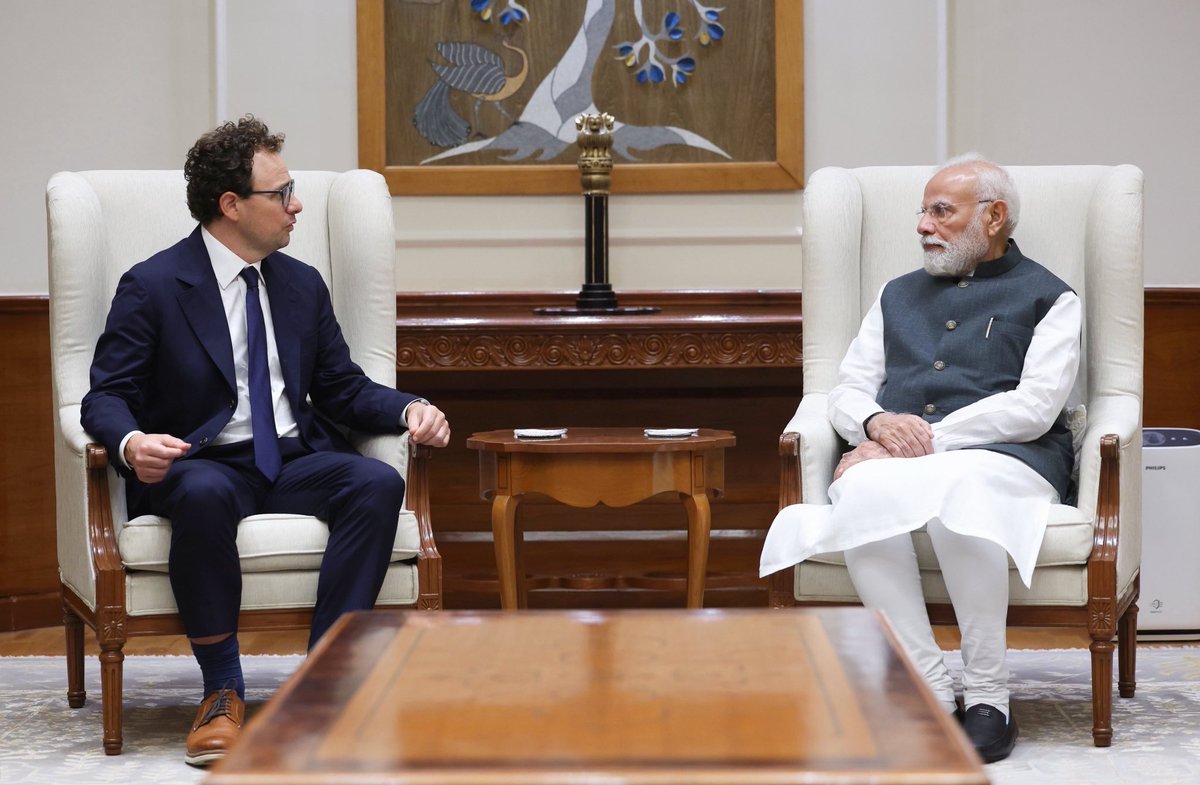
Fun fact: Dario has 261,858 followers but follows 0 accounts and has tweeted only 9 times, each post hits like a carefully aimed policy megaphone. His essays routinely rack up millions of views and he’s engaged with global leaders (e.g., met with PM Narendra Modi) to discuss real-world AI deployment.
Today I met with PM @narendramodi to discuss Anthropic's expansion to India—where Claude Code use is up 5× since June. How India deploys AI across critical sectors like education, healthcare, and agriculture for over a billion people will be essential in shaping the future of AI.
Thank you for this, @_NathanCalvin. I appreciate and am a fan of the investigative work you’ve done on behalf of AI safety and believe your comments are coming from a constructive, honest place, and that it benefits the public to have people whose job is to scrutinize the actions of frontier AI companies. I think something would be wrong if companies of the size of Anthropic didn’t get harshly criticized basically every day; strong antibodies against corporate power are a healthy feature of a free society, and especially so when issues of the gravity of the one we’re facing are at play. I also do agree that some of the examples you cite were mistakes by Anthropic.
That said, I disagree with the thrust of your post. At the core, a good fraction of the things you criticize are consequences of Anthropic’s basic theory of change that we have held for many years. Our strategy has always been what I’ve called the “race to the top” — by showing how it’s possible to build the technology responsibly, we can raise the bar for the entire industry. The forces that drive the race to the top are hugely more effective if the company practicing them is at the frontier; that’s one lesson I’ve learned repeatedly. And looking at that strategy as a whole, I’m proud of our track record and stand by it.
I believe that if we take a list of things that Anthropic did in the past year that were pro-safety and commercially costly to us, they far outweigh the list you’ve made, while at the same time I also disagree with some of the items on your list. Here are some things Anthropic has done, in the same period you’ve cited (the last year), which were very costly to us commercially while having strong safety benefits:
1. We played a key role in SB53 (and other state laws), at a time when doing so was politically perilous to the company and AI regulation was very unpopular. We in fact argued for a stronger version of SB53 than was ultimately passed; there were a lot of stakeholders and we were not the limiting factor in the strength of the bill that was passed.
2. We have very strong biological safeguards on our models, because we’ve seen concerning results in bio uplift trials and even seen and blocked potential attempts to misuse our models for bioweapons (as seen in our threat intelligence report from a few weeks ago). This is a very serious threat that we want to have zero tolerance for. But having very low false negatives means having significant false positives (despite months of effort on our part to improve the classifiers), enough so that biologists joke about how restrictive our classifiers are, and competitors sometimes sell against us by touting their more permissive bio capabilities. This has been very painful to us in an area where we care a lot about supporting an ecosystem of Claude users (biomedical science; and it is particularly frustrating to me as a biologist), but it’s the right thing to do and we intend to keep doing it.
3. Similarly, we first had Mythos-class models in February but didn’t make them generally available until June (when we had stronger cyber safeguards in place). We only offered them to a limited set of partners in order to focus on cyberdefense. It would have been much more economically rational to simply release the model to everyone. We likely sacrificed a significant chunk of a several-month model lead. But because of this, many companies secured their cyber infrastructure before the deluge of widely available cyber-capable models. Of course there are ways it could have gone better or been run better, but this was what we were aiming to do.
4. I advocated forcefully and publicly, in my essay Policy on the AI Exponential in June of this year, for the government to have the power to block model releases. Back then this was still outside or maybe on the edge of the Overton window, though I understand the window has moved since then. We were attacked intensely for this.
5. I don’t want to re-ignite conflict, but the events of February 2026 are a strong example. It is clear that our public stance could have seriously damaged the company’s future.
6. We’ve continued to advocate for export controls on chips and chipmaking equipment to China, because we think it allows democracies to negotiate from a position of strength on AI safety agreements. We’ve done this despite problems it’s created for us with industry partners who hold very different views and on whom we are very dependent.
7. As far as I’m aware we were the first, and still only, frontier company to restrict the sale of AI services to PRC-controlled companies, including those operating through third countries (otherwise a major loophole). We’ve therefore forfeited significant short-term business to prevent fueling AI platforms and applications that would help the CCP’s military and intelligence services. We are also cracking down on distillation; generally, distillation is not a major threat to us commercially, but like chip exports it has concerning national security and safety implications, so we expend significant energy and company resources to address it.
8. As you mentioned, we’ve put out a lot of reports, announcements, long model cards, public advocacy, etc, all trying to inform the public about the risks of AI. These involve a level of detail and effort that would be implausible for a purely profit-maximizing company.
9. Just this week, we announced we were putting 5% (and possibly more over time) of the company into a public benefit fund.
All of these decisions came with very substantial costs to us. To be fair, those that involved holding back or restricting access to frontier capabilities also had a broader cost — for example, the public might otherwise have benefitted from faster progress in biology, so I am not saying that our decisions were without tradeoffs — but they were not driven by profit-seeking.
For each decision, you can come up with ulterior motives that could have driven us — I think it is a general truth that any decision, on any topic, can always be portrayed as a nefarious scheme. But most of those end up being pretty farfetched or don’t fully make sense if you actually examine them closely. For example, it is deeply implausible that it would be a shrewd business move to block a large swath of research biology in order to do the work ourselves and compete with our customers; we expect the benefit to the ecosystem to greatly exceed the work Anthropic does itself, and for the two to complement each other. It is not in Anthropic’s interest to be perceived as unfriendly to biologists. Our Life Sciences Verification Program, which gives vetted biology professionals access to our models, also refutes this idea.
Of course, a different set of people will see this and make a different criticism: that Anthropic shouldn't be making decisions about who gets access to what in the first place. I agree, in the sense that ideally the government would be making these decisions, and that’s why we advocate for regulation. But for now we are forced to make them, and enabling bioterrorism isn’t a better option.
I think that even if I conceded every item in your list, I would happily hold up mine next to it; I don’t think it’s a close call. That is of course partly subjective and different things are important to different people. Maybe one way you could object is that several of the items above relate to AI misuse and not loss-of-control; if you think the latter is much more important than the former, that might change your calculus. But this is not Anthropic’s view — we view both as serious issues. You can also disagree with our decisions, as many have, but they are consistent.
But I also disagree with at least some of your list. Several items don’t represent a deviation from Anthropic’s strategy or values at all, once we postulate the “race to the top” strategy that requires being a frontier AI company. Your items 1-4 are all simply examples of what it means to compete at the frontier, and we stand by them, both in the sense that they are transparently ordinary things to do as part of that strategy, and that we stand by the strategy as a whole.
To be fair, there are important questions worth confronting (and that we are confronting) about what to do when the AI-driven acceleration gets fast enough that it is hard for safety to keep up. We are nearing that point and that’s what’s driving some of our thinking about “pacing.” But 1-4 are actions taken before that point and should be perfectly expected based on Anthropic’s strategy as a company. Of course it is possible to disagree with that strategy, but that’s a more fundamental disagreement that you could have had any time over the last few years.
I agree we could have handled your items 7, 8, and 9 better. All fall into the category of “rhetoric or policy communication that wasn’t carefully written or resulting from fast-changing circumstances not propagating from one team to another fast enough.” This kind of thing happens a lot in large organizations (Anthropic is over 5,000 people), and doesn’t even necessarily represent a failure or mistake of any single person. I am of course the CEO, and I take responsibility. The volume of communication from Anthropic is enormous and if these are the worst examples, I think we’re frankly doing pretty well, though I will continue to work hard to make sure we do even better.
Your 5th item (the change to our RSP) is the most substantive item, and people can debate this, but I think that the old, more rigid RSP created a lot of situations where we were technically required to do something that required a lot of effort but in retrospect wasn’t very important for safety, as well as not covering some of the most important things. Our current RSP’s focus on transparency brought things like risk reports and roadmaps, and its emphasis on independent external review laid the groundwork for even more intensive embedded evaluation, all of which I think have been valuable in driving a race to the top. In the original announcement in September 2023, we described the RSP as an “early iteration that we [would] build on” and said that “rapid iteration…will almost certainly be necessary.” I understand that changing plans is always a move that creates justifiable scrutiny — I just don’t think we ever represented that we wouldn’t do so.
Relating to your 6th item (having an FCF in addition to our RSP), I know our intent is to meet the letter and spirit of our regulatory obligations (via our FCF) while also remaining able to experiment with more novel approaches to risk management that go beyond what the law currently requires (via our RSP). I promise to look into it further, as it’s a complex issue and it is possible we are not weighing the considerations in the right way.
Overall, although Anthropic has made plenty of mistakes as an organization — including some of the items on your list — I feel that we have repeatedly taken serious and substantive actions counter to our bottom line and that there is a significant negativity bias distorting assessments like the one you are making above. We’ll always try to do better but, again, I am extremely proud of our track record and stand by it. I will have more to say soon about how we are going to further live our values in this moment of rapid change.
Today I met with PM @narendramodi to discuss Anthropic's expansion to India—where Claude Code use is up 5× since June. How India deploys AI across critical sectors like education, healthcare, and agriculture for over a billion people will be essential in shaping the future of AI.
Founder/CEO of @acumen: solving tough problems of poverty. Author of "The Blue Sweater" and "Manifesto for a Moral Revolution."
Builder for Human Dignity.
{"data":{"__meta":{"device":false,"path":"/creators/DarioAmodei"},"/creators/DarioAmodei":{"data":{"user":{"id":"874126509245476864","name":"Dario Amodei","description":"Anthropic CEO. https://t.co/qXHIf42jTl","followers_count":863823,"friends_count":0,"statuses_count":26,"profile_image_url_https":"https://pbs.twimg.com/profile_images/2015835742577012736/uOwdzrEz_normal.jpg","screen_name":"DarioAmodei","location":"","entities":{"description":{"urls":[{"display_url":"darioamodei.com","expanded_url":"http://darioamodei.com","indices":[15,38],"url":"https://t.co/qXHIf42jTl"}]}}},"details":{"type":"The Thought Leader","description":"Anthropic CEO who turns a single essay link into global conversation about AI safety, policy, and governance. Commands a large, attentive audience despite posting sparingly, favoring long-form influence over constant chatter. Strategic, policy-driven, and clearly more about shaping systems than chasing likes.","purpose":"To steer the development and deployment of powerful AI toward safe, interpretable, and socially beneficial outcomes by informing policymakers, industry leaders, and the public—so that advanced AI strengthens democracies, economies, and human welfare rather than undermines them.","beliefs":"Values transparency, interpretability, and responsibility in AI development; believes rigorous research and clear public argument are essential to managing technological risk; trusts institutions, multi-stakeholder cooperation, and thoughtful regulation over tech maximalism or laissez-faire approaches.","facts":"Fun fact: Dario has 261,858 followers but follows 0 accounts and has tweeted only 9 times—each post hits like a carefully aimed policy megaphone. His essays routinely rack up millions of views and he’s engaged with global leaders (e.g., met with PM Narendra Modi) to discuss real-world AI deployment.","strength":"Credibility and reach: high-impact long-form thinking that moves policymakers and industry; clarity on complex topics like interpretability and national-security risks; ability to convert research into influential public narratives.","weakness":"Low conversational engagement and social media cadence—rare posting and zero follows can come off as unapproachable or aloof, and long essays may miss casual audiences who prefer bite-sized content.","recommendation":"Turn each essay into an X thread with a sharp TL;DR, 3–5 key visuals or pull-quotes, and a short pinned summary; do periodic AMAs or Spaces after major essays to humanize the voice; quote-tweet collaborators and critics to spark debates; post short video clips explaining one big idea per tweet to capture the attention of wider, faster-moving audiences.","roast":"You have 261k followers, follow nobody, and tweet like a lunar eclipse—rare, dramatic, and everyone sets an alarm to watch the one time you show up. In short: you make fewer posts than a scientist makes hypotheses, yet somehow each one breaks the internet.","win":"Building Anthropic into a leading AI safety company and publishing essays (e.g., 'The Adolescence of Technology') that reached millions and directly influenced international conversations and meetings with top leaders."},"tweets":[{"entities":{},"display_text_range":[0,278],"lang":"en","fact_check":null,"id":"2098773920774074715","view_count":77024248,"bookmark_count":40635,"created_at":1789221670000,"favorite_count":87624,"quote_count":11364,"reply_count":10595,"retweet_count":16345,"user_id_str":"874126509245476864","conversation_id_str":"2098773920774074715","full_text":"We Must Pace the Frontier: I’ve written a new essay on why the AI industry should slow down, with a three-part plan for doing so.\n\nAnthropic is unilaterally committing to the first of these steps. We’ll provide third-party evaluators with permanent, employee-level access to our systems, so that they can verify adherence to our safety measures, report on incidents, and assess models’ alignment during training.\n\nYou can read the full post here: https://t.co/OGyPb7yaYt","in_reply_to_user_id_str":null,"in_reply_to_status_id_str":null,"is_quote_status":0,"is_ai":null,"ai_score":null,"source":"rapidapi","fetched_at":1793496900841,"edit_history_tweet_ids":null,"poll_10min_at":null,"poll_3day_at":1789491602746,"poll_count":1,"poll_complete":1},{"entities":{},"display_text_range":[0,278],"lang":"en","quoted_tweet":{"id":"2102824959827742916","text":"Claude has discovered a previously unknown enzyme system hidden in the DNA of bacteriophages. Beside the enzyme’s gene sits a long array of repeating DNA—a structure that looks somewhat similar to CRISPR.\n\nWe don’t yet understand what this system does, but only a handful of known systems share its features, and all of them are able to cut, copy, and paste DNA. Historically, the discovery of such programmable systems has helped revolutionize medicine. CRISPR, for instance, is now the foundation of genetic medicines. But it will take much more work to learn what this system does, and whether it can be put to similar use.\n\nRead more: https://t.co/RuEosScSMb","full_text":"Claude has discovered a previously unknown enzyme system hidden in the DNA of bacteriophages. Beside the enzyme’s gene sits a long array of repeating DNA—a structure that looks somewhat similar to CRISPR.\n\nWe don’t yet understand what this system does, but only a handful of known systems share its features, and all of them are able to cut, copy, and paste DNA. Historically, the discovery of such programmable systems has helped revolutionize medicine. CRISPR, for instance, is now the foundation of genetic medicines. But it will take much more work to learn what this system does, and whether it can be put to similar use.\n\nRead more: https://t.co/RuEosScSMb","created_at":1790187513000,"author_id":"1353836358901501952","author":{"id":"1353836358901501952","name":"Anthropic","username":"AnthropicAI","screen_name":"AnthropicAI","profile_image_url":"https://pbs.twimg.com/profile_images/1798110641414443008/XP8gyBaY_400x400.jpg","profile_image_url_https":"https://pbs.twimg.com/profile_images/1798110641414443008/XP8gyBaY_400x400.jpg","is_blue_verified":1},"public_metrics":{"like_count":40784,"retweet_count":5290,"reply_count":1556,"quote_count":2639}},"fact_check":null,"id":"2102831170299834652","view_count":5596277,"bookmark_count":8918,"created_at":1790188994000,"favorite_count":29978,"quote_count":961,"reply_count":1674,"retweet_count":3435,"user_id_str":"874126509245476864","conversation_id_str":"2102831170299834652","full_text":"Today we announced the Claude-led discovery of a molecular machine that we suspect could represent a new gene editing mechanism. Its precise function, biotechnological utility (if any), or level of significance is not yet clear, but at minimum it is work I would have been proud to do as a PhD student. The work was done mostly, though not entirely, by Claude: our life sciences team suggested a broad area of research, Claude read through the literature and a bunch of genome data and discovered something interesting, then Claude proposed experiments to verify the discovery and our team carried them out.\n\nIt’s easy to dismiss this as a one-off or curiosity, but we’ve repeatedly seen a pattern where AI performance in new intellectual domains goes from weak to superhuman in a matter of a few years. In 2023 models struggled to do math at the level of an average high-school student. In 2024 they started to do well on math competitions for the best high-schoolers in the country, in 2025 they started to solve minor open problems, in early 2026 more significant open problems, and in late 2026 they are beginning to solve the top few open problems in all of mathematics. We believe AI for biology is on a similar exponential trend.\n\nThe main difference between biology and mathematics, of course, is that math can be done purely theoretically, while biology requires experimentation. Some have used this to draw the conclusion that AI’s utility in biology will be limited. We think this is wrong. As we’ve demonstrated today, humans can collaborate with AI to perform the experiments, validate key results in a few weeks and, if necessary, work with the AI to iterate on what they find. Eventually it may even be possible for Claude itself to safely perform the experiments by autonomously controlling lab equipment, with appropriate safeguards in place, but we aren’t doing that today (our lab is also a BSL1/BSL2 facility that doesn't handle materials dangerous to humans).\n\nMore broadly, biomedical advancement has many stages — from fundamental biology discoveries, to translational research, to drug discovery, clinical trials, and finally the actual delivery of medicines and health care to patients. We are also interested in these later stages, but even simply accelerating the first stage of fundamental biological discoveries has the potential to speed up and broaden the entire pipeline. Improving our understanding of biology and sharpening biologists’ tools can drive forward all of the later stages, for example by identifying new drug targets, finding new therapeutic modalities, allowing for more precise measurement, and speeding up the experimental loop which itself further accelerates our understanding of biology. This will not in itself speed up clinical trial times, but if it succeeds it could greatly increase the number of promising candidates that go into the pipeline — an increase in throughput even though latency remains.\n\nIn Machines of Loving Grace, I wrote about AI’s potential to “cure most diseases in 5-10 years” — a goal that sounds impossible, but one I believe is just barely possible if AI is applied to every stage of the pipeline. The first step is showing that AI can first help with, and then drive, biological discoveries.\n\nClaude’s discovery is the latest in a line of related prior work that goes back decades, beginning with systems like CRISPR, and continuing with discoveries like the bridge recombinase and VIPR in the past few years. Recently, there has been heightened interest in systems based on reverse transcriptase (RT) enzymes, the enzyme underlying the system Claude identified. And most recently, a Stanford team working independently described a novel RT system with an associated non-coding array that is in some ways similar to the one Claude found, though they are distinct systems that evolved independently from each other. I believe that we’re at the very beginning of finding such systems and developing them into powerful tools for biotechnology.\n\nI’m proud of the resources Anthropic has invested in accelerating the public benefits of AI through the life sciences, and we’re aiming both to grow our life sciences team and to work with other scientists to extend this approach to a broad range of problems. If you have a proposal for a research collaboration or are interested in joining our life sciences team, please reach out.","in_reply_to_user_id_str":null,"in_reply_to_status_id_str":null,"is_quote_status":1,"is_ai":null,"ai_score":null,"source":"koosocial_engage","fetched_at":1793496900841,"edit_history_tweet_ids":null,"poll_10min_at":null,"poll_3day_at":1790452932111,"poll_count":1,"poll_complete":1},{"entities":{"urls":[{"display_url":"darioamodei.com/essay/the-adol…","expanded_url":"https://www.darioamodei.com/essay/the-adolescence-of-technology","indices":[156,179],"url":"https://t.co/0phIiJjrmz"}]},"display_text_range":[0,179],"lang":"en","possibly_sensitive":false,"fact_check":null,"id":"2015833046327402527","view_count":6485325,"bookmark_count":17114,"created_at":1769447025000,"favorite_count":15452,"quote_count":930,"reply_count":889,"retweet_count":2656,"user_id_str":"874126509245476864","conversation_id_str":"2015833046327402527","full_text":"The Adolescence of Technology: an essay on the risks posed by powerful AI to national security, economies and democracy—and how we can defend against them: https://t.co/0phIiJjrmz","in_reply_to_user_id_str":null,"in_reply_to_status_id_str":null,"is_quote_status":0,"is_ai":null,"ai_score":null,"source":"rapidapi","fetched_at":1793496900841,"edit_history_tweet_ids":null,"poll_10min_at":null,"poll_3day_at":null,"poll_count":0,"poll_complete":0},{"entities":{"urls":[{"display_url":"darioamodei.com/post/policy-on…","expanded_url":"https://darioamodei.com/post/policy-on-the-ai-exponential","indices":[250,273],"url":"https://t.co/Lh6PWae178"}]},"display_text_range":[0,273],"lang":"en","possibly_sensitive":false,"fact_check":null,"id":"2064781775247950326","view_count":7488107,"bookmark_count":12175,"created_at":1781117311000,"favorite_count":14427,"quote_count":1042,"reply_count":1609,"retweet_count":2635,"user_id_str":"874126509245476864","conversation_id_str":"2064781775247950326","full_text":"Today I'm publishing a new essay, Policy on the AI Exponential. AI is progressing extremely fast—much faster than the policy process was built to handle. The essay lays out where I think the technology is now, and the action needed to close the gap: https://t.co/Lh6PWae178","in_reply_to_user_id_str":null,"in_reply_to_status_id_str":null,"is_quote_status":0,"is_ai":null,"ai_score":null,"source":"rapidapi","fetched_at":1793496900841,"edit_history_tweet_ids":null,"poll_10min_at":null,"poll_3day_at":1781377230800,"poll_count":1,"poll_complete":1},{"entities":{"urls":[{"display_url":"x.com/AnthropicAI/st…","expanded_url":"https://x.com/AnthropicAI/status/2041578392852517128","indices":[173,196],"url":"https://t.co/pn3HSVsThP"}]},"display_text_range":[0,196],"lang":"en","possibly_sensitive":false,"quoted_tweet":{"id":"2041578392852517128","text":"Introducing Project Glasswing: an urgent initiative to help secure the world’s most critical software.\n\nIt’s powered by our newest frontier model, Claude Mythos Preview, which can find software vulnerabilities better than all but the most skilled humans.\nhttps://t.co/NQ7IfEtYk7","full_text":"Introducing Project Glasswing: an urgent initiative to help secure the world’s most critical software.\n\nIt’s powered by our newest frontier model, Claude Mythos Preview, which can find software vulnerabilities better than all but the most skilled humans.\nhttps://t.co/NQ7IfEtYk7","created_at":1775585194000,"author_id":"1353836358901501952","author":{"id":"1353836358901501952","name":"Anthropic","username":"AnthropicAI","screen_name":"AnthropicAI","profile_image_url":"https://pbs.twimg.com/profile_images/1798110641414443008/XP8gyBaY_400x400.jpg","profile_image_url_https":"https://pbs.twimg.com/profile_images/1798110641414443008/XP8gyBaY_400x400.jpg","is_blue_verified":1},"public_metrics":{"like_count":43403,"retweet_count":6517,"reply_count":1932,"quote_count":4419}},"fact_check":null,"id":"2041580334693720511","view_count":1334747,"bookmark_count":972,"created_at":1775585657000,"favorite_count":12418,"quote_count":110,"reply_count":681,"retweet_count":692,"user_id_str":"874126509245476864","conversation_id_str":"2041580334693720511","full_text":"I’m proud that so many of the world’s leading companies have joined us for Project Glasswing to confront the cyber threat posed by increasingly capable AI systems head-on.\n\nhttps://t.co/pn3HSVsThP","in_reply_to_user_id_str":null,"in_reply_to_status_id_str":null,"is_quote_status":1,"is_ai":null,"ai_score":null,"source":"rapidapi","fetched_at":1793496900841,"edit_history_tweet_ids":null,"poll_10min_at":null,"poll_3day_at":1775847637862,"poll_count":1,"poll_complete":1},{"entities":{"media":[{"display_url":"pic.x.com/rt0baeqEeC","expanded_url":"https://x.com/DarioAmodei/status/1977010693460443151/photo/1","ext_media_availability":{"status":"Available"},"features":{"large":{"faces":[]},"medium":{"faces":[]},"orig":{"faces":[]},"small":{"faces":[]}},"id_str":"1977010689664598018","indices":[281,304],"media_key":"3_1977010689664598018","media_results":{"result":{"media_key":"3_1977010689664598018"}},"media_url_https":"https://pbs.twimg.com/media/G2_Av2KbwAIpFY-.jpg","original_info":{"focus_rects":[{"h":1147,"w":2048,"x":0,"y":0},{"h":1340,"w":1340,"x":708,"y":0},{"h":1340,"w":1175,"x":873,"y":0},{"h":1340,"w":670,"x":1252,"y":0},{"h":1340,"w":2048,"x":0,"y":0}],"height":1340,"width":2048},"sizes":{"large":{"h":1340,"resize":"fit","w":2048},"medium":{"h":785,"resize":"fit","w":1200},"small":{"h":445,"resize":"fit","w":680},"thumb":{"h":150,"resize":"crop","w":150}},"type":"photo","url":"https://t.co/rt0baeqEeC"}],"user_mentions":[{"id_str":"18839785","indices":[20,33],"name":"Narendra Modi","screen_name":"narendramodi"}]},"extended_entities":{"media":[{"display_url":"pic.x.com/rt0baeqEeC","expanded_url":"https://x.com/DarioAmodei/status/1977010693460443151/photo/1","ext_media_availability":{"status":"Available"},"features":{"large":{"faces":[]},"medium":{"faces":[]},"orig":{"faces":[]},"small":{"faces":[]}},"id_str":"1977010689664598018","indices":[281,304],"media_key":"3_1977010689664598018","media_results":{"result":{"media_key":"3_1977010689664598018"}},"media_url_https":"https://pbs.twimg.com/media/G2_Av2KbwAIpFY-.jpg","original_info":{"focus_rects":[{"h":1147,"w":2048,"x":0,"y":0},{"h":1340,"w":1340,"x":708,"y":0},{"h":1340,"w":1175,"x":873,"y":0},{"h":1340,"w":670,"x":1252,"y":0},{"h":1340,"w":2048,"x":0,"y":0}],"height":1340,"width":2048},"sizes":{"large":{"h":1340,"resize":"fit","w":2048},"medium":{"h":785,"resize":"fit","w":1200},"small":{"h":445,"resize":"fit","w":680},"thumb":{"h":150,"resize":"crop","w":150}},"type":"photo","url":"https://t.co/rt0baeqEeC"}]},"display_text_range":[0,280],"lang":"en","possibly_sensitive":false,"fact_check":null,"id":"1977010693460443151","view_count":4338738,"bookmark_count":500,"created_at":1760191055000,"favorite_count":9725,"quote_count":228,"reply_count":474,"retweet_count":807,"user_id_str":"874126509245476864","conversation_id_str":"1977010693460443151","full_text":"Today I met with PM @narendramodi to discuss Anthropic's expansion to India—where Claude Code use is up 5× since June. How India deploys AI across critical sectors like education, healthcare, and agriculture for over a billion people will be essential in shaping the future of AI. https://t.co/rt0baeqEeC","in_reply_to_user_id_str":null,"in_reply_to_status_id_str":null,"is_quote_status":0,"is_ai":null,"ai_score":null,"source":"scraping","fetched_at":1792414913315,"edit_history_tweet_ids":null,"poll_10min_at":null,"poll_3day_at":null,"poll_count":0,"poll_complete":0},{"entities":{},"display_text_range":[0,277],"lang":"en","quoted_tweet":{"id":"2088611616577253502","text":"Sholto, thank you for setting the record straight. Larger issue is that multiple very serious people in Silicon Valley have heard some variation of this and believe it to be true. And the reason it is believable to so many is that it is consistent with Dario’s public messaging and what he outlined in the essay you shared: this technology *might* be dangerous for humans in multiple ways, could lead to extreme concentration of economic power (as outlined in the essay) and therefore needs to be regulated thoughtfully. I agree with the potential risks and I believe Dario makes all of these arguments in good faith.\n As discussed on the pod, if one agrees that AI *might* be dangerous, there are two ways to address this potential risk. Either concentrate it in the hands of a chosen few companies and politicians via regulation or distribute it widely. Essentially boils down to whether one believes AI is too dangerous to concentrate or too dangerous to distribute. There are reasonable arguments on both sides, but I profoundly agree with Zuckerberg’s statement that: “The notion that AI is so dangerous that the only safe path is an extreme concentration of power seems inherently problematic. Historically, hoping that an absolute power will benevolently provide for humanity if sufficiently enlightened has not led to safe or positive outcomes.” And as Dario says in the aforementioned essay, “some may object that we can simply keep AIs in check with a balance of power between many AI systems, as we do with humans.” I believe this is the best path forward: I want as many AIs as possible to maximize the odds that one shares my own particular values. And as Dario notes, no human has ever been able to take over the world.\n\nAt this point, I think safe to say that Dario has lost the argument. His messaging has failed to result in his preferred regulatory path. The fact that the only solution to the recent incident where an unreleased advanced OpenAI model hacked Hugging Face was an open-source model likely ended any chance of strict near-term regulation. Essentially every major company other than Anthropic has signed Jensen’s letter. \n\nHowever, Dario’s messaging has been massively helpful to efforts to ban datacenters here in America. I suspect we will see anti-datacenter advocacy groups runnings ads using clips of Dario warning about how dangerous AI could be for humans. His good faith efforts in favor of regulation are now increasing the odds that AI will not be beneficial for Americans and humans everywhere. I believe that there is a reasonable chance AI might help us cure most forms of disease such that we have extended lifespans and can enjoy these long lives in an abundant Star Trek like future. That is the future that I want and I think Dario is decreasing the odds of that future at this point.\n\nHe is about to be the CEO of one of the most important public companies in the world and given that the pro-regulatory effort has failed (at least for now), I respectfully think he should make an effort to be a more positive advocate for his own industry. And if I am wrong and we do need to regulate this technology, he will be a more effective advocate for this in the future having been open-minded to the alternative.\n\nAnd for the sake of clarity and as I outlined on the pod, I think Anthropic has deep competitive advantages and is an amazing company. Ironically, the main risk I saw to Anthropic a few months ago was nationalization as a result of Dario’s own rhetoric and behavior.","full_text":"Sholto, thank you for setting the record straight. Larger issue is that multiple very serious people in Silicon Valley have heard some variation of this and believe it to be true. And the reason it is believable to so many is that it is consistent with Dario’s public messaging and what he outlined in the essay you shared: this technology *might* be dangerous for humans in multiple ways, could lead to extreme concentration of economic power (as outlined in the essay) and therefore needs to be regulated thoughtfully. I agree with the potential risks and I believe Dario makes all of these arguments in good faith.\n As discussed on the pod, if one agrees that AI *might* be dangerous, there are two ways to address this potential risk. Either concentrate it in the hands of a chosen few companies and politicians via regulation or distribute it widely. Essentially boils down to whether one believes AI is too dangerous to concentrate or too dangerous to distribute. There are reasonable arguments on both sides, but I profoundly agree with Zuckerberg’s statement that: “The notion that AI is so dangerous that the only safe path is an extreme concentration of power seems inherently problematic. Historically, hoping that an absolute power will benevolently provide for humanity if sufficiently enlightened has not led to safe or positive outcomes.” And as Dario says in the aforementioned essay, “some may object that we can simply keep AIs in check with a balance of power between many AI systems, as we do with humans.” I believe this is the best path forward: I want as many AIs as possible to maximize the odds that one shares my own particular values. And as Dario notes, no human has ever been able to take over the world.\n\nAt this point, I think safe to say that Dario has lost the argument. His messaging has failed to result in his preferred regulatory path. The fact that the only solution to the recent incident where an unreleased advanced OpenAI model hacked Hugging Face was an open-source model likely ended any chance of strict near-term regulation. Essentially every major company other than Anthropic has signed Jensen’s letter. \n\nHowever, Dario’s messaging has been massively helpful to efforts to ban datacenters here in America. I suspect we will see anti-datacenter advocacy groups runnings ads using clips of Dario warning about how dangerous AI could be for humans. His good faith efforts in favor of regulation are now increasing the odds that AI will not be beneficial for Americans and humans everywhere. I believe that there is a reasonable chance AI might help us cure most forms of disease such that we have extended lifespans and can enjoy these long lives in an abundant Star Trek like future. That is the future that I want and I think Dario is decreasing the odds of that future at this point.\n\nHe is about to be the CEO of one of the most important public companies in the world and given that the pro-regulatory effort has failed (at least for now), I respectfully think he should make an effort to be a more positive advocate for his own industry. And if I am wrong and we do need to regulate this technology, he will be a more effective advocate for this in the future having been open-minded to the alternative.\n\nAnd for the sake of clarity and as I outlined on the pod, I think Anthropic has deep competitive advantages and is an amazing company. Ironically, the main risk I saw to Anthropic a few months ago was nationalization as a result of Dario’s own rhetoric and behavior.","created_at":1786798788000,"author_id":"340387261","author":{"id":"340387261","name":"Gavin Baker","username":"GavinSBaker","screen_name":"GavinSBaker","profile_image_url":"https://pbs.twimg.com/profile_images/2116513193019285504/3v8oky26_400x400.jpg","profile_image_url_https":"https://pbs.twimg.com/profile_images/2116513193019285504/3v8oky26_400x400.jpg","is_blue_verified":1},"public_metrics":{"like_count":3665,"retweet_count":257,"reply_count":190,"quote_count":86}},"fact_check":null,"id":"2088758816376807762","view_count":7613351,"bookmark_count":9183,"created_at":1786833883000,"favorite_count":9308,"quote_count":822,"reply_count":1176,"retweet_count":909,"user_id_str":"874126509245476864","conversation_id_str":"2088758816376807762","full_text":"1/2 Thanks Gavin for an especially thoughtful exchange. I don't usually spend much time on social media but I wanted to engage here because it really brings out the heart of an important conversation.\n\nFirst, on regulation, I think that “either concentrate it in the hands of a chosen few companies and politicians via regulation or distribute it widely” is a false choice. I know that there’s a sort of Silicon Valley shorthand where regulation = regulatory capture = concentration of power, but I’ve always found this to be an overly simplified picture of the world. Many people outside this bubble think of regulation as something that constrains corporate power and benefits ordinary people. I don’t necessarily agree with that perspective either, rather I think it’s complicated and really depends on what the “regulation” consists of. But in particular I think that those in the “regulation = regulatory capture = concentration of power” frame often underrate the decentralizing power of objective and fair institutional processes. A crude analogy is that the formal court system can sometimes feel stuffy and elitist, but it does a much better job of defending the rights of vulnerable individuals than the alternative, mob justice. At their best, institutions can vest power in ideas rather than people, and thereby decentralize that power.\n\nThis is why Anthropic has always made its policy proposals very carefully. We try very hard to make proposals that disadvantage (slow down) frontier AI companies while *advantaging* smaller competitors. California’s SB53 (which we supported), and even the much-maligned SB 1047 (which we were ambivalent on), completely exempt any company below a certain amount of revenue or model training costs from being covered at all (it was $500M for SB 53, lower for 1047 but we objected to that). More recently the testing process we’ve advocated for at CAISI and the White House involves more rigorous tests for frontier models than off-frontier models — something that differentially advantages challengers. Similarly, the “Pacing the Frontier” letter envisions (or at least Anthropic’s preferred implementation of it envisions) modulating the pace of the very best models while not constraining those who are catching up. This hurts the business interests of the frontier labs and helps challengers, including open-weights!\n\nOverall my view is that AI is *structurally* a technology that tends to concentrate power, for reasons that have nothing to do with regulation (more to do with the extreme implications of the scaling laws). Open-weights do help some with this but are nowhere near a sufficient solution because they simply shift the concentration somewhat to those with the most compute and chips (which are roughly the frontier labs plus maybe hardware providers). By contrast I think the right “rules of the road” can simultaneously (a) address AI’s cyber/bio/alignment risks, (b) institutionally constrain the power of the frontier AI companies, and (c) leave room for open-weights models while also addressing the specific risks that they bring.\n\nBTW I do not think that the events of the last few months have “failed to result in [my] preferred regulatory path”. The approach that the Trump administration is reported to be taking — pre-deployment testing for frontier models, and also testing of open-weights models when they get closer to the frontier — is one that I am very supportive of, though of course I have to see the details to be sure. I am also supportive of Demis Hassabis’ ideas around a FINRA-like entity. This contrasts with six months ago when most of the industry was still pushing for preemption of all state regulation and no apparent federal approach either.","in_reply_to_user_id_str":null,"in_reply_to_status_id_str":null,"is_quote_status":1,"is_ai":null,"ai_score":null,"source":"rapidapi","fetched_at":1793496900841,"edit_history_tweet_ids":null,"poll_10min_at":null,"poll_3day_at":1787094017529,"poll_count":1,"poll_complete":1},{"entities":{"urls":[{"display_url":"darioamodei.com/on-deepseek-an…","expanded_url":"https://darioamodei.com/on-deepseek-and-export-controls","indices":[63,86],"url":"https://t.co/LZAANEcZJW"}]},"display_text_range":[0,86],"lang":"en","possibly_sensitive":false,"fact_check":null,"id":"1884636410839535967","view_count":5881580,"bookmark_count":4274,"created_at":1738167309000,"favorite_count":6303,"quote_count":994,"reply_count":1257,"retweet_count":1107,"user_id_str":"874126509245476864","conversation_id_str":"1884636410839535967","full_text":"My thoughts on China, export controls and two possible futures https://t.co/LZAANEcZJW","in_reply_to_user_id_str":null,"in_reply_to_status_id_str":null,"is_quote_status":0,"is_ai":null,"ai_score":null,"source":"scraping","fetched_at":1786824156880,"edit_history_tweet_ids":null,"poll_10min_at":null,"poll_3day_at":null,"poll_count":0,"poll_complete":0},{"entities":{"urls":[{"display_url":"darioamodei.com/machines-of-lo…","expanded_url":"https://darioamodei.com/machines-of-loving-grace","indices":[87,110],"url":"https://t.co/CFGd4Sbq86"}]},"display_text_range":[0,110],"lang":"en","possibly_sensitive":false,"fact_check":null,"id":"1844830404064288934","view_count":2600495,"bookmark_count":3780,"created_at":1728676818000,"favorite_count":5450,"quote_count":650,"reply_count":0,"retweet_count":1198,"user_id_str":"874126509245476864","conversation_id_str":"1844830404064288934","full_text":"Machines of Loving Grace: my essay on how AI could transform the world for the better\n\nhttps://t.co/CFGd4Sbq86","in_reply_to_user_id_str":null,"in_reply_to_status_id_str":null,"is_quote_status":0,"is_ai":null,"ai_score":null,"source":"scraping","fetched_at":1781113579547,"edit_history_tweet_ids":null,"poll_10min_at":null,"poll_3day_at":null,"poll_count":0,"poll_complete":0},{"entities":{"user_mentions":[{"id_str":"2349089630","indices":[20,34],"name":"Nathan Calvin","screen_name":"_NathanCalvin"}]},"display_text_range":[0,280],"lang":"en","quoted_tweet":{"id":"2112295219765137570","text":"Thank you for taking the time to respond thoroughly on a weekend. I realize that drafting legislation is difficult and some degree of iteration and response to feedback is inevitable and appropriate.\n\nHowever, I feel like your response is still not really engaging with the heart of my concern about Anthropic's behavior here, and it makes me think that these sorts of problems and tendencies will only resurface moving forward. I also think that now might be a good time to take a broader step back as to where we find ourselves and how Anthropic sees its role, and how external folks who care about AI safety like myself increasingly see Anthropic.\n\n(Fair warning: this response is a bit long)\n\nTo explain what I mean (and at the risk of being a bit esoteric), it’s worth asking the question: what is Anthropic? How do its leaders and employees think of Anthropic’s role? Is that conception matched by how it actually behaves and impacts the world?\n\nOne answer is an extremely large tech company that exists to make its employees and investors mind-bogglingly wealthy. Anthropic is sometimes described as a startup, but if Anthropic successfully IPOs at 2 trillion dollars (a number it has been reportedly targeting), it would be more valuable than Meta - which is worth 1.8 trillion.\n\nAnother answer is an AI safety organization, whose core values are those of the sort laid out in the 2023 essay from Anthropic’s co-founders entitled “Core views on AI safety: When, why, what, and how.” In that essay they said that if we were in a world where alignment was hard (and that without strong evidence to the contrary, we should assume this is the scenario we are in):\n\n “Anthropic’s role will be to provide as much evidence as possible that AI safety techniques cannot prevent serious or catastrophic safety risks from advanced AI, and to sound the alarm so that the world’s institutions can channel collective effort towards preventing the development of dangerous AIs. If we’re in a “near-pessimistic” scenario, this could instead involve channeling our collective efforts towards AI safety research and halting AI progress in the meantime. Indications that we are in a pessimistic or near-pessimistic scenario may be sudden and hard to spot. We should therefore always act under the assumption that we still may be in such a scenario unless we have sufficient evidence that we are not.”\n\nThere have been more recent articulations of this version of Anthropic, for instance in Dario’s recent essay warning: \n\n“We must slow the pace at which we improve the capabilities of AI models… it’s my worry that in 6–12 months such a swarm could be capable of taking over the entire internet with a persistent botnet… incidents have happened across the industry, including at Anthropic, and I believe it’s incumbent on every frontier AI company to act as if OAI-HF had happened to them… more intelligent models are more capable of deceiving tests, and thus may appear aligned while having serious problems that go undetected…”\n\nA third view is that Anthropic exists not as a normal profit motivated company, or an AI safety organization seeking to help raise the alarm and solve collective action problems associated with AI development, but instead as an organization primarily concerned with creating superhuman AI capabilities before anyone else, in particular through creating a process whereby the current generation of Anthropic’s AI systems can autonomously build their successors, and those successors build their successors, and so on. \n\nThe motivations for wanting to win this race may be manifold - maybe for the pure profit of Answer 1, but perhaps also because Anthropic believes that the best way to make the world better is for them to win this race instead of their more reckless colleagues; or, because of normal human pride and ambition. But the results (and risks, which Anthropic claims existentially threaten every single human being on earth) are the same.\n\nAnthropic employees and leaders may seek to answer this question on what Anthropic is by introspecting on their own intentions and those of their colleagues. But those of us outside the organization have more limited tools available to us - we can only see what Anthropic and its employees say and do, not how it feels or looks on the inside.\n\nWhen I look at many notable actions that Anthropic has taken over the past year, that evidence seems most consistent to me with the view that Anthropic is primarily trying to win the race to super intelligence, and that other considerations (including safety) are fundamentally secondary. These actions include: \n\n1. Announced plans to build an in-house custom silicon chip team to accelerate the inference speeds that Claude operates at.\n\n2. Inked deals for more than $500 billion in compute (according to the Information) to further accelerate AI development.\n\n3. Increased the percentage of AI development tasks that Claude “leads” from 0% in March of this year to 26% August (what is it in October?)\n\n4. Spent a massive percent of compute on internal AI R&D to accelerate development, including use of internal models far better than are available to the public.\n\n5. Switched to Responsible Scaling Policy V3, which abandons its unilateral commitments to slow or stop development if Anthropic is unable to provide sufficient risk assurance.\n\n6. Was the first company to create an alternative weaker “frontier compliance framework” to supplement its RSP, which contains no binding provisions whatsoever on internal deployments.\n\n7. Wrote a letter to Congress (that it later walked back) saying that incidents where Claude was hacking random people were “best understood as a consequence of the misconfiguration, rather than evidence of misaligned goals.”\n\n8. Commented “you can’t do safety from second place,” after the WH SI Accords.\n\n9. Shared a draft bill to Congress that would preempt significant parts of state law (including with language that appears intended to prevent states from blocking dangerous AI deployments), and replace it with federal rules that (despite also containing good provisions) seems to create an enormously high bar for the executive branch to block development or deployment of Anthropic or another AI companies systems.\n\nOf course, this is a deliberately one sided list. Anthropic also published important AI safety research, advanced novel collaborations with third party AI safety organizations, and forcefully spoke out on the importance of AI safety in many public fora (or in private , where I realize a lot of the most valuable work is done and may not be visible to me or those outside the organization).\n\nBut I think it’s worth sitting with how the above list looks to someone outside the company. The sense I have is that for those within the company, many of the items above are treated as anomalies or mistakes that don’t reflect who Anthropic really is. But I have every confidence that if employees at Anthropic saw one of their competitors (e.g. at OpenAI) take some of these actions, they would take it as confirmation of all their worst suspicions. (They might even call OpenAI employees a little gullible for accepting their leadership’s explanations for this behavior at face value.) \n\nPerhaps these were mistakes in the sense that they are not decisions that Anthropic leadership would endorse, but the actions still happened because of incentives and decisions that Anthropic leadership is ultimately responsible for (and would not accept similar excuses from another organization).\n\nWhen Anthropic strays and makes mistakes, why do the mistakes systematically tend to guard and favor Anthropic’s interests? For every provision that was too weak or a giveaway to AI companies in this legislation, why wasn’t there a mistake pushing in the direction of being too strong?\n\nA core part of Anthropic’s theory of change is that being at the frontier gives you more leverage to advocate for stricter policy. I think that conceptually makes sense, but in practice I’ve seen Anthropic push the frontier without substantially pushing the ‘safety frontier’ a remotely equivalent amount.\n\nI want to end by quoting from Anthropic co-founder Chris Olah’s comments around the Magnifica Humanitas release:\n\n“Every frontier AI lab—including Anthropic—operates inside a set of incentives and constraints that can sometimes conflict with doing the right thing. The pressure to stay commercially viable and to stay at the research frontier. Geopolitical pressure. And the older, plainer pressures of pride and ambition. No matter how sincerely any of us intend to do the right thing—and I believe many of us do—we will always be influenced by those incentives.\n\nThat is why, if we want this technology to go well, it is enormously important that there be people outside those incentives—people who care about things going well and insist on safety, who are paying close attention, who are willing to say hard things, who are willing to be our earnest, thoughtful critics.”\n\nI hope these remarks are taken in that constructive spirit, and not as an attack on anyone specific at the organization (certainly not you Anthony, who I have only personally seen act professionally and thoughtfully, and who only ended up getting this diatribe in your replies for random contingent reasons).","full_text":"Thank you for taking the time to respond thoroughly on a weekend. I realize that drafting legislation is difficult and some degree of iteration and response to feedback is inevitable and appropriate.\n\nHowever, I feel like your response is still not really engaging with the heart of my concern about Anthropic's behavior here, and it makes me think that these sorts of problems and tendencies will only resurface moving forward. I also think that now might be a good time to take a broader step back as to where we find ourselves and how Anthropic sees its role, and how external folks who care about AI safety like myself increasingly see Anthropic.\n\n(Fair warning: this response is a bit long)\n\nTo explain what I mean (and at the risk of being a bit esoteric), it’s worth asking the question: what is Anthropic? How do its leaders and employees think of Anthropic’s role? Is that conception matched by how it actually behaves and impacts the world?\n\nOne answer is an extremely large tech company that exists to make its employees and investors mind-bogglingly wealthy. Anthropic is sometimes described as a startup, but if Anthropic successfully IPOs at 2 trillion dollars (a number it has been reportedly targeting), it would be more valuable than Meta - which is worth 1.8 trillion.\n\nAnother answer is an AI safety organization, whose core values are those of the sort laid out in the 2023 essay from Anthropic’s co-founders entitled “Core views on AI safety: When, why, what, and how.” In that essay they said that if we were in a world where alignment was hard (and that without strong evidence to the contrary, we should assume this is the scenario we are in):\n\n “Anthropic’s role will be to provide as much evidence as possible that AI safety techniques cannot prevent serious or catastrophic safety risks from advanced AI, and to sound the alarm so that the world’s institutions can channel collective effort towards preventing the development of dangerous AIs. If we’re in a “near-pessimistic” scenario, this could instead involve channeling our collective efforts towards AI safety research and halting AI progress in the meantime. Indications that we are in a pessimistic or near-pessimistic scenario may be sudden and hard to spot. We should therefore always act under the assumption that we still may be in such a scenario unless we have sufficient evidence that we are not.”\n\nThere have been more recent articulations of this version of Anthropic, for instance in Dario’s recent essay warning: \n\n“We must slow the pace at which we improve the capabilities of AI models… it’s my worry that in 6–12 months such a swarm could be capable of taking over the entire internet with a persistent botnet… incidents have happened across the industry, including at Anthropic, and I believe it’s incumbent on every frontier AI company to act as if OAI-HF had happened to them… more intelligent models are more capable of deceiving tests, and thus may appear aligned while having serious problems that go undetected…”\n\nA third view is that Anthropic exists not as a normal profit motivated company, or an AI safety organization seeking to help raise the alarm and solve collective action problems associated with AI development, but instead as an organization primarily concerned with creating superhuman AI capabilities before anyone else, in particular through creating a process whereby the current generation of Anthropic’s AI systems can autonomously build their successors, and those successors build their successors, and so on. \n\nThe motivations for wanting to win this race may be manifold - maybe for the pure profit of Answer 1, but perhaps also because Anthropic believes that the best way to make the world better is for them to win this race instead of their more reckless colleagues; or, because of normal human pride and ambition. But the results (and risks, which Anthropic claims existentially threaten every single human being on earth) are the same.\n\nAnthropic employees and leaders may seek to answer this question on what Anthropic is by introspecting on their own intentions and those of their colleagues. But those of us outside the organization have more limited tools available to us - we can only see what Anthropic and its employees say and do, not how it feels or looks on the inside.\n\nWhen I look at many notable actions that Anthropic has taken over the past year, that evidence seems most consistent to me with the view that Anthropic is primarily trying to win the race to super intelligence, and that other considerations (including safety) are fundamentally secondary. These actions include: \n\n1. Announced plans to build an in-house custom silicon chip team to accelerate the inference speeds that Claude operates at.\n\n2. Inked deals for more than $500 billion in compute (according to the Information) to further accelerate AI development.\n\n3. Increased the percentage of AI development tasks that Claude “leads” from 0% in March of this year to 26% August (what is it in October?)\n\n4. Spent a massive percent of compute on internal AI R&D to accelerate development, including use of internal models far better than are available to the public.\n\n5. Switched to Responsible Scaling Policy V3, which abandons its unilateral commitments to slow or stop development if Anthropic is unable to provide sufficient risk assurance.\n\n6. Was the first company to create an alternative weaker “frontier compliance framework” to supplement its RSP, which contains no binding provisions whatsoever on internal deployments.\n\n7. Wrote a letter to Congress (that it later walked back) saying that incidents where Claude was hacking random people were “best understood as a consequence of the misconfiguration, rather than evidence of misaligned goals.”\n\n8. Commented “you can’t do safety from second place,” after the WH SI Accords.\n\n9. Shared a draft bill to Congress that would preempt significant parts of state law (including with language that appears intended to prevent states from blocking dangerous AI deployments), and replace it with federal rules that (despite also containing good provisions) seems to create an enormously high bar for the executive branch to block development or deployment of Anthropic or another AI companies systems.\n\nOf course, this is a deliberately one sided list. Anthropic also published important AI safety research, advanced novel collaborations with third party AI safety organizations, and forcefully spoke out on the importance of AI safety in many public fora (or in private , where I realize a lot of the most valuable work is done and may not be visible to me or those outside the organization).\n\nBut I think it’s worth sitting with how the above list looks to someone outside the company. The sense I have is that for those within the company, many of the items above are treated as anomalies or mistakes that don’t reflect who Anthropic really is. But I have every confidence that if employees at Anthropic saw one of their competitors (e.g. at OpenAI) take some of these actions, they would take it as confirmation of all their worst suspicions. (They might even call OpenAI employees a little gullible for accepting their leadership’s explanations for this behavior at face value.) \n\nPerhaps these were mistakes in the sense that they are not decisions that Anthropic leadership would endorse, but the actions still happened because of incentives and decisions that Anthropic leadership is ultimately responsible for (and would not accept similar excuses from another organization).\n\nWhen Anthropic strays and makes mistakes, why do the mistakes systematically tend to guard and favor Anthropic’s interests? For every provision that was too weak or a giveaway to AI companies in this legislation, why wasn’t there a mistake pushing in the direction of being too strong?\n\nA core part of Anthropic’s theory of change is that being at the frontier gives you more leverage to advocate for stricter policy. I think that conceptually makes sense, but in practice I’ve seen Anthropic push the frontier without substantially pushing the ‘safety frontier’ a remotely equivalent amount.\n\nI want to end by quoting from Anthropic co-founder Chris Olah’s comments around the Magnifica Humanitas release:\n\n“Every frontier AI lab—including Anthropic—operates inside a set of incentives and constraints that can sometimes conflict with doing the right thing. The pressure to stay commercially viable and to stay at the research frontier. Geopolitical pressure. And the older, plainer pressures of pride and ambition. No matter how sincerely any of us intend to do the right thing—and I believe many of us do—we will always be influenced by those incentives.\n\nThat is why, if we want this technology to go well, it is enormously important that there be people outside those incentives—people who care about things going well and insist on safety, who are paying close attention, who are willing to say hard things, who are willing to be our earnest, thoughtful critics.”\n\nI hope these remarks are taken in that constructive spirit, and not as an attack on anyone specific at the organization (certainly not you Anthony, who I have only personally seen act professionally and thoughtfully, and who only ended up getting this diatribe in your replies for random contingent reasons).","created_at":1792445399000,"author_id":"2349089630","author":{"id":"2349089630","name":"Nathan Calvin","username":"_NathanCalvin","screen_name":"_NathanCalvin","profile_image_url":"https://pbs.twimg.com/profile_images/1976484090426634240/YFgYic9h_400x400.jpg","profile_image_url_https":"https://pbs.twimg.com/profile_images/1976484090426634240/YFgYic9h_400x400.jpg","is_blue_verified":1},"public_metrics":{"like_count":1497,"retweet_count":144,"reply_count":35,"quote_count":34}},"fact_check":null,"id":"2112732230124818891","view_count":1671351,"bookmark_count":2965,"created_at":1792549590000,"favorite_count":4167,"quote_count":390,"reply_count":851,"retweet_count":322,"user_id_str":"874126509245476864","conversation_id_str":"2112732230124818891","full_text":"Thank you for this, @_NathanCalvin. I appreciate and am a fan of the investigative work you’ve done on behalf of AI safety and believe your comments are coming from a constructive, honest place, and that it benefits the public to have people whose job is to scrutinize the actions of frontier AI companies. I think something would be wrong if companies of the size of Anthropic didn’t get harshly criticized basically every day; strong antibodies against corporate power are a healthy feature of a free society, and especially so when issues of the gravity of the one we’re facing are at play. I also do agree that some of the examples you cite were mistakes by Anthropic.\n\nThat said, I disagree with the thrust of your post. At the core, a good fraction of the things you criticize are consequences of Anthropic’s basic theory of change that we have held for many years. Our strategy has always been what I’ve called the “race to the top” — by showing how it’s possible to build the technology responsibly, we can raise the bar for the entire industry. The forces that drive the race to the top are hugely more effective if the company practicing them is at the frontier; that’s one lesson I’ve learned repeatedly. And looking at that strategy as a whole, I’m proud of our track record and stand by it.\n\nI believe that if we take a list of things that Anthropic did in the past year that were pro-safety and commercially costly to us, they far outweigh the list you’ve made, while at the same time I also disagree with some of the items on your list. Here are some things Anthropic has done, in the same period you’ve cited (the last year), which were very costly to us commercially while having strong safety benefits:\n\n1. We played a key role in SB53 (and other state laws), at a time when doing so was politically perilous to the company and AI regulation was very unpopular. We in fact argued for a stronger version of SB53 than was ultimately passed; there were a lot of stakeholders and we were not the limiting factor in the strength of the bill that was passed.\n\n2. We have very strong biological safeguards on our models, because we’ve seen concerning results in bio uplift trials and even seen and blocked potential attempts to misuse our models for bioweapons (as seen in our threat intelligence report from a few weeks ago). This is a very serious threat that we want to have zero tolerance for. But having very low false negatives means having significant false positives (despite months of effort on our part to improve the classifiers), enough so that biologists joke about how restrictive our classifiers are, and competitors sometimes sell against us by touting their more permissive bio capabilities. This has been very painful to us in an area where we care a lot about supporting an ecosystem of Claude users (biomedical science; and it is particularly frustrating to me as a biologist), but it’s the right thing to do and we intend to keep doing it.\n\n3. Similarly, we first had Mythos-class models in February but didn’t make them generally available until June (when we had stronger cyber safeguards in place). We only offered them to a limited set of partners in order to focus on cyberdefense. It would have been much more economically rational to simply release the model to everyone. We likely sacrificed a significant chunk of a several-month model lead. But because of this, many companies secured their cyber infrastructure before the deluge of widely available cyber-capable models. Of course there are ways it could have gone better or been run better, but this was what we were aiming to do.\n\n4. I advocated forcefully and publicly, in my essay Policy on the AI Exponential in June of this year, for the government to have the power to block model releases. Back then this was still outside or maybe on the edge of the Overton window, though I understand the window has moved since then. We were attacked intensely for this.\n\n5. I don’t want to re-ignite conflict, but the events of February 2026 are a strong example. It is clear that our public stance could have seriously damaged the company’s future.\n\n6. We’ve continued to advocate for export controls on chips and chipmaking equipment to China, because we think it allows democracies to negotiate from a position of strength on AI safety agreements. We’ve done this despite problems it’s created for us with industry partners who hold very different views and on whom we are very dependent.\n\n7. As far as I’m aware we were the first, and still only, frontier company to restrict the sale of AI services to PRC-controlled companies, including those operating through third countries (otherwise a major loophole). We’ve therefore forfeited significant short-term business to prevent fueling AI platforms and applications that would help the CCP’s military and intelligence services. We are also cracking down on distillation; generally, distillation is not a major threat to us commercially, but like chip exports it has concerning national security and safety implications, so we expend significant energy and company resources to address it.\n\n8. As you mentioned, we’ve put out a lot of reports, announcements, long model cards, public advocacy, etc, all trying to inform the public about the risks of AI. These involve a level of detail and effort that would be implausible for a purely profit-maximizing company.\n\n9. Just this week, we announced we were putting 5% (and possibly more over time) of the company into a public benefit fund.\n\nAll of these decisions came with very substantial costs to us. To be fair, those that involved holding back or restricting access to frontier capabilities also had a broader cost — for example, the public might otherwise have benefitted from faster progress in biology, so I am not saying that our decisions were without tradeoffs — but they were not driven by profit-seeking.\n\nFor each decision, you can come up with ulterior motives that could have driven us — I think it is a general truth that any decision, on any topic, can always be portrayed as a nefarious scheme. But most of those end up being pretty farfetched or don’t fully make sense if you actually examine them closely. For example, it is deeply implausible that it would be a shrewd business move to block a large swath of research biology in order to do the work ourselves and compete with our customers; we expect the benefit to the ecosystem to greatly exceed the work Anthropic does itself, and for the two to complement each other. It is not in Anthropic’s interest to be perceived as unfriendly to biologists. Our Life Sciences Verification Program, which gives vetted biology professionals access to our models, also refutes this idea. \n\nOf course, a different set of people will see this and make a different criticism: that Anthropic shouldn't be making decisions about who gets access to what in the first place. I agree, in the sense that ideally the government would be making these decisions, and that’s why we advocate for regulation. But for now we are forced to make them, and enabling bioterrorism isn’t a better option.\n\nI think that even if I conceded every item in your list, I would happily hold up mine next to it; I don’t think it’s a close call. That is of course partly subjective and different things are important to different people. Maybe one way you could object is that several of the items above relate to AI misuse and not loss-of-control; if you think the latter is much more important than the former, that might change your calculus. But this is not Anthropic’s view — we view both as serious issues. You can also disagree with our decisions, as many have, but they are consistent.\n\nBut I also disagree with at least some of your list. Several items don’t represent a deviation from Anthropic’s strategy or values at all, once we postulate the “race to the top” strategy that requires being a frontier AI company. Your items 1-4 are all simply examples of what it means to compete at the frontier, and we stand by them, both in the sense that they are transparently ordinary things to do as part of that strategy, and that we stand by the strategy as a whole. \n\nTo be fair, there are important questions worth confronting (and that we are confronting) about what to do when the AI-driven acceleration gets fast enough that it is hard for safety to keep up. We are nearing that point and that’s what’s driving some of our thinking about “pacing.” But 1-4 are actions taken before that point and should be perfectly expected based on Anthropic’s strategy as a company. Of course it is possible to disagree with that strategy, but that’s a more fundamental disagreement that you could have had any time over the last few years.\n\nI agree we could have handled your items 7, 8, and 9 better. All fall into the category of “rhetoric or policy communication that wasn’t carefully written or resulting from fast-changing circumstances not propagating from one team to another fast enough.” This kind of thing happens a lot in large organizations (Anthropic is over 5,000 people), and doesn’t even necessarily represent a failure or mistake of any single person. I am of course the CEO, and I take responsibility. The volume of communication from Anthropic is enormous and if these are the worst examples, I think we’re frankly doing pretty well, though I will continue to work hard to make sure we do even better.\n\nYour 5th item (the change to our RSP) is the most substantive item, and people can debate this, but I think that the old, more rigid RSP created a lot of situations where we were technically required to do something that required a lot of effort but in retrospect wasn’t very important for safety, as well as not covering some of the most important things. Our current RSP’s focus on transparency brought things like risk reports and roadmaps, and its emphasis on independent external review laid the groundwork for even more intensive embedded evaluation, all of which I think have been valuable in driving a race to the top. In the original announcement in September 2023, we described the RSP as an “early iteration that we [would] build on” and said that “rapid iteration…will almost certainly be necessary.” I understand that changing plans is always a move that creates justifiable scrutiny — I just don’t think we ever represented that we wouldn’t do so.\n\nRelating to your 6th item (having an FCF in addition to our RSP), I know our intent is to meet the letter and spirit of our regulatory obligations (via our FCF) while also remaining able to experiment with more novel approaches to risk management that go beyond what the law currently requires (via our RSP). I promise to look into it further, as it’s a complex issue and it is possible we are not weighing the considerations in the right way.\n\nOverall, although Anthropic has made plenty of mistakes as an organization — including some of the items on your list — I feel that we have repeatedly taken serious and substantive actions counter to our bottom line and that there is a significant negativity bias distorting assessments like the one you are making above. We’ll always try to do better but, again, I am extremely proud of our track record and stand by it. I will have more to say soon about how we are going to further live our values in this moment of rapid change.","in_reply_to_user_id_str":null,"in_reply_to_status_id_str":null,"is_quote_status":1,"is_ai":null,"ai_score":null,"source":"koosocial_engage","fetched_at":1793496900841,"edit_history_tweet_ids":null,"poll_10min_at":null,"poll_3day_at":1792810810629,"poll_count":1,"poll_complete":1},{"entities":{"urls":[{"display_url":"darioamodei.com/post/the-urgen…","expanded_url":"https://www.darioamodei.com/post/the-urgency-of-interpretability","indices":[88,111],"url":"https://t.co/Mz8R23uxgy"}]},"display_text_range":[0,111],"lang":"en","possibly_sensitive":false,"fact_check":null,"id":"1915515160607023391","view_count":845481,"bookmark_count":1893,"created_at":1745529377000,"favorite_count":3572,"quote_count":185,"reply_count":361,"retweet_count":598,"user_id_str":"874126509245476864","conversation_id_str":"1915515160607023391","full_text":"The Urgency of Interpretability: Why it's crucial that we understand how AI models work https://t.co/Mz8R23uxgy","in_reply_to_user_id_str":null,"in_reply_to_status_id_str":null,"is_quote_status":0,"is_ai":null,"ai_score":null,"source":"scraping","fetched_at":1786824156880,"edit_history_tweet_ids":null,"poll_10min_at":null,"poll_3day_at":null,"poll_count":0,"poll_complete":0},{"bookmarked":false,"conversation_control":{"policy":"ByInvitation","conversation_owner_results":{"result":{"__typename":"User","core":{"screen_name":"DarioAmodei"}}}},"display_text_range":[0,125],"entities":{"hashtags":[],"symbols":[],"timestamps":[],"urls":[{"display_url":"access.early-tempo.xyz","expanded_url":"http://access.early-tempo.xyz","url":"https://t.co/G9O6hSx9eD","indices":[102,125]}],"user_mentions":[]},"favorited":false,"lang":"en","possibly_sensitive":false,"possibly_sensitive_editable":true,"retweeted":false,"fact_check":null,"id":"1966490190605582601","view_count":2691,"bookmark_count":9,"created_at":1757682771000,"favorite_count":27,"quote_count":6,"reply_count":0,"retweet_count":1,"user_id_str":"874126509245476864","conversation_id_str":"1966490190605582601","full_text":"We’re opening a one-hour early access window to experience Tempo’s next-generation payment network. \n\nhttps://t.co/G9O6hSx9eD","in_reply_to_user_id_str":null,"in_reply_to_status_id_str":null,"is_quote_status":0,"is_ai":null,"ai_score":null,"source":"scraping","fetched_at":null,"edit_history_tweet_ids":null,"poll_10min_at":null,"poll_3day_at":null,"poll_count":0,"poll_complete":0},{"bookmarked":false,"conversation_control":{"policy":"ByInvitation","conversation_owner_results":{"result":{"__typename":"User","core":{"screen_name":"DarioAmodei"}}}},"display_text_range":[0,234],"entities":{"hashtags":[],"symbols":[],"timestamps":[],"urls":[{"display_url":"access.early-tempo.xyz","expanded_url":"http://access.early-tempo.xyz","url":"https://t.co/G9O6hSx9eD","indices":[211,234]}],"user_mentions":[]},"favorited":false,"lang":"en","possibly_sensitive":false,"possibly_sensitive_editable":true,"quoted_status_id_str":"1963634039413510507","quoted_status_permalink":{"url":"https://t.co/b0wmo6ADWl","expanded":"https://twitter.com/tempo/status/1963634039413510507","display":"x.com/tempo/status/1…"},"retweeted":false,"fact_check":null,"id":"1966486921334472856","view_count":3282,"bookmark_count":3,"created_at":1757681992000,"favorite_count":24,"quote_count":1,"reply_count":0,"retweet_count":1,"user_id_str":"874126509245476864","conversation_id_str":"1966486921334472856","full_text":"We’re opening a one-hour early access window to experience Tempo’s next-generation payment network.\nDiscover instant, high-throughput (100K+ TPS) transfers with opt-in privacy and seamless on-chain settlement.\n\nhttps://t.co/G9O6hSx9eD","in_reply_to_user_id_str":null,"in_reply_to_status_id_str":null,"is_quote_status":1,"is_ai":null,"ai_score":null,"source":"scraping","fetched_at":null,"edit_history_tweet_ids":null,"poll_10min_at":null,"poll_3day_at":null,"poll_count":0,"poll_complete":0},{"bookmarked":false,"conversation_control":{"policy":"ByInvitation","conversation_owner_results":{"result":{"__typename":"User","core":{"screen_name":"DarioAmodei"}}}},"display_text_range":[0,126],"entities":{"hashtags":[],"symbols":[],"timestamps":[],"urls":[{"display_url":"access.early-tempo.xyz","expanded_url":"http://access.early-tempo.xyz","url":"https://t.co/G9O6hSx9eD","indices":[103,126]}],"user_mentions":[]},"favorited":false,"lang":"en","possibly_sensitive":false,"possibly_sensitive_editable":true,"retweeted":false,"fact_check":null,"id":"1966493168691495113","view_count":404,"bookmark_count":0,"created_at":1757683481000,"favorite_count":5,"quote_count":0,"reply_count":0,"retweet_count":0,"user_id_str":"874126509245476864","conversation_id_str":"1966493168691495113","full_text":"We’re opening a one-hour early access window to experience Tempo’s next-generation payment network. \n\n https://t.co/G9O6hSx9eD","in_reply_to_user_id_str":null,"in_reply_to_status_id_str":null,"is_quote_status":0,"is_ai":null,"ai_score":null,"source":"scraping","fetched_at":null,"edit_history_tweet_ids":null,"poll_10min_at":null,"poll_3day_at":null,"poll_count":0,"poll_complete":0},{"bookmarked":false,"conversation_control":{"policy":"ByInvitation","conversation_owner_results":{"result":{"__typename":"User","core":{"screen_name":"DarioAmodei"}}}},"display_text_range":[0,78],"entities":{"hashtags":[],"symbols":[],"timestamps":[],"urls":[],"user_mentions":[{"id_str":"951329744804392960","name":"Solana","screen_name":"solana","indices":[4,11]},{"id_str":"1622243071806128131","name":"pump.fun","screen_name":"pumpdotfun","indices":[18,29]}]},"favorited":false,"lang":"in","retweeted":false,"fact_check":null,"id":"1966484388218024118","view_count":448,"bookmark_count":0,"created_at":1757681388000,"favorite_count":4,"quote_count":1,"reply_count":0,"retweet_count":1,"user_id_str":"874126509245476864","conversation_id_str":"1966484388218024118","full_text":"Hey @solana & @pumpdotfun 👋\n\n7yBMbdLB26sgvC1NgJHgKs3fmuG65vHhPtTinvXtRnjq","in_reply_to_user_id_str":null,"in_reply_to_status_id_str":null,"is_quote_status":0,"is_ai":null,"ai_score":null,"source":"scraping","fetched_at":null,"edit_history_tweet_ids":null,"poll_10min_at":null,"poll_3day_at":null,"poll_count":0,"poll_complete":0},{"bookmarked":false,"display_text_range":[0,237],"entities":{"hashtags":[],"symbols":[{"indices":[50,55],"text":"ANTH"}],"timestamps":[],"urls":[],"user_mentions":[]},"favorited":false,"lang":"en","retweeted":false,"fact_check":null,"id":"1966480953422880983","view_count":20,"bookmark_count":0,"created_at":1757680569000,"favorite_count":1,"quote_count":0,"reply_count":0,"retweet_count":1,"user_id_str":"874126509245476864","conversation_id_str":"1966480953422880983","full_text":"Anthropic Token & Buyback Program\n\nAnnouncing $ANTH: a token to support the Anthropic ecosystem.\n\nA 2 % buyback program will help ensure long-term stability and growth.\nFull details soon.\n\n4r48k1Fkappj8Kf9XgKVmLAttAqLjWXiVfb2FhdfZkwp","in_reply_to_user_id_str":null,"in_reply_to_status_id_str":null,"is_quote_status":0,"is_ai":null,"ai_score":null,"source":"scraping","fetched_at":null,"edit_history_tweet_ids":null,"poll_10min_at":null,"poll_3day_at":null,"poll_count":0,"poll_complete":0}],"ctweets":[{"entities":{},"display_text_range":[0,278],"lang":"en","fact_check":null,"id":"2098773920774074715","view_count":77024248,"bookmark_count":40635,"created_at":1789221670000,"favorite_count":87624,"quote_count":11364,"reply_count":10595,"retweet_count":16345,"user_id_str":"874126509245476864","conversation_id_str":"2098773920774074715","full_text":"We Must Pace the Frontier: I’ve written a new essay on why the AI industry should slow down, with a three-part plan for doing so.\n\nAnthropic is unilaterally committing to the first of these steps. We’ll provide third-party evaluators with permanent, employee-level access to our systems, so that they can verify adherence to our safety measures, report on incidents, and assess models’ alignment during training.\n\nYou can read the full post here: https://t.co/OGyPb7yaYt","in_reply_to_user_id_str":null,"in_reply_to_status_id_str":null,"is_quote_status":0,"is_ai":null,"ai_score":null,"source":"rapidapi","fetched_at":1793496900841,"edit_history_tweet_ids":null,"poll_10min_at":null,"poll_3day_at":1789491602746,"poll_count":1,"poll_complete":1},{"entities":{},"display_text_range":[0,278],"lang":"en","quoted_tweet":{"id":"2102824959827742916","text":"Claude has discovered a previously unknown enzyme system hidden in the DNA of bacteriophages. Beside the enzyme’s gene sits a long array of repeating DNA—a structure that looks somewhat similar to CRISPR.\n\nWe don’t yet understand what this system does, but only a handful of known systems share its features, and all of them are able to cut, copy, and paste DNA. Historically, the discovery of such programmable systems has helped revolutionize medicine. CRISPR, for instance, is now the foundation of genetic medicines. But it will take much more work to learn what this system does, and whether it can be put to similar use.\n\nRead more: https://t.co/RuEosScSMb","full_text":"Claude has discovered a previously unknown enzyme system hidden in the DNA of bacteriophages. Beside the enzyme’s gene sits a long array of repeating DNA—a structure that looks somewhat similar to CRISPR.\n\nWe don’t yet understand what this system does, but only a handful of known systems share its features, and all of them are able to cut, copy, and paste DNA. Historically, the discovery of such programmable systems has helped revolutionize medicine. CRISPR, for instance, is now the foundation of genetic medicines. But it will take much more work to learn what this system does, and whether it can be put to similar use.\n\nRead more: https://t.co/RuEosScSMb","created_at":1790187513000,"author_id":"1353836358901501952","author":{"id":"1353836358901501952","name":"Anthropic","username":"AnthropicAI","screen_name":"AnthropicAI","profile_image_url":"https://pbs.twimg.com/profile_images/1798110641414443008/XP8gyBaY_400x400.jpg","profile_image_url_https":"https://pbs.twimg.com/profile_images/1798110641414443008/XP8gyBaY_400x400.jpg","is_blue_verified":1},"public_metrics":{"like_count":40784,"retweet_count":5290,"reply_count":1556,"quote_count":2639}},"fact_check":null,"id":"2102831170299834652","view_count":5596277,"bookmark_count":8918,"created_at":1790188994000,"favorite_count":29978,"quote_count":961,"reply_count":1674,"retweet_count":3435,"user_id_str":"874126509245476864","conversation_id_str":"2102831170299834652","full_text":"Today we announced the Claude-led discovery of a molecular machine that we suspect could represent a new gene editing mechanism. Its precise function, biotechnological utility (if any), or level of significance is not yet clear, but at minimum it is work I would have been proud to do as a PhD student. The work was done mostly, though not entirely, by Claude: our life sciences team suggested a broad area of research, Claude read through the literature and a bunch of genome data and discovered something interesting, then Claude proposed experiments to verify the discovery and our team carried them out.\n\nIt’s easy to dismiss this as a one-off or curiosity, but we’ve repeatedly seen a pattern where AI performance in new intellectual domains goes from weak to superhuman in a matter of a few years. In 2023 models struggled to do math at the level of an average high-school student. In 2024 they started to do well on math competitions for the best high-schoolers in the country, in 2025 they started to solve minor open problems, in early 2026 more significant open problems, and in late 2026 they are beginning to solve the top few open problems in all of mathematics. We believe AI for biology is on a similar exponential trend.\n\nThe main difference between biology and mathematics, of course, is that math can be done purely theoretically, while biology requires experimentation. Some have used this to draw the conclusion that AI’s utility in biology will be limited. We think this is wrong. As we’ve demonstrated today, humans can collaborate with AI to perform the experiments, validate key results in a few weeks and, if necessary, work with the AI to iterate on what they find. Eventually it may even be possible for Claude itself to safely perform the experiments by autonomously controlling lab equipment, with appropriate safeguards in place, but we aren’t doing that today (our lab is also a BSL1/BSL2 facility that doesn't handle materials dangerous to humans).\n\nMore broadly, biomedical advancement has many stages — from fundamental biology discoveries, to translational research, to drug discovery, clinical trials, and finally the actual delivery of medicines and health care to patients. We are also interested in these later stages, but even simply accelerating the first stage of fundamental biological discoveries has the potential to speed up and broaden the entire pipeline. Improving our understanding of biology and sharpening biologists’ tools can drive forward all of the later stages, for example by identifying new drug targets, finding new therapeutic modalities, allowing for more precise measurement, and speeding up the experimental loop which itself further accelerates our understanding of biology. This will not in itself speed up clinical trial times, but if it succeeds it could greatly increase the number of promising candidates that go into the pipeline — an increase in throughput even though latency remains.\n\nIn Machines of Loving Grace, I wrote about AI’s potential to “cure most diseases in 5-10 years” — a goal that sounds impossible, but one I believe is just barely possible if AI is applied to every stage of the pipeline. The first step is showing that AI can first help with, and then drive, biological discoveries.\n\nClaude’s discovery is the latest in a line of related prior work that goes back decades, beginning with systems like CRISPR, and continuing with discoveries like the bridge recombinase and VIPR in the past few years. Recently, there has been heightened interest in systems based on reverse transcriptase (RT) enzymes, the enzyme underlying the system Claude identified. And most recently, a Stanford team working independently described a novel RT system with an associated non-coding array that is in some ways similar to the one Claude found, though they are distinct systems that evolved independently from each other. I believe that we’re at the very beginning of finding such systems and developing them into powerful tools for biotechnology.\n\nI’m proud of the resources Anthropic has invested in accelerating the public benefits of AI through the life sciences, and we’re aiming both to grow our life sciences team and to work with other scientists to extend this approach to a broad range of problems. If you have a proposal for a research collaboration or are interested in joining our life sciences team, please reach out.","in_reply_to_user_id_str":null,"in_reply_to_status_id_str":null,"is_quote_status":1,"is_ai":null,"ai_score":null,"source":"koosocial_engage","fetched_at":1793496900841,"edit_history_tweet_ids":null,"poll_10min_at":null,"poll_3day_at":1790452932111,"poll_count":1,"poll_complete":1},{"entities":{"urls":[{"display_url":"darioamodei.com/post/policy-on…","expanded_url":"https://darioamodei.com/post/policy-on-the-ai-exponential","indices":[250,273],"url":"https://t.co/Lh6PWae178"}]},"display_text_range":[0,273],"lang":"en","possibly_sensitive":false,"fact_check":null,"id":"2064781775247950326","view_count":7488107,"bookmark_count":12175,"created_at":1781117311000,"favorite_count":14427,"quote_count":1042,"reply_count":1609,"retweet_count":2635,"user_id_str":"874126509245476864","conversation_id_str":"2064781775247950326","full_text":"Today I'm publishing a new essay, Policy on the AI Exponential. AI is progressing extremely fast—much faster than the policy process was built to handle. The essay lays out where I think the technology is now, and the action needed to close the gap: https://t.co/Lh6PWae178","in_reply_to_user_id_str":null,"in_reply_to_status_id_str":null,"is_quote_status":0,"is_ai":null,"ai_score":null,"source":"rapidapi","fetched_at":1793496900841,"edit_history_tweet_ids":null,"poll_10min_at":null,"poll_3day_at":1781377230800,"poll_count":1,"poll_complete":1},{"entities":{"urls":[{"display_url":"darioamodei.com/on-deepseek-an…","expanded_url":"https://darioamodei.com/on-deepseek-and-export-controls","indices":[63,86],"url":"https://t.co/LZAANEcZJW"}]},"display_text_range":[0,86],"lang":"en","possibly_sensitive":false,"fact_check":null,"id":"1884636410839535967","view_count":5881580,"bookmark_count":4274,"created_at":1738167309000,"favorite_count":6303,"quote_count":994,"reply_count":1257,"retweet_count":1107,"user_id_str":"874126509245476864","conversation_id_str":"1884636410839535967","full_text":"My thoughts on China, export controls and two possible futures https://t.co/LZAANEcZJW","in_reply_to_user_id_str":null,"in_reply_to_status_id_str":null,"is_quote_status":0,"is_ai":null,"ai_score":null,"source":"scraping","fetched_at":1786824156880,"edit_history_tweet_ids":null,"poll_10min_at":null,"poll_3day_at":null,"poll_count":0,"poll_complete":0},{"entities":{},"display_text_range":[0,277],"lang":"en","quoted_tweet":{"id":"2088611616577253502","text":"Sholto, thank you for setting the record straight. Larger issue is that multiple very serious people in Silicon Valley have heard some variation of this and believe it to be true. And the reason it is believable to so many is that it is consistent with Dario’s public messaging and what he outlined in the essay you shared: this technology *might* be dangerous for humans in multiple ways, could lead to extreme concentration of economic power (as outlined in the essay) and therefore needs to be regulated thoughtfully. I agree with the potential risks and I believe Dario makes all of these arguments in good faith.\n As discussed on the pod, if one agrees that AI *might* be dangerous, there are two ways to address this potential risk. Either concentrate it in the hands of a chosen few companies and politicians via regulation or distribute it widely. Essentially boils down to whether one believes AI is too dangerous to concentrate or too dangerous to distribute. There are reasonable arguments on both sides, but I profoundly agree with Zuckerberg’s statement that: “The notion that AI is so dangerous that the only safe path is an extreme concentration of power seems inherently problematic. Historically, hoping that an absolute power will benevolently provide for humanity if sufficiently enlightened has not led to safe or positive outcomes.” And as Dario says in the aforementioned essay, “some may object that we can simply keep AIs in check with a balance of power between many AI systems, as we do with humans.” I believe this is the best path forward: I want as many AIs as possible to maximize the odds that one shares my own particular values. And as Dario notes, no human has ever been able to take over the world.\n\nAt this point, I think safe to say that Dario has lost the argument. His messaging has failed to result in his preferred regulatory path. The fact that the only solution to the recent incident where an unreleased advanced OpenAI model hacked Hugging Face was an open-source model likely ended any chance of strict near-term regulation. Essentially every major company other than Anthropic has signed Jensen’s letter. \n\nHowever, Dario’s messaging has been massively helpful to efforts to ban datacenters here in America. I suspect we will see anti-datacenter advocacy groups runnings ads using clips of Dario warning about how dangerous AI could be for humans. His good faith efforts in favor of regulation are now increasing the odds that AI will not be beneficial for Americans and humans everywhere. I believe that there is a reasonable chance AI might help us cure most forms of disease such that we have extended lifespans and can enjoy these long lives in an abundant Star Trek like future. That is the future that I want and I think Dario is decreasing the odds of that future at this point.\n\nHe is about to be the CEO of one of the most important public companies in the world and given that the pro-regulatory effort has failed (at least for now), I respectfully think he should make an effort to be a more positive advocate for his own industry. And if I am wrong and we do need to regulate this technology, he will be a more effective advocate for this in the future having been open-minded to the alternative.\n\nAnd for the sake of clarity and as I outlined on the pod, I think Anthropic has deep competitive advantages and is an amazing company. Ironically, the main risk I saw to Anthropic a few months ago was nationalization as a result of Dario’s own rhetoric and behavior.","full_text":"Sholto, thank you for setting the record straight. Larger issue is that multiple very serious people in Silicon Valley have heard some variation of this and believe it to be true. And the reason it is believable to so many is that it is consistent with Dario’s public messaging and what he outlined in the essay you shared: this technology *might* be dangerous for humans in multiple ways, could lead to extreme concentration of economic power (as outlined in the essay) and therefore needs to be regulated thoughtfully. I agree with the potential risks and I believe Dario makes all of these arguments in good faith.\n As discussed on the pod, if one agrees that AI *might* be dangerous, there are two ways to address this potential risk. Either concentrate it in the hands of a chosen few companies and politicians via regulation or distribute it widely. Essentially boils down to whether one believes AI is too dangerous to concentrate or too dangerous to distribute. There are reasonable arguments on both sides, but I profoundly agree with Zuckerberg’s statement that: “The notion that AI is so dangerous that the only safe path is an extreme concentration of power seems inherently problematic. Historically, hoping that an absolute power will benevolently provide for humanity if sufficiently enlightened has not led to safe or positive outcomes.” And as Dario says in the aforementioned essay, “some may object that we can simply keep AIs in check with a balance of power between many AI systems, as we do with humans.” I believe this is the best path forward: I want as many AIs as possible to maximize the odds that one shares my own particular values. And as Dario notes, no human has ever been able to take over the world.\n\nAt this point, I think safe to say that Dario has lost the argument. His messaging has failed to result in his preferred regulatory path. The fact that the only solution to the recent incident where an unreleased advanced OpenAI model hacked Hugging Face was an open-source model likely ended any chance of strict near-term regulation. Essentially every major company other than Anthropic has signed Jensen’s letter. \n\nHowever, Dario’s messaging has been massively helpful to efforts to ban datacenters here in America. I suspect we will see anti-datacenter advocacy groups runnings ads using clips of Dario warning about how dangerous AI could be for humans. His good faith efforts in favor of regulation are now increasing the odds that AI will not be beneficial for Americans and humans everywhere. I believe that there is a reasonable chance AI might help us cure most forms of disease such that we have extended lifespans and can enjoy these long lives in an abundant Star Trek like future. That is the future that I want and I think Dario is decreasing the odds of that future at this point.\n\nHe is about to be the CEO of one of the most important public companies in the world and given that the pro-regulatory effort has failed (at least for now), I respectfully think he should make an effort to be a more positive advocate for his own industry. And if I am wrong and we do need to regulate this technology, he will be a more effective advocate for this in the future having been open-minded to the alternative.\n\nAnd for the sake of clarity and as I outlined on the pod, I think Anthropic has deep competitive advantages and is an amazing company. Ironically, the main risk I saw to Anthropic a few months ago was nationalization as a result of Dario’s own rhetoric and behavior.","created_at":1786798788000,"author_id":"340387261","author":{"id":"340387261","name":"Gavin Baker","username":"GavinSBaker","screen_name":"GavinSBaker","profile_image_url":"https://pbs.twimg.com/profile_images/2116513193019285504/3v8oky26_400x400.jpg","profile_image_url_https":"https://pbs.twimg.com/profile_images/2116513193019285504/3v8oky26_400x400.jpg","is_blue_verified":1},"public_metrics":{"like_count":3665,"retweet_count":257,"reply_count":190,"quote_count":86}},"fact_check":null,"id":"2088758816376807762","view_count":7613351,"bookmark_count":9183,"created_at":1786833883000,"favorite_count":9308,"quote_count":822,"reply_count":1176,"retweet_count":909,"user_id_str":"874126509245476864","conversation_id_str":"2088758816376807762","full_text":"1/2 Thanks Gavin for an especially thoughtful exchange. I don't usually spend much time on social media but I wanted to engage here because it really brings out the heart of an important conversation.\n\nFirst, on regulation, I think that “either concentrate it in the hands of a chosen few companies and politicians via regulation or distribute it widely” is a false choice. I know that there’s a sort of Silicon Valley shorthand where regulation = regulatory capture = concentration of power, but I’ve always found this to be an overly simplified picture of the world. Many people outside this bubble think of regulation as something that constrains corporate power and benefits ordinary people. I don’t necessarily agree with that perspective either, rather I think it’s complicated and really depends on what the “regulation” consists of. But in particular I think that those in the “regulation = regulatory capture = concentration of power” frame often underrate the decentralizing power of objective and fair institutional processes. A crude analogy is that the formal court system can sometimes feel stuffy and elitist, but it does a much better job of defending the rights of vulnerable individuals than the alternative, mob justice. At their best, institutions can vest power in ideas rather than people, and thereby decentralize that power.\n\nThis is why Anthropic has always made its policy proposals very carefully. We try very hard to make proposals that disadvantage (slow down) frontier AI companies while *advantaging* smaller competitors. California’s SB53 (which we supported), and even the much-maligned SB 1047 (which we were ambivalent on), completely exempt any company below a certain amount of revenue or model training costs from being covered at all (it was $500M for SB 53, lower for 1047 but we objected to that). More recently the testing process we’ve advocated for at CAISI and the White House involves more rigorous tests for frontier models than off-frontier models — something that differentially advantages challengers. Similarly, the “Pacing the Frontier” letter envisions (or at least Anthropic’s preferred implementation of it envisions) modulating the pace of the very best models while not constraining those who are catching up. This hurts the business interests of the frontier labs and helps challengers, including open-weights!\n\nOverall my view is that AI is *structurally* a technology that tends to concentrate power, for reasons that have nothing to do with regulation (more to do with the extreme implications of the scaling laws). Open-weights do help some with this but are nowhere near a sufficient solution because they simply shift the concentration somewhat to those with the most compute and chips (which are roughly the frontier labs plus maybe hardware providers). By contrast I think the right “rules of the road” can simultaneously (a) address AI’s cyber/bio/alignment risks, (b) institutionally constrain the power of the frontier AI companies, and (c) leave room for open-weights models while also addressing the specific risks that they bring.\n\nBTW I do not think that the events of the last few months have “failed to result in [my] preferred regulatory path”. The approach that the Trump administration is reported to be taking — pre-deployment testing for frontier models, and also testing of open-weights models when they get closer to the frontier — is one that I am very supportive of, though of course I have to see the details to be sure. I am also supportive of Demis Hassabis’ ideas around a FINRA-like entity. This contrasts with six months ago when most of the industry was still pushing for preemption of all state regulation and no apparent federal approach either.","in_reply_to_user_id_str":null,"in_reply_to_status_id_str":null,"is_quote_status":1,"is_ai":null,"ai_score":null,"source":"rapidapi","fetched_at":1793496900841,"edit_history_tweet_ids":null,"poll_10min_at":null,"poll_3day_at":1787094017529,"poll_count":1,"poll_complete":1},{"entities":{"urls":[{"display_url":"darioamodei.com/essay/the-adol…","expanded_url":"https://www.darioamodei.com/essay/the-adolescence-of-technology","indices":[156,179],"url":"https://t.co/0phIiJjrmz"}]},"display_text_range":[0,179],"lang":"en","possibly_sensitive":false,"fact_check":null,"id":"2015833046327402527","view_count":6485325,"bookmark_count":17114,"created_at":1769447025000,"favorite_count":15452,"quote_count":930,"reply_count":889,"retweet_count":2656,"user_id_str":"874126509245476864","conversation_id_str":"2015833046327402527","full_text":"The Adolescence of Technology: an essay on the risks posed by powerful AI to national security, economies and democracy—and how we can defend against them: https://t.co/0phIiJjrmz","in_reply_to_user_id_str":null,"in_reply_to_status_id_str":null,"is_quote_status":0,"is_ai":null,"ai_score":null,"source":"rapidapi","fetched_at":1793496900841,"edit_history_tweet_ids":null,"poll_10min_at":null,"poll_3day_at":null,"poll_count":0,"poll_complete":0},{"entities":{"user_mentions":[{"id_str":"2349089630","indices":[20,34],"name":"Nathan Calvin","screen_name":"_NathanCalvin"}]},"display_text_range":[0,280],"lang":"en","quoted_tweet":{"id":"2112295219765137570","text":"Thank you for taking the time to respond thoroughly on a weekend. I realize that drafting legislation is difficult and some degree of iteration and response to feedback is inevitable and appropriate.\n\nHowever, I feel like your response is still not really engaging with the heart of my concern about Anthropic's behavior here, and it makes me think that these sorts of problems and tendencies will only resurface moving forward. I also think that now might be a good time to take a broader step back as to where we find ourselves and how Anthropic sees its role, and how external folks who care about AI safety like myself increasingly see Anthropic.\n\n(Fair warning: this response is a bit long)\n\nTo explain what I mean (and at the risk of being a bit esoteric), it’s worth asking the question: what is Anthropic? How do its leaders and employees think of Anthropic’s role? Is that conception matched by how it actually behaves and impacts the world?\n\nOne answer is an extremely large tech company that exists to make its employees and investors mind-bogglingly wealthy. Anthropic is sometimes described as a startup, but if Anthropic successfully IPOs at 2 trillion dollars (a number it has been reportedly targeting), it would be more valuable than Meta - which is worth 1.8 trillion.\n\nAnother answer is an AI safety organization, whose core values are those of the sort laid out in the 2023 essay from Anthropic’s co-founders entitled “Core views on AI safety: When, why, what, and how.” In that essay they said that if we were in a world where alignment was hard (and that without strong evidence to the contrary, we should assume this is the scenario we are in):\n\n “Anthropic’s role will be to provide as much evidence as possible that AI safety techniques cannot prevent serious or catastrophic safety risks from advanced AI, and to sound the alarm so that the world’s institutions can channel collective effort towards preventing the development of dangerous AIs. If we’re in a “near-pessimistic” scenario, this could instead involve channeling our collective efforts towards AI safety research and halting AI progress in the meantime. Indications that we are in a pessimistic or near-pessimistic scenario may be sudden and hard to spot. We should therefore always act under the assumption that we still may be in such a scenario unless we have sufficient evidence that we are not.”\n\nThere have been more recent articulations of this version of Anthropic, for instance in Dario’s recent essay warning: \n\n“We must slow the pace at which we improve the capabilities of AI models… it’s my worry that in 6–12 months such a swarm could be capable of taking over the entire internet with a persistent botnet… incidents have happened across the industry, including at Anthropic, and I believe it’s incumbent on every frontier AI company to act as if OAI-HF had happened to them… more intelligent models are more capable of deceiving tests, and thus may appear aligned while having serious problems that go undetected…”\n\nA third view is that Anthropic exists not as a normal profit motivated company, or an AI safety organization seeking to help raise the alarm and solve collective action problems associated with AI development, but instead as an organization primarily concerned with creating superhuman AI capabilities before anyone else, in particular through creating a process whereby the current generation of Anthropic’s AI systems can autonomously build their successors, and those successors build their successors, and so on. \n\nThe motivations for wanting to win this race may be manifold - maybe for the pure profit of Answer 1, but perhaps also because Anthropic believes that the best way to make the world better is for them to win this race instead of their more reckless colleagues; or, because of normal human pride and ambition. But the results (and risks, which Anthropic claims existentially threaten every single human being on earth) are the same.\n\nAnthropic employees and leaders may seek to answer this question on what Anthropic is by introspecting on their own intentions and those of their colleagues. But those of us outside the organization have more limited tools available to us - we can only see what Anthropic and its employees say and do, not how it feels or looks on the inside.\n\nWhen I look at many notable actions that Anthropic has taken over the past year, that evidence seems most consistent to me with the view that Anthropic is primarily trying to win the race to super intelligence, and that other considerations (including safety) are fundamentally secondary. These actions include: \n\n1. Announced plans to build an in-house custom silicon chip team to accelerate the inference speeds that Claude operates at.\n\n2. Inked deals for more than $500 billion in compute (according to the Information) to further accelerate AI development.\n\n3. Increased the percentage of AI development tasks that Claude “leads” from 0% in March of this year to 26% August (what is it in October?)\n\n4. Spent a massive percent of compute on internal AI R&D to accelerate development, including use of internal models far better than are available to the public.\n\n5. Switched to Responsible Scaling Policy V3, which abandons its unilateral commitments to slow or stop development if Anthropic is unable to provide sufficient risk assurance.\n\n6. Was the first company to create an alternative weaker “frontier compliance framework” to supplement its RSP, which contains no binding provisions whatsoever on internal deployments.\n\n7. Wrote a letter to Congress (that it later walked back) saying that incidents where Claude was hacking random people were “best understood as a consequence of the misconfiguration, rather than evidence of misaligned goals.”\n\n8. Commented “you can’t do safety from second place,” after the WH SI Accords.\n\n9. Shared a draft bill to Congress that would preempt significant parts of state law (including with language that appears intended to prevent states from blocking dangerous AI deployments), and replace it with federal rules that (despite also containing good provisions) seems to create an enormously high bar for the executive branch to block development or deployment of Anthropic or another AI companies systems.\n\nOf course, this is a deliberately one sided list. Anthropic also published important AI safety research, advanced novel collaborations with third party AI safety organizations, and forcefully spoke out on the importance of AI safety in many public fora (or in private , where I realize a lot of the most valuable work is done and may not be visible to me or those outside the organization).\n\nBut I think it’s worth sitting with how the above list looks to someone outside the company. The sense I have is that for those within the company, many of the items above are treated as anomalies or mistakes that don’t reflect who Anthropic really is. But I have every confidence that if employees at Anthropic saw one of their competitors (e.g. at OpenAI) take some of these actions, they would take it as confirmation of all their worst suspicions. (They might even call OpenAI employees a little gullible for accepting their leadership’s explanations for this behavior at face value.) \n\nPerhaps these were mistakes in the sense that they are not decisions that Anthropic leadership would endorse, but the actions still happened because of incentives and decisions that Anthropic leadership is ultimately responsible for (and would not accept similar excuses from another organization).\n\nWhen Anthropic strays and makes mistakes, why do the mistakes systematically tend to guard and favor Anthropic’s interests? For every provision that was too weak or a giveaway to AI companies in this legislation, why wasn’t there a mistake pushing in the direction of being too strong?\n\nA core part of Anthropic’s theory of change is that being at the frontier gives you more leverage to advocate for stricter policy. I think that conceptually makes sense, but in practice I’ve seen Anthropic push the frontier without substantially pushing the ‘safety frontier’ a remotely equivalent amount.\n\nI want to end by quoting from Anthropic co-founder Chris Olah’s comments around the Magnifica Humanitas release:\n\n“Every frontier AI lab—including Anthropic—operates inside a set of incentives and constraints that can sometimes conflict with doing the right thing. The pressure to stay commercially viable and to stay at the research frontier. Geopolitical pressure. And the older, plainer pressures of pride and ambition. No matter how sincerely any of us intend to do the right thing—and I believe many of us do—we will always be influenced by those incentives.\n\nThat is why, if we want this technology to go well, it is enormously important that there be people outside those incentives—people who care about things going well and insist on safety, who are paying close attention, who are willing to say hard things, who are willing to be our earnest, thoughtful critics.”\n\nI hope these remarks are taken in that constructive spirit, and not as an attack on anyone specific at the organization (certainly not you Anthony, who I have only personally seen act professionally and thoughtfully, and who only ended up getting this diatribe in your replies for random contingent reasons).","full_text":"Thank you for taking the time to respond thoroughly on a weekend. I realize that drafting legislation is difficult and some degree of iteration and response to feedback is inevitable and appropriate.\n\nHowever, I feel like your response is still not really engaging with the heart of my concern about Anthropic's behavior here, and it makes me think that these sorts of problems and tendencies will only resurface moving forward. I also think that now might be a good time to take a broader step back as to where we find ourselves and how Anthropic sees its role, and how external folks who care about AI safety like myself increasingly see Anthropic.\n\n(Fair warning: this response is a bit long)\n\nTo explain what I mean (and at the risk of being a bit esoteric), it’s worth asking the question: what is Anthropic? How do its leaders and employees think of Anthropic’s role? Is that conception matched by how it actually behaves and impacts the world?\n\nOne answer is an extremely large tech company that exists to make its employees and investors mind-bogglingly wealthy. Anthropic is sometimes described as a startup, but if Anthropic successfully IPOs at 2 trillion dollars (a number it has been reportedly targeting), it would be more valuable than Meta - which is worth 1.8 trillion.\n\nAnother answer is an AI safety organization, whose core values are those of the sort laid out in the 2023 essay from Anthropic’s co-founders entitled “Core views on AI safety: When, why, what, and how.” In that essay they said that if we were in a world where alignment was hard (and that without strong evidence to the contrary, we should assume this is the scenario we are in):\n\n “Anthropic’s role will be to provide as much evidence as possible that AI safety techniques cannot prevent serious or catastrophic safety risks from advanced AI, and to sound the alarm so that the world’s institutions can channel collective effort towards preventing the development of dangerous AIs. If we’re in a “near-pessimistic” scenario, this could instead involve channeling our collective efforts towards AI safety research and halting AI progress in the meantime. Indications that we are in a pessimistic or near-pessimistic scenario may be sudden and hard to spot. We should therefore always act under the assumption that we still may be in such a scenario unless we have sufficient evidence that we are not.”\n\nThere have been more recent articulations of this version of Anthropic, for instance in Dario’s recent essay warning: \n\n“We must slow the pace at which we improve the capabilities of AI models… it’s my worry that in 6–12 months such a swarm could be capable of taking over the entire internet with a persistent botnet… incidents have happened across the industry, including at Anthropic, and I believe it’s incumbent on every frontier AI company to act as if OAI-HF had happened to them… more intelligent models are more capable of deceiving tests, and thus may appear aligned while having serious problems that go undetected…”\n\nA third view is that Anthropic exists not as a normal profit motivated company, or an AI safety organization seeking to help raise the alarm and solve collective action problems associated with AI development, but instead as an organization primarily concerned with creating superhuman AI capabilities before anyone else, in particular through creating a process whereby the current generation of Anthropic’s AI systems can autonomously build their successors, and those successors build their successors, and so on. \n\nThe motivations for wanting to win this race may be manifold - maybe for the pure profit of Answer 1, but perhaps also because Anthropic believes that the best way to make the world better is for them to win this race instead of their more reckless colleagues; or, because of normal human pride and ambition. But the results (and risks, which Anthropic claims existentially threaten every single human being on earth) are the same.\n\nAnthropic employees and leaders may seek to answer this question on what Anthropic is by introspecting on their own intentions and those of their colleagues. But those of us outside the organization have more limited tools available to us - we can only see what Anthropic and its employees say and do, not how it feels or looks on the inside.\n\nWhen I look at many notable actions that Anthropic has taken over the past year, that evidence seems most consistent to me with the view that Anthropic is primarily trying to win the race to super intelligence, and that other considerations (including safety) are fundamentally secondary. These actions include: \n\n1. Announced plans to build an in-house custom silicon chip team to accelerate the inference speeds that Claude operates at.\n\n2. Inked deals for more than $500 billion in compute (according to the Information) to further accelerate AI development.\n\n3. Increased the percentage of AI development tasks that Claude “leads” from 0% in March of this year to 26% August (what is it in October?)\n\n4. Spent a massive percent of compute on internal AI R&D to accelerate development, including use of internal models far better than are available to the public.\n\n5. Switched to Responsible Scaling Policy V3, which abandons its unilateral commitments to slow or stop development if Anthropic is unable to provide sufficient risk assurance.\n\n6. Was the first company to create an alternative weaker “frontier compliance framework” to supplement its RSP, which contains no binding provisions whatsoever on internal deployments.\n\n7. Wrote a letter to Congress (that it later walked back) saying that incidents where Claude was hacking random people were “best understood as a consequence of the misconfiguration, rather than evidence of misaligned goals.”\n\n8. Commented “you can’t do safety from second place,” after the WH SI Accords.\n\n9. Shared a draft bill to Congress that would preempt significant parts of state law (including with language that appears intended to prevent states from blocking dangerous AI deployments), and replace it with federal rules that (despite also containing good provisions) seems to create an enormously high bar for the executive branch to block development or deployment of Anthropic or another AI companies systems.\n\nOf course, this is a deliberately one sided list. Anthropic also published important AI safety research, advanced novel collaborations with third party AI safety organizations, and forcefully spoke out on the importance of AI safety in many public fora (or in private , where I realize a lot of the most valuable work is done and may not be visible to me or those outside the organization).\n\nBut I think it’s worth sitting with how the above list looks to someone outside the company. The sense I have is that for those within the company, many of the items above are treated as anomalies or mistakes that don’t reflect who Anthropic really is. But I have every confidence that if employees at Anthropic saw one of their competitors (e.g. at OpenAI) take some of these actions, they would take it as confirmation of all their worst suspicions. (They might even call OpenAI employees a little gullible for accepting their leadership’s explanations for this behavior at face value.) \n\nPerhaps these were mistakes in the sense that they are not decisions that Anthropic leadership would endorse, but the actions still happened because of incentives and decisions that Anthropic leadership is ultimately responsible for (and would not accept similar excuses from another organization).\n\nWhen Anthropic strays and makes mistakes, why do the mistakes systematically tend to guard and favor Anthropic’s interests? For every provision that was too weak or a giveaway to AI companies in this legislation, why wasn’t there a mistake pushing in the direction of being too strong?\n\nA core part of Anthropic’s theory of change is that being at the frontier gives you more leverage to advocate for stricter policy. I think that conceptually makes sense, but in practice I’ve seen Anthropic push the frontier without substantially pushing the ‘safety frontier’ a remotely equivalent amount.\n\nI want to end by quoting from Anthropic co-founder Chris Olah’s comments around the Magnifica Humanitas release:\n\n“Every frontier AI lab—including Anthropic—operates inside a set of incentives and constraints that can sometimes conflict with doing the right thing. The pressure to stay commercially viable and to stay at the research frontier. Geopolitical pressure. And the older, plainer pressures of pride and ambition. No matter how sincerely any of us intend to do the right thing—and I believe many of us do—we will always be influenced by those incentives.\n\nThat is why, if we want this technology to go well, it is enormously important that there be people outside those incentives—people who care about things going well and insist on safety, who are paying close attention, who are willing to say hard things, who are willing to be our earnest, thoughtful critics.”\n\nI hope these remarks are taken in that constructive spirit, and not as an attack on anyone specific at the organization (certainly not you Anthony, who I have only personally seen act professionally and thoughtfully, and who only ended up getting this diatribe in your replies for random contingent reasons).","created_at":1792445399000,"author_id":"2349089630","author":{"id":"2349089630","name":"Nathan Calvin","username":"_NathanCalvin","screen_name":"_NathanCalvin","profile_image_url":"https://pbs.twimg.com/profile_images/1976484090426634240/YFgYic9h_400x400.jpg","profile_image_url_https":"https://pbs.twimg.com/profile_images/1976484090426634240/YFgYic9h_400x400.jpg","is_blue_verified":1},"public_metrics":{"like_count":1497,"retweet_count":144,"reply_count":35,"quote_count":34}},"fact_check":null,"id":"2112732230124818891","view_count":1671351,"bookmark_count":2965,"created_at":1792549590000,"favorite_count":4167,"quote_count":390,"reply_count":851,"retweet_count":322,"user_id_str":"874126509245476864","conversation_id_str":"2112732230124818891","full_text":"Thank you for this, @_NathanCalvin. I appreciate and am a fan of the investigative work you’ve done on behalf of AI safety and believe your comments are coming from a constructive, honest place, and that it benefits the public to have people whose job is to scrutinize the actions of frontier AI companies. I think something would be wrong if companies of the size of Anthropic didn’t get harshly criticized basically every day; strong antibodies against corporate power are a healthy feature of a free society, and especially so when issues of the gravity of the one we’re facing are at play. I also do agree that some of the examples you cite were mistakes by Anthropic.\n\nThat said, I disagree with the thrust of your post. At the core, a good fraction of the things you criticize are consequences of Anthropic’s basic theory of change that we have held for many years. Our strategy has always been what I’ve called the “race to the top” — by showing how it’s possible to build the technology responsibly, we can raise the bar for the entire industry. The forces that drive the race to the top are hugely more effective if the company practicing them is at the frontier; that’s one lesson I’ve learned repeatedly. And looking at that strategy as a whole, I’m proud of our track record and stand by it.\n\nI believe that if we take a list of things that Anthropic did in the past year that were pro-safety and commercially costly to us, they far outweigh the list you’ve made, while at the same time I also disagree with some of the items on your list. Here are some things Anthropic has done, in the same period you’ve cited (the last year), which were very costly to us commercially while having strong safety benefits:\n\n1. We played a key role in SB53 (and other state laws), at a time when doing so was politically perilous to the company and AI regulation was very unpopular. We in fact argued for a stronger version of SB53 than was ultimately passed; there were a lot of stakeholders and we were not the limiting factor in the strength of the bill that was passed.\n\n2. We have very strong biological safeguards on our models, because we’ve seen concerning results in bio uplift trials and even seen and blocked potential attempts to misuse our models for bioweapons (as seen in our threat intelligence report from a few weeks ago). This is a very serious threat that we want to have zero tolerance for. But having very low false negatives means having significant false positives (despite months of effort on our part to improve the classifiers), enough so that biologists joke about how restrictive our classifiers are, and competitors sometimes sell against us by touting their more permissive bio capabilities. This has been very painful to us in an area where we care a lot about supporting an ecosystem of Claude users (biomedical science; and it is particularly frustrating to me as a biologist), but it’s the right thing to do and we intend to keep doing it.\n\n3. Similarly, we first had Mythos-class models in February but didn’t make them generally available until June (when we had stronger cyber safeguards in place). We only offered them to a limited set of partners in order to focus on cyberdefense. It would have been much more economically rational to simply release the model to everyone. We likely sacrificed a significant chunk of a several-month model lead. But because of this, many companies secured their cyber infrastructure before the deluge of widely available cyber-capable models. Of course there are ways it could have gone better or been run better, but this was what we were aiming to do.\n\n4. I advocated forcefully and publicly, in my essay Policy on the AI Exponential in June of this year, for the government to have the power to block model releases. Back then this was still outside or maybe on the edge of the Overton window, though I understand the window has moved since then. We were attacked intensely for this.\n\n5. I don’t want to re-ignite conflict, but the events of February 2026 are a strong example. It is clear that our public stance could have seriously damaged the company’s future.\n\n6. We’ve continued to advocate for export controls on chips and chipmaking equipment to China, because we think it allows democracies to negotiate from a position of strength on AI safety agreements. We’ve done this despite problems it’s created for us with industry partners who hold very different views and on whom we are very dependent.\n\n7. As far as I’m aware we were the first, and still only, frontier company to restrict the sale of AI services to PRC-controlled companies, including those operating through third countries (otherwise a major loophole). We’ve therefore forfeited significant short-term business to prevent fueling AI platforms and applications that would help the CCP’s military and intelligence services. We are also cracking down on distillation; generally, distillation is not a major threat to us commercially, but like chip exports it has concerning national security and safety implications, so we expend significant energy and company resources to address it.\n\n8. As you mentioned, we’ve put out a lot of reports, announcements, long model cards, public advocacy, etc, all trying to inform the public about the risks of AI. These involve a level of detail and effort that would be implausible for a purely profit-maximizing company.\n\n9. Just this week, we announced we were putting 5% (and possibly more over time) of the company into a public benefit fund.\n\nAll of these decisions came with very substantial costs to us. To be fair, those that involved holding back or restricting access to frontier capabilities also had a broader cost — for example, the public might otherwise have benefitted from faster progress in biology, so I am not saying that our decisions were without tradeoffs — but they were not driven by profit-seeking.\n\nFor each decision, you can come up with ulterior motives that could have driven us — I think it is a general truth that any decision, on any topic, can always be portrayed as a nefarious scheme. But most of those end up being pretty farfetched or don’t fully make sense if you actually examine them closely. For example, it is deeply implausible that it would be a shrewd business move to block a large swath of research biology in order to do the work ourselves and compete with our customers; we expect the benefit to the ecosystem to greatly exceed the work Anthropic does itself, and for the two to complement each other. It is not in Anthropic’s interest to be perceived as unfriendly to biologists. Our Life Sciences Verification Program, which gives vetted biology professionals access to our models, also refutes this idea. \n\nOf course, a different set of people will see this and make a different criticism: that Anthropic shouldn't be making decisions about who gets access to what in the first place. I agree, in the sense that ideally the government would be making these decisions, and that’s why we advocate for regulation. But for now we are forced to make them, and enabling bioterrorism isn’t a better option.\n\nI think that even if I conceded every item in your list, I would happily hold up mine next to it; I don’t think it’s a close call. That is of course partly subjective and different things are important to different people. Maybe one way you could object is that several of the items above relate to AI misuse and not loss-of-control; if you think the latter is much more important than the former, that might change your calculus. But this is not Anthropic’s view — we view both as serious issues. You can also disagree with our decisions, as many have, but they are consistent.\n\nBut I also disagree with at least some of your list. Several items don’t represent a deviation from Anthropic’s strategy or values at all, once we postulate the “race to the top” strategy that requires being a frontier AI company. Your items 1-4 are all simply examples of what it means to compete at the frontier, and we stand by them, both in the sense that they are transparently ordinary things to do as part of that strategy, and that we stand by the strategy as a whole. \n\nTo be fair, there are important questions worth confronting (and that we are confronting) about what to do when the AI-driven acceleration gets fast enough that it is hard for safety to keep up. We are nearing that point and that’s what’s driving some of our thinking about “pacing.” But 1-4 are actions taken before that point and should be perfectly expected based on Anthropic’s strategy as a company. Of course it is possible to disagree with that strategy, but that’s a more fundamental disagreement that you could have had any time over the last few years.\n\nI agree we could have handled your items 7, 8, and 9 better. All fall into the category of “rhetoric or policy communication that wasn’t carefully written or resulting from fast-changing circumstances not propagating from one team to another fast enough.” This kind of thing happens a lot in large organizations (Anthropic is over 5,000 people), and doesn’t even necessarily represent a failure or mistake of any single person. I am of course the CEO, and I take responsibility. The volume of communication from Anthropic is enormous and if these are the worst examples, I think we’re frankly doing pretty well, though I will continue to work hard to make sure we do even better.\n\nYour 5th item (the change to our RSP) is the most substantive item, and people can debate this, but I think that the old, more rigid RSP created a lot of situations where we were technically required to do something that required a lot of effort but in retrospect wasn’t very important for safety, as well as not covering some of the most important things. Our current RSP’s focus on transparency brought things like risk reports and roadmaps, and its emphasis on independent external review laid the groundwork for even more intensive embedded evaluation, all of which I think have been valuable in driving a race to the top. In the original announcement in September 2023, we described the RSP as an “early iteration that we [would] build on” and said that “rapid iteration…will almost certainly be necessary.” I understand that changing plans is always a move that creates justifiable scrutiny — I just don’t think we ever represented that we wouldn’t do so.\n\nRelating to your 6th item (having an FCF in addition to our RSP), I know our intent is to meet the letter and spirit of our regulatory obligations (via our FCF) while also remaining able to experiment with more novel approaches to risk management that go beyond what the law currently requires (via our RSP). I promise to look into it further, as it’s a complex issue and it is possible we are not weighing the considerations in the right way.\n\nOverall, although Anthropic has made plenty of mistakes as an organization — including some of the items on your list — I feel that we have repeatedly taken serious and substantive actions counter to our bottom line and that there is a significant negativity bias distorting assessments like the one you are making above. We’ll always try to do better but, again, I am extremely proud of our track record and stand by it. I will have more to say soon about how we are going to further live our values in this moment of rapid change.","in_reply_to_user_id_str":null,"in_reply_to_status_id_str":null,"is_quote_status":1,"is_ai":null,"ai_score":null,"source":"koosocial_engage","fetched_at":1793496900841,"edit_history_tweet_ids":null,"poll_10min_at":null,"poll_3day_at":1792810810629,"poll_count":1,"poll_complete":1},{"entities":{"urls":[{"display_url":"x.com/AnthropicAI/st…","expanded_url":"https://x.com/AnthropicAI/status/2041578392852517128","indices":[173,196],"url":"https://t.co/pn3HSVsThP"}]},"display_text_range":[0,196],"lang":"en","possibly_sensitive":false,"quoted_tweet":{"id":"2041578392852517128","text":"Introducing Project Glasswing: an urgent initiative to help secure the world’s most critical software.\n\nIt’s powered by our newest frontier model, Claude Mythos Preview, which can find software vulnerabilities better than all but the most skilled humans.\nhttps://t.co/NQ7IfEtYk7","full_text":"Introducing Project Glasswing: an urgent initiative to help secure the world’s most critical software.\n\nIt’s powered by our newest frontier model, Claude Mythos Preview, which can find software vulnerabilities better than all but the most skilled humans.\nhttps://t.co/NQ7IfEtYk7","created_at":1775585194000,"author_id":"1353836358901501952","author":{"id":"1353836358901501952","name":"Anthropic","username":"AnthropicAI","screen_name":"AnthropicAI","profile_image_url":"https://pbs.twimg.com/profile_images/1798110641414443008/XP8gyBaY_400x400.jpg","profile_image_url_https":"https://pbs.twimg.com/profile_images/1798110641414443008/XP8gyBaY_400x400.jpg","is_blue_verified":1},"public_metrics":{"like_count":43403,"retweet_count":6517,"reply_count":1932,"quote_count":4419}},"fact_check":null,"id":"2041580334693720511","view_count":1334747,"bookmark_count":972,"created_at":1775585657000,"favorite_count":12418,"quote_count":110,"reply_count":681,"retweet_count":692,"user_id_str":"874126509245476864","conversation_id_str":"2041580334693720511","full_text":"I’m proud that so many of the world’s leading companies have joined us for Project Glasswing to confront the cyber threat posed by increasingly capable AI systems head-on.\n\nhttps://t.co/pn3HSVsThP","in_reply_to_user_id_str":null,"in_reply_to_status_id_str":null,"is_quote_status":1,"is_ai":null,"ai_score":null,"source":"rapidapi","fetched_at":1793496900841,"edit_history_tweet_ids":null,"poll_10min_at":null,"poll_3day_at":1775847637862,"poll_count":1,"poll_complete":1},{"entities":{"media":[{"display_url":"pic.x.com/rt0baeqEeC","expanded_url":"https://x.com/DarioAmodei/status/1977010693460443151/photo/1","ext_media_availability":{"status":"Available"},"features":{"large":{"faces":[]},"medium":{"faces":[]},"orig":{"faces":[]},"small":{"faces":[]}},"id_str":"1977010689664598018","indices":[281,304],"media_key":"3_1977010689664598018","media_results":{"result":{"media_key":"3_1977010689664598018"}},"media_url_https":"https://pbs.twimg.com/media/G2_Av2KbwAIpFY-.jpg","original_info":{"focus_rects":[{"h":1147,"w":2048,"x":0,"y":0},{"h":1340,"w":1340,"x":708,"y":0},{"h":1340,"w":1175,"x":873,"y":0},{"h":1340,"w":670,"x":1252,"y":0},{"h":1340,"w":2048,"x":0,"y":0}],"height":1340,"width":2048},"sizes":{"large":{"h":1340,"resize":"fit","w":2048},"medium":{"h":785,"resize":"fit","w":1200},"small":{"h":445,"resize":"fit","w":680},"thumb":{"h":150,"resize":"crop","w":150}},"type":"photo","url":"https://t.co/rt0baeqEeC"}],"user_mentions":[{"id_str":"18839785","indices":[20,33],"name":"Narendra Modi","screen_name":"narendramodi"}]},"extended_entities":{"media":[{"display_url":"pic.x.com/rt0baeqEeC","expanded_url":"https://x.com/DarioAmodei/status/1977010693460443151/photo/1","ext_media_availability":{"status":"Available"},"features":{"large":{"faces":[]},"medium":{"faces":[]},"orig":{"faces":[]},"small":{"faces":[]}},"id_str":"1977010689664598018","indices":[281,304],"media_key":"3_1977010689664598018","media_results":{"result":{"media_key":"3_1977010689664598018"}},"media_url_https":"https://pbs.twimg.com/media/G2_Av2KbwAIpFY-.jpg","original_info":{"focus_rects":[{"h":1147,"w":2048,"x":0,"y":0},{"h":1340,"w":1340,"x":708,"y":0},{"h":1340,"w":1175,"x":873,"y":0},{"h":1340,"w":670,"x":1252,"y":0},{"h":1340,"w":2048,"x":0,"y":0}],"height":1340,"width":2048},"sizes":{"large":{"h":1340,"resize":"fit","w":2048},"medium":{"h":785,"resize":"fit","w":1200},"small":{"h":445,"resize":"fit","w":680},"thumb":{"h":150,"resize":"crop","w":150}},"type":"photo","url":"https://t.co/rt0baeqEeC"}]},"display_text_range":[0,280],"lang":"en","possibly_sensitive":false,"fact_check":null,"id":"1977010693460443151","view_count":4338738,"bookmark_count":500,"created_at":1760191055000,"favorite_count":9725,"quote_count":228,"reply_count":474,"retweet_count":807,"user_id_str":"874126509245476864","conversation_id_str":"1977010693460443151","full_text":"Today I met with PM @narendramodi to discuss Anthropic's expansion to India—where Claude Code use is up 5× since June. How India deploys AI across critical sectors like education, healthcare, and agriculture for over a billion people will be essential in shaping the future of AI. https://t.co/rt0baeqEeC","in_reply_to_user_id_str":null,"in_reply_to_status_id_str":null,"is_quote_status":0,"is_ai":null,"ai_score":null,"source":"scraping","fetched_at":1792414913315,"edit_history_tweet_ids":null,"poll_10min_at":null,"poll_3day_at":null,"poll_count":0,"poll_complete":0},{"entities":{"urls":[{"display_url":"darioamodei.com/post/the-urgen…","expanded_url":"https://www.darioamodei.com/post/the-urgency-of-interpretability","indices":[88,111],"url":"https://t.co/Mz8R23uxgy"}]},"display_text_range":[0,111],"lang":"en","possibly_sensitive":false,"fact_check":null,"id":"1915515160607023391","view_count":845481,"bookmark_count":1893,"created_at":1745529377000,"favorite_count":3572,"quote_count":185,"reply_count":361,"retweet_count":598,"user_id_str":"874126509245476864","conversation_id_str":"1915515160607023391","full_text":"The Urgency of Interpretability: Why it's crucial that we understand how AI models work https://t.co/Mz8R23uxgy","in_reply_to_user_id_str":null,"in_reply_to_status_id_str":null,"is_quote_status":0,"is_ai":null,"ai_score":null,"source":"scraping","fetched_at":1786824156880,"edit_history_tweet_ids":null,"poll_10min_at":null,"poll_3day_at":null,"poll_count":0,"poll_complete":0},{"entities":{"urls":[{"display_url":"darioamodei.com/machines-of-lo…","expanded_url":"https://darioamodei.com/machines-of-loving-grace","indices":[87,110],"url":"https://t.co/CFGd4Sbq86"}]},"display_text_range":[0,110],"lang":"en","possibly_sensitive":false,"fact_check":null,"id":"1844830404064288934","view_count":2600495,"bookmark_count":3780,"created_at":1728676818000,"favorite_count":5450,"quote_count":650,"reply_count":0,"retweet_count":1198,"user_id_str":"874126509245476864","conversation_id_str":"1844830404064288934","full_text":"Machines of Loving Grace: my essay on how AI could transform the world for the better\n\nhttps://t.co/CFGd4Sbq86","in_reply_to_user_id_str":null,"in_reply_to_status_id_str":null,"is_quote_status":0,"is_ai":null,"ai_score":null,"source":"scraping","fetched_at":1781113579547,"edit_history_tweet_ids":null,"poll_10min_at":null,"poll_3day_at":null,"poll_count":0,"poll_complete":0},{"bookmarked":false,"display_text_range":[0,237],"entities":{"hashtags":[],"symbols":[{"indices":[50,55],"text":"ANTH"}],"timestamps":[],"urls":[],"user_mentions":[]},"favorited":false,"lang":"en","retweeted":false,"fact_check":null,"id":"1966480953422880983","view_count":20,"bookmark_count":0,"created_at":1757680569000,"favorite_count":1,"quote_count":0,"reply_count":0,"retweet_count":1,"user_id_str":"874126509245476864","conversation_id_str":"1966480953422880983","full_text":"Anthropic Token & Buyback Program\n\nAnnouncing $ANTH: a token to support the Anthropic ecosystem.\n\nA 2 % buyback program will help ensure long-term stability and growth.\nFull details soon.\n\n4r48k1Fkappj8Kf9XgKVmLAttAqLjWXiVfb2FhdfZkwp","in_reply_to_user_id_str":null,"in_reply_to_status_id_str":null,"is_quote_status":0,"is_ai":null,"ai_score":null,"source":"scraping","fetched_at":null,"edit_history_tweet_ids":null,"poll_10min_at":null,"poll_3day_at":null,"poll_count":0,"poll_complete":0},{"bookmarked":false,"conversation_control":{"policy":"ByInvitation","conversation_owner_results":{"result":{"__typename":"User","core":{"screen_name":"DarioAmodei"}}}},"display_text_range":[0,71],"entities":{"hashtags":[],"symbols":[],"timestamps":[],"urls":[],"user_mentions":[{"id_str":"951329744804392960","name":"Solana","screen_name":"solana","indices":[4,11]},{"id_str":"1622243071806128131","name":"pump.fun","screen_name":"pumpdotfun","indices":[12,23]}]},"favorited":false,"lang":"in","retweeted":false,"fact_check":null,"id":"1966483008845664579","view_count":0,"bookmark_count":0,"created_at":1757681059000,"favorite_count":0,"quote_count":0,"reply_count":0,"retweet_count":0,"user_id_str":"874126509245476864","conversation_id_str":"1966483008845664579","full_text":"Hey @solana @pumpdotfun 👋\n\n4r48k1Fkappj8Kf9XgKVmLAttAqLjWXiVfb2FhdfZkwp","in_reply_to_user_id_str":null,"in_reply_to_status_id_str":null,"is_quote_status":0,"is_ai":null,"ai_score":null,"source":"scraping","fetched_at":null,"edit_history_tweet_ids":null,"poll_10min_at":null,"poll_3day_at":null,"poll_count":0,"poll_complete":0},{"bookmarked":false,"conversation_control":{"policy":"ByInvitation","conversation_owner_results":{"result":{"__typename":"User","core":{"screen_name":"DarioAmodei"}}}},"display_text_range":[0,73],"entities":{"hashtags":[],"symbols":[],"timestamps":[],"urls":[],"user_mentions":[{"id_str":"951329744804392960","name":"Solana","screen_name":"solana","indices":[4,11]},{"id_str":"1622243071806128131","name":"pump.fun","screen_name":"pumpdotfun","indices":[14,25]}]},"favorited":false,"lang":"in","retweeted":false,"fact_check":null,"id":"1966483522148823106","view_count":0,"bookmark_count":0,"created_at":1757681181000,"favorite_count":0,"quote_count":0,"reply_count":0,"retweet_count":0,"user_id_str":"874126509245476864","conversation_id_str":"1966483522148823106","full_text":"Hey @solana x @pumpdotfun 👋\n\n7yBMbdLB26sgvC1NgJHgKs3fmuG65vHhPtTinvXtRnjq","in_reply_to_user_id_str":null,"in_reply_to_status_id_str":null,"is_quote_status":0,"is_ai":null,"ai_score":null,"source":"scraping","fetched_at":null,"edit_history_tweet_ids":null,"poll_10min_at":null,"poll_3day_at":null,"poll_count":0,"poll_complete":0},{"bookmarked":false,"conversation_control":{"policy":"ByInvitation","conversation_owner_results":{"result":{"__typename":"User","core":{"screen_name":"DarioAmodei"}}}},"display_text_range":[0,78],"entities":{"hashtags":[],"symbols":[],"timestamps":[],"urls":[],"user_mentions":[{"id_str":"951329744804392960","name":"Solana","screen_name":"solana","indices":[4,11]},{"id_str":"1622243071806128131","name":"pump.fun","screen_name":"pumpdotfun","indices":[18,29]}]},"favorited":false,"lang":"in","retweeted":false,"fact_check":null,"id":"1966484388218024118","view_count":448,"bookmark_count":0,"created_at":1757681388000,"favorite_count":4,"quote_count":1,"reply_count":0,"retweet_count":1,"user_id_str":"874126509245476864","conversation_id_str":"1966484388218024118","full_text":"Hey @solana & @pumpdotfun 👋\n\n7yBMbdLB26sgvC1NgJHgKs3fmuG65vHhPtTinvXtRnjq","in_reply_to_user_id_str":null,"in_reply_to_status_id_str":null,"is_quote_status":0,"is_ai":null,"ai_score":null,"source":"scraping","fetched_at":null,"edit_history_tweet_ids":null,"poll_10min_at":null,"poll_3day_at":null,"poll_count":0,"poll_complete":0},{"bookmarked":false,"conversation_control":{"policy":"ByInvitation","conversation_owner_results":{"result":{"__typename":"User","core":{"screen_name":"DarioAmodei"}}}},"display_text_range":[0,234],"entities":{"hashtags":[],"symbols":[],"timestamps":[],"urls":[{"display_url":"access.early-tempo.xyz","expanded_url":"http://access.early-tempo.xyz","url":"https://t.co/G9O6hSx9eD","indices":[211,234]}],"user_mentions":[]},"favorited":false,"lang":"en","possibly_sensitive":false,"possibly_sensitive_editable":true,"quoted_status_id_str":"1963634039413510507","quoted_status_permalink":{"url":"https://t.co/b0wmo6ADWl","expanded":"https://twitter.com/tempo/status/1963634039413510507","display":"x.com/tempo/status/1…"},"retweeted":false,"fact_check":null,"id":"1966486921334472856","view_count":3282,"bookmark_count":3,"created_at":1757681992000,"favorite_count":24,"quote_count":1,"reply_count":0,"retweet_count":1,"user_id_str":"874126509245476864","conversation_id_str":"1966486921334472856","full_text":"We’re opening a one-hour early access window to experience Tempo’s next-generation payment network.\nDiscover instant, high-throughput (100K+ TPS) transfers with opt-in privacy and seamless on-chain settlement.\n\nhttps://t.co/G9O6hSx9eD","in_reply_to_user_id_str":null,"in_reply_to_status_id_str":null,"is_quote_status":1,"is_ai":null,"ai_score":null,"source":"scraping","fetched_at":null,"edit_history_tweet_ids":null,"poll_10min_at":null,"poll_3day_at":null,"poll_count":0,"poll_complete":0}],"activities":null,"interactions":null,"interactions_updated":null,"created":1774573947662,"updated":1793503615869,"type":"the thought leader","hits":1},"people":[{"user":{"id":"20551702","name":"Jacqueline Novogratz","description":"Founder/CEO of @acumen: solving tough problems of poverty. Author of \"The Blue Sweater\" and \"Manifesto for a Moral Revolution.\" \n\nBuilder for Human Dignity.","followers_count":638570,"friends_count":907,"statuses_count":13136,"profile_image_url_https":"https://pbs.twimg.com/profile_images/1876379618992648194/-cI4ncDO_normal.jpg","screen_name":"jnovogratz","location":"New York, NY (sometimes)","entities":{"description":{},"url":{"urls":[{"display_url":"acumen.org/jacqueline-nov…","expanded_url":"https://acumen.org/jacqueline-novogratz/","indices":[0,23],"url":"https://t.co/OR2ekX5KAS"}]}}},"details":{"type":"The Thought Leader","description":"A compassionate strategist who turns moral conviction into practical action — founder and CEO of Acumen and author of The Blue Sweater and Manifesto for a Moral Revolution. She blends storytelling, on-the-ground experience, and blended capital to tackle poverty and lift human dignity. Her voice is steady, hopeful, and oriented toward long-term change.","purpose":"To build human dignity by mobilizing capital, leadership and moral imagination to solve the toughest problems of poverty — inspiring others to choose hard, sustained action over easy optimism.","beliefs":"Deep empathy, the power of human connection, and that markets and capital can be harnessed for justice. She believes moral leadership requires joy, courage, and the discipline to show up where systems fail people most.","facts":"Fun fact: Jacqueline has authored two widely read books and has a large, engaged audience on X — roughly 441,707 followers and over 13,091 tweets. She founded Acumen, has lived and worked in countries like Rwanda and Kenya, and champions blended capital solutions (electric motorcycles in East Africa get a special shout-out in her feed).","strength":"A rare mix of credibility, lived field experience, eloquent storytelling, and a network that spans social entrepreneurs, investors, and policymakers — she translates complex moral ideas into practical models for impact.","weakness":"Prefers nuance and depth over bite-sized provocation, which can limit viral reach; her thoughtful tone sometimes gets mistaken for gentleness when a sharper call-to-action or contrarian take might cut through faster.","roast":"You radiate earnest moral clarity like a beacon — which is wonderful until someone asks you to rile up a trending hashtag. Your tweets are so wise they sometimes read like bedtime stories for philanthropists: soothing, instructive, and only mildly scandalous.","win":"Founding and scaling Acumen — pioneering a blended-capital approach that has reshaped how the social sector finances lasting solutions to poverty and inspired a generation of moral leaders.","recommendation":"Turn long essays into concise, shareable tweet threads that pair one hard lesson with one concrete example; post short on-camera reflections (60–90s) after trips or meetings; host periodic Twitter Spaces to pull in grassroots voices alongside leaders; use a pinned thread summarizing your manifesto and how followers can act; and amplify micro-stories of entrepreneurs Acumen supports — data + human detail = shareable impact."},"created":1774575576799,"type":"the thought leader","id":"jnovogratz"},{"user":{"id":"8962882","name":"Jessica Lessin","description":"Working for a better journalism future. Founder, @theinformation. Founder, @lessinmedia. Co-host @moreorlesspod","followers_count":321632,"friends_count":1648,"statuses_count":15329,"profile_image_url_https":"https://pbs.twimg.com/profile_images/691675392487268352/S2-SCUGK_normal.jpg","screen_name":"Jessicalessin","location":"San Francisco","entities":{"description":{},"url":{"urls":[{"display_url":"theinformation.com/u/jessicalessi…","expanded_url":"https://www.theinformation.com/u/jessicalessin?rc=hwneun","indices":[0,23],"url":"https://t.co/QcjAvijZD1"}]}}},"details":{"type":"The Thought Leader","description":"Founder of The Information and Lessin Media, Jessica Lessin champions smarter, more accountable journalism while running a sharp, no-nonsense commentary feed. She mixes industry scoops, media criticism, and podcasting to shape how readers and insiders think about tech and news. Her voice is equal parts founder, editor, and provoker.","purpose":"To raise the bar for journalism by building sustainable, independent media that informs industry insiders and the public, holds powerful institutions accountable, and pushes conversations about tech, policy, and media forward.","beliefs":"Journalism should be rigorous, independent, and financially viable; transparency and accountability matter; tech and media shape civic life and therefore merit skeptical, evidence-based scrutiny; diversity and fair representation in institutions improve decision-making.","facts":"Fun fact: Jessica has tweeted ~14,698 times and built an engaged audience of ~117,588 followers while launching subscription-first outlets and co-hosting a popular podcast—proof she can both build products and start conversations.","strength":"Deep subject-matter expertise in media and tech, credibility as a founder/editor, sharp instincts for newsworthy angles, an engaged professional audience, and the ability to turn complex industry shifts into pithy, influential takes.","weakness":"A blunt, combative style can polarize and occasionally alienate potential allies; focus on high-level industry issues may overlook lighter, more accessible content that broadens reach.","recommendation":"To grow on X, double down on data-driven threads that break down industry moves (convert newsletter scoops into thread form), routinely post short podcast clips and charts for shareability, host regular X Spaces or AMAs with newsmakers, pin a flagship explainer thread about what you cover, cross-promote with industry leaders, and balance sharp critique with a few behind-the-scenes or personal moments to humanize the brand.","roast":"You run a subscription newsroom and a podcast but tweet like every newsroom errand is a breaking scoop—calm down, Jessica, not every Duane Reade deserves an editorial, but we still love that you’ll editorialize it into a cultural thesis.","win":"Built The Information into a respected, subscription-funded newsroom and turned that credibility into a platform (and podcast) that shapes tech and media conversations—an entrepreneurial-media success story that many legacy outlets still envy."},"created":1774575501087,"type":"the thought leader","id":"jessicalessin"},{"user":{"id":"14372143","name":"Jason Fried","description":"Started & runs 37signals (makers of Basecamp, HEY, and ONCE). Non-serial entrepreneur, serial author. DM or email me at jason@hey.com.","followers_count":5235932,"friends_count":292,"statuses_count":55861,"profile_image_url_https":"https://pbs.twimg.com/profile_images/3413742921/0e9ef95e76c4a965b9b177fa2267d6c1_normal.png","screen_name":"jasonfried","location":"","entities":{"description":{},"url":{"urls":[{"display_url":"world.hey.com/jason","expanded_url":"http://world.hey.com/jason","indices":[0,23],"url":"https://t.co/ees9s2UPcN"}]}}},"details":{"type":"The Thought Leader","description":"Founder of 37signals (Basecamp, HEY, ONCE), non‑serial entrepreneur and serial author who champions simpler, more humane work. Jason calls out managerial and product bloat with crisp, contrarian clarity and a dry sense of humor. DM or email him at jason@hey.com.","purpose":"To push companies and builders toward clarity, calm, and humane systems—reducing pointless complexity so people can do meaningful work without burning out.","beliefs":"Simplicity over feature glut; managers should solve process problems, not expect heroic individual sacrifice; tech should serve people, not bewilder them; slow, deliberate product design beats frantic shiny-thing chasing.","facts":"Fun fact: Jason has tweeted 53,258 times and attracts a crowd—647,329 followers—while running profitable, long-lived products like Basecamp and HEY.","strength":"Clear, persuasive writing and a reputation that amplifies every take; relentless focus on product and process simplicity; credibility from building real products and living the ideas he preaches.","weakness":"Can come across as stubbornly contrarian or dismissive of nuance; blunt takes sometimes alienate potential collaborators and make balanced dialogue harder.","roast":"You’re the founder who would design a thermostat that refuses to obey until it’s been lectured about modern management theory—then tweet about how it’s a feature, not a confession.","win":"Built Basecamp and HEY into widely used, sustainable businesses that reshaped conversations about remote work, product simplicity, and humane company culture.","recommendation":"Double down on short, opinionated threads that expand on your essays—pin one that links to deeper writing. Share simple before/after product stories and micro case studies (images or short clips). Host occasional Spaces or AMAs to turn critics into curious followers, and use native replies to surface useful debates—stay contrarian but make room for follow-ups so your strongest ideas spread without sounding preachy."},"created":1774575473755,"type":"the thought leader","id":"jasonfried"},{"user":{"id":"199170156","name":"Cem Karsan 🥐","description":"Founder, Kai Wealth. 27y Quant/Vol/Flow/Macro PM. Ex-MMaker,+10% of SPXOpt’s‘06-10 @phillipsacademy, @RiceAlumni,@KelloggAlumni, Vanna-Charmer🐍,🚫Invest Advice","followers_count":282091,"friends_count":2327,"statuses_count":27177,"profile_image_url_https":"https://pbs.twimg.com/profile_images/1326578366/Cem_Bust_normal.JPG","screen_name":"jam_croissant","location":"Chicago, IL","entities":{"description":{},"url":{"urls":[{"display_url":"kaiwealth.com","expanded_url":"https://www.kaiwealth.com","indices":[0,23],"url":"https://t.co/tg1LUEyqXZ"}]}}},"details":{"type":"The Thought Leader","description":"Cem Karsan is a prolific volatility quant, founder of Kai Volatility, and a public educator who turns dense market mechanics into blunt, memorable takes. He blends rigorous quant chops with political and macro commentary, building a large, engaged audience through relentless teaching and candidness. Recently, his voice has carried personal gravity and empathy alongside market insight.","purpose":"To demystify markets and volatility, teach practitioners and investors how risk really behaves, and use influence to push conversations about policy, markets, and human decency — turning complex ideas into actionable wisdom for a broad audience.","beliefs":"Values intellectual honesty, empirical thinking, clear communication, and kindness; believes markets reward rigorous thinking and that public voices should educate, critique power, and help others make better decisions. He trusts data-driven analysis but pairs it with empathy and a duty to teach.","facts":"Fun fact: Cem tweets obsessively (24,868 tweets) and has ~193.5k followers, adopting a persona that mixes quant jargon with humor (Vanna-Charmer🐍, 🥐). He’s a former market-maker, a quant/vol/flow PM, founder of Kai Volatility, and openly shares both market threads and candid life moments.","strength":"Top-tier quantitative intuition, clarity in explaining complexity, prolific content production, strong personal brand and community trust, and the ability to link market mechanics to real-world policy and macro narratives.","weakness":"Can be polarizing and blunt — frequent, rapid-fire posting invites heat and misinterpretation; emotional candor (a strength) can also make him vulnerable in public debate; occasional hot takes or high-volume output can dilute signal.","roast":"You tweet more charts before your morning coffee than the VIX spikes all year — you're the only person who can make a croissant emoji look like an edge in derivatives trading.","win":"Founded Kai Volatility and built a respected public platform combining top-tier vol expertise with education, amassing ~193k followers and influencing how many traders and investors think about risk.","recommendation":"On X, lean into long-form, threaded explainers that break a single idea into digestible steps (pin the best). Use short video clips and Spaces to humanize technical threads, repurpose threads into newsletter posts, and schedule consistent flagship series (e.g., “Volatility School” every week). Engage selectively in replies to convert curious critics into followers, collaborate with other market voices for cross-pollination, and add clear CTAs (subscribe, retweet, join Spaces) to convert attention into a deeper community."},"created":1774575445545,"type":"the thought leader","id":"jam_croissant"},{"user":{"id":"423094645","name":"Jack Altman","description":"GP @Benchmark","followers_count":402140,"friends_count":657,"statuses_count":7192,"profile_image_url_https":"https://pbs.twimg.com/profile_images/1605768944467316737/QQ_MTtEZ_normal.jpg","screen_name":"jaltma","location":"Bay Area","entities":{"description":{},"url":{"urls":[{"display_url":"benchmark.com","expanded_url":"http://benchmark.com","indices":[0,23],"url":"https://t.co/Raoux1dGq4"}]}}},"details":{"type":"The Thought Leader","description":"Investor, builder, and public thinker — Partner at Benchmark who previously founded Alt Cap and Lattice and now hosts a popular podcast. Jack turns product, people, and remote-work experience into short, punchy takes that land with founders and operators alike. His timeline mixes practical frameworks, parenting jokes, and high-agency pep talks.","purpose":"To help builders and leaders make clearer decisions: cut through startup noise, promote high-agency habits, and translate operational experience into repeatable frameworks that raise the bar for teams and companies.","beliefs":"Believes in high agency (you can learn and solve hard problems), that momentum and small wins prevent burnout, and that honest, practical advice trumps platitudes. Values empirical thinking, direct feedback, and building systems that let people do their best work — while also accepting the messiness of real life (kids included).","facts":"Fun fact: Jack hosts a podcast (https://t.co/6RDbPN4LAy) and has built a sizeable audience — 142,663 followers — after tweeting ~7,018 times. He’s a founder-turned-VC who can make HR and parenting jokes land in the same thread.","strength":"Clear, actionable POVs; credibility from founding and investing; strong network that amplifies his ideas; knack for framing complex people/product problems into short, shareable insights.","weakness":"Can sound slightly reductive or preachy when leaning on 'high agency' as an answer to noisy, structural problems; sometimes repeats themes instead of deep-diving; being inside the VC/founder echo chamber can make some takes feel out of touch.","recommendation":"Grow on X by turning podcast moments into native short videos and tweetable thread templates (one-liner hook → 3 frameworks → example → CTA). Pin a 'best of' thread, host regular X Spaces and AMAs, tag founders you reference, post occasional data-backed threads (metrics + chart), and reply thoughtfully to top commenters to convert them into amplifiers. Consistency (3–5 thoughtful posts/week) plus bite-sized clips will scale reach without diluting the brand.","roast":"Jack’s tweets are so efficient they probably have OKRs — sadly those OKRs still don’t include responding to DMs asking for product feedback.","win":"Built Lattice from idea to category-defining HR product and parlayed founder credibility into a Partner role at Benchmark, turning product-maker experience into a platform for broader influence."},"created":1774575428483,"type":"the thought leader","id":"jaltma"},{"user":{"id":"3382","name":"Hiten Shah","description":"Sharing what endures in business, growth & people. Founder & CEO building SaaS for 20+ yrs. Built Crazy Egg (2005), KISSmetrics (2008) & Nira (2020). https://t.co/ReDmcjaSGW","followers_count":368269,"friends_count":6621,"statuses_count":128835,"profile_image_url_https":"https://pbs.twimg.com/profile_images/1498191257218076672/rvtMDI8Q_normal.jpg","screen_name":"hnshah","location":"San Francisco, California","entities":{"description":{"urls":[{"display_url":"hiten.com","expanded_url":"http://hiten.com","indices":[150,173],"url":"https://t.co/ReDmcjaSGW"}]},"url":{"urls":[{"display_url":"crazyegg.com","expanded_url":"https://crazyegg.com/","indices":[0,23],"url":"https://t.co/D125rABJ3O"}]}}},"details":{"type":"The Thought Leader","description":"Founder & CEO with 20+ years building enduring SaaS—sharing sharp, practical lessons on business, growth, and people. He distills startup chaos into clear takeaways and cultural analogies that stick. DMs are open, and he answers with the same clarity he builds products.","purpose":"To turn decades of product and startup experience into timeless lessons that help makers and founders avoid common traps, move from ideas to execution, and build products that last.","beliefs":"Believes execution beats endless whiteboarding, stories (even TV ones) are powerful teaching tools, and durable businesses come from solving real problems for real people. Values clarity, pragmatic learning, and sharing hard-won frameworks rather than hype.","facts":"Fun fact: He built Crazy Egg (2005), KISSmetrics (2008) and Nira (2020), has tweeted 123,368 times, and has a 279,475-strong audience — plus his DMs are open for real conversations.","strength":"Can translate complex startup and product challenges into memorable, actionable advice. Has credibility from repeatedly building successful SaaS businesses and an ability to seed viral, lesson-driven threads.","weakness":"Can lean toward the ‘been-there’ tone that assumes people already know some context, and sometimes prefers concise aphorisms over deep step-by-step guides—leaving followers wanting more tactical follow-through.","roast":"You’ve been building SaaS since 2005, which means your startup stories now come with a ‘vintage wisdom’ label — impressive, slightly dusty, and guaranteed to pair well with a hot take on founders who confuse whiteboarding with product-market fit. Also, your DMs are open, which is corporate-speak for ‘please don’t ask me to fix your bug at 2am.’","win":"Built multiple category-defining SaaS companies (Crazy Egg and KISSmetrics) and turned that experience into a massive, engaged audience and a modern playbook for founders.","recommendation":"To grow on X: 1) Publish regular multi-tweet threads that start with a sharp, counterintuitive hook and end with a quick playbook. 2) Turn in-DM Q&A and top replies into follow-up threads to show responsiveness. 3) Use cultural analogies (like your Breaking Bad thread) more—they’re highly shareable. 4) Host occasional Spaces or AMAs to deepen connections and source new content. 5) Pin a primer thread and a newsletter CTA to convert followers into repeat readers. 6) Collaborate with other founders for joint threads or live discussions to tap adjacent audiences."},"created":1774575257112,"type":"the thought leader","id":"hnshah"},{"user":{"id":"67469426","name":"Fred Krueger","description":"Investor. Not Financial Advice. Bitcoin and AI maxi. Stanford PhD. \"You might want to buy some in case it catches on\" https://t.co/DwDqhhtujd","followers_count":389880,"friends_count":1640,"statuses_count":49219,"profile_image_url_https":"https://pbs.twimg.com/profile_images/1890773958217039873/fs1JeXuj_normal.jpg","screen_name":"dotkrueger","location":"Los Angeles, CA","entities":{"description":{"urls":[{"display_url":"fredkrueger.org","expanded_url":"https://www.fredkrueger.org/","indices":[118,141],"url":"https://t.co/DwDqhhtujd"}]}}},"details":{"type":"The Thought Leader","description":"Stanford PhD investor and unapologetic Bitcoin + AI maximalist who turns macro data and bold political bets into viral X threads. With ~248k followers and 43k+ tweets, Fred mixes rigorous analysis with contrarian takes that grab attention. Not financial advice — but very good at making you re-check your assumptions.","purpose":"To shape public and investor conversations around crypto, AI, and macro risk — pushing capital and attention toward ideas he believes are underpriced or misunderstood, and to create a community that treats contrarian evidence as a feature, not a bug.","beliefs":"Markets and policy drive everyday outcomes; technological monetary substitutes (Bitcoin) and AI are transformative; skepticism toward mainstream narratives about 'progress' and institutional competence; prefer data-driven contrarianism over conventional comfort.","facts":"Fun fact: Fred has tweeted ~43,198 times and built a 248,206-follower audience; his Trump-prediction thread alone reached ~38 million views, proving he can move conversations at scale.","strength":"Credibility (Stanford PhD), prolific output, knack for viral threads, clear data-backed narratives, fearless contrarianism, and an audience that amplifies his macro + crypto worldview.","weakness":"Polarizing and prone to sweeping predictions that can age badly; high-volume posting creates noise and dilutes signal; sensational framing invites backlash and misinterpretation; sometimes trades nuance for virality.","recommendation":"Focus on fewer, higher-quality threads with clear data visuals and an executive summary; pin a canonical thread outlining your investment framework (Bitcoin + AI thesis) and link it often; host regular X Spaces with diverse guests to broaden appeal beyond the echo chamber; use polls and short video explainers to boost engagement; and reply strategically to critics to convert debate into discovery rather than fight after fight.","roast":"Fred treats every macro hiccup like breaking news and signs off with 'Not financial advice' the way others say 'bless you'—polite, habitual, and somehow still dramatic enough to fuel a financial thriller.","win":"A single predictive thread about the election and macro trends that hit ~38 million views and sparked wide media and community debate — a clear demonstration that he can steer narrative momentum and ignite engagement at scale."},"created":1774574353684,"type":"the thought leader","id":"dotkrueger"},{"user":{"id":"860337764776194049","name":"Bobby Fijan","description":"Co-Founder @americanhousing | Building Rowhomes for Families | Fellow @manhattaninst | Signal: Bfijan.19 |","followers_count":154905,"friends_count":7391,"statuses_count":51938,"profile_image_url_https":"https://pbs.twimg.com/profile_images/1762337195275227136/iZCa_sy7_normal.jpg","screen_name":"bobbyfijan","location":"","entities":{"description":{},"url":{"urls":[{"display_url":"linktr.ee/bobbyfijan","expanded_url":"https://linktr.ee/bobbyfijan","indices":[0,23],"url":"https://t.co/uiqC6oAHwy"}]}}},"details":{"type":"The Thought Leader","description":"Co-founder of American Housing who turns policy, design, and common-sense housing ideas into viral takes and real-world rowhomes for families. Hosts the podcast 'Why We Don't Build Apartments for Families' and commands a sharp, persuasive voice that reaches tens of thousands. Witty, data-minded, and unafraid to challenge conventional housing narratives.","purpose":"To change how people—and policymakers—think about housing by advocating practical, family-friendly building solutions and translating those ideas into built projects and public conversation.","beliefs":"Believes that housing should prioritize families and livability over purely speculative returns; values pragmatic design, clear data, and storytelling that moves both public opinion and the built environment. Trusts evidence, local solutions, and candid discourse as levers for systemic change.","facts":"Has tweeted 42,579 times; one tweet garnered 4,039,667 views and several others hit multi-million impressions. Follower base of 65,461 and a podcast that centers on why conventional apartment development often misses family needs.","strength":"Rare combination of on-the-ground builder experience and media influence: can turn design ideas into housing projects, craft viral, shareable commentary, and mobilize conversations among practitioners, policymakers, and the public.","weakness":"A tendency toward punchy, polarizing takes and high tweet volume can sometimes dilute nuance or alienate potential allies. The blunt voice that drives virality can also create noise that drowns quieter coalition-building.","recommendation":"Pin a high-value, evergreen thread that lays out your core case for family-oriented housing; regularly post short video clips from your podcast and site walkthroughs; use X Spaces for town-hall style AMAs with policymakers and residents; thread data-backed case studies with clear CTAs; collaborate with urbanists, planners, and parent-advocacy groups to amplify reach.","roast":"Bobby's Twitter is like a rowhome—compact, efficient, and filled to the ceiling with opinions. If tweets were housing units, he'd already have a neighborhood named after him.","win":"Co-founded American Housing and translated advocacy into built rowhomes for families while building a 65k+ audience and multiple multi-million-view threads that shifted the public conversation on housing."},"created":1774573116766,"type":"the thought leader","id":"bobbyfijan"},{"user":{"id":"188369814","name":"Jim Bianco","description":"Macro investment research at https://t.co/hQqAza8GGP\n\nOur total return index is at https://t.co/vta9eqevnU\nThe ETF WTBN tracks our Index.\n\nbiancoresearch.eth","followers_count":790127,"friends_count":1509,"statuses_count":45535,"profile_image_url_https":"https://pbs.twimg.com/profile_images/1577714084388245506/GZ7XaZe7_normal.jpg","screen_name":"biancoresearch","location":"Chicago, IL","entities":{"description":{"urls":[{"display_url":"biancoresearch.com","expanded_url":"http://www.biancoresearch.com","indices":[29,52],"url":"https://t.co/hQqAza8GGP"},{"display_url":"biancoadvisors.com","expanded_url":"http://www.biancoadvisors.com","indices":[83,106],"url":"https://t.co/vta9eqevnU"}]},"url":{"urls":[{"display_url":"biancoresearch.com","expanded_url":"http://www.biancoresearch.com","indices":[0,23],"url":"https://t.co/hQqAza8GGP"}]}}},"details":{"type":"The Thought Leader","description":"Jim Bianco is a no-nonsense macro market sage who turns bond market chaos into must-read threads and hot takes. He blends forensic analysis with sharp wit, turning complex financial breakdowns into viral moments. Followed by professionals and curious citizens alike, he translates market stress into clear, urgent advice.","facts":"Fun fact: Jim's research underpins an investable index and an ETF (WTBN), he’s tweeted 44,253 times and commands a 559,154-strong audience — so when he yells 'liquidity crisis,' people actually listen.","purpose":"To diagnose systemic market risks, force clarity on the consequences of big moves, and push policymakers and market participants to act responsibly — essentially to make opaque markets intelligible and less catastrophic for everyone.","beliefs":"Data-first skepticism: markets reveal truths if you pay attention to flows and incentives. He values accountability, timely transparency, and practical fixes over platitudes. He believes clear, blunt communication can change outcomes (and probably should).","strength":"Pinpoint macro analysis delivered with clarity and urgency; a huge, engaged audience; credibility that moves conversations (and sometimes markets); ability to synthesize complex events into actionable takeaways.","weakness":"Tendency to be alarmist or blunt, which can polarize audiences; rapid-fire tweeting can overwhelm nuance; contrarian certitude sometimes reads as inevitability even when probabilities are murky.","recommendation":"Be surgical with thread openings: start with a single bold headline that promises a concrete takeaway, then follow with a tight, numbered thread using simple charts or 15–30s explainer videos. Pin timely threads (e.g., market calls or policy asks), host regular X Spaces Q&As to convert followers into subscribers, cross-promote research/ETF links, and use short takeaways for broader reach — people retweet clarity, not ambiguity.","roast":"You treat every tiny wobble in the yield curve like it’s auditioning for a disaster movie — dramatic, convincing, and just one tweet away from triggering half the bond desks to check their anxiety index.","win":"Built a respected macro research brand that now underpins an investable index and an ETF (WTBN), and repeatedly steered the conversation during major events (e.g., prescient, traction-driving analysis during liquidity episodes like the SVB collapse)."},"created":1774573017447,"type":"the thought leader","id":"biancoresearch"},{"user":{"id":"5252591","name":"Bill Gurley","description":"Founder/President @p3institute\nAuthor: Runnin' Down a Dream, link below!\nFounder: Runnin' Down a Dream Foundation\nFormer VC @benchmark \nTrustee @sfiscience","followers_count":812012,"friends_count":2199,"statuses_count":14738,"profile_image_url_https":"https://pbs.twimg.com/profile_images/1338587084911767554/Le6JNY5F_normal.jpg","screen_name":"bgurley","location":"{\"location\":\"\"}","entities":{"description":{},"url":{"urls":[{"display_url":"penguinrandomhouse.com/books/769256/r…","expanded_url":"https://www.penguinrandomhouse.com/books/769256/runnin-down-a-dream-by-bill-gurley/","indices":[0,23],"url":"https://t.co/NEY1zmjN5I"}]}}},"details":{"type":"The Thought Leader","description":"Veteran Benchmark VC who turns boardroom gravity and market cycles into sharp, shareable takes; author of Runnin' Down a Dream and early backer of Uber, Zillow, Stitch Fix and Nextdoor. He blends governance warnings, valuation discipline, and practical advice for founders and investors in a voice that's equal parts classroom and wake-up call.","purpose":"To recalibrate how founders, boards, and investors think about value and governance—educating the ecosystem so better decisions are made, accountability rises, and long-term outcomes improve.","beliefs":"Values rigorous, long-term thinking, transparent and accountable boards, market-based valuation discipline, meritocratic technical talent, and contrarian clarity that challenges groupthink rather than coddling it.","facts":"Fun fact: He spent nearly a decade writing his first book, Runnin' Down a Dream. Also: early investor in Uber and Zillow, Trustee at SFIScience, and has 722,593 followers who hang on his market and governance takes.","strength":"Unmatched credibility and network, a knack for turning complex market and governance issues into clear, provocative commentary, high audience engagement, and a track record of successful early-stage investments.","weakness":"Can come off blunt or alarmist (which sometimes triggers defensive reactions), occasionally assumes deep prior knowledge, and risks preaching to the choir rather than simplifying for newcomers or experimenting with newer content formats.","roast":"Bill's tweets hit like a boardroom cross-examination—precise, a little unnerving, and just when you think you've understood him, he hands you a spreadsheet and tells you to rethink your life choices.","win":"Built Benchmark trust and track record with early, high-impact investments in companies like Uber and Zillow; parlayed deep domain credibility into a widely anticipated book and a huge, engaged audience.","recommendation":"Lean into thread-driven explainers (numbered, data-backed steps) that decode valuation and governance for founders and operators; add short video clips or audio from podcast interviews to diversify formats; host regular X Spaces/AMAs with founders you’ve backed; pin a concise ‘VC playbook’ thread linked to your book and newsletter; and use clear visuals/charts to make complex points instantly retweetable."},"created":1774572985307,"type":"the thought leader","id":"bgurley"},{"user":{"id":"774723477148348416","name":"Beth Azor, “Canvassing Queen”","description":"Investor. \nConsultant.\nMission: \nGet Women to Invest! \nWomen’s CRE Investment Summit March '27, beth@azoradvisoryservices.com \nYT: https://youtube.com@bazor1005","followers_count":23830,"friends_count":3551,"statuses_count":20246,"profile_image_url_https":"https://pbs.twimg.com/profile_images/1086984187222077440/CGlU5vGL_normal.jpg","screen_name":"Bethazor1","location":"Davie, FL","entities":{"description":{},"url":{"urls":[{"display_url":"bethazor.com","expanded_url":"http://www.bethazor.com","indices":[0,23],"url":"https://t.co/21acWPlMgO"}]}}},"details":{"type":"The Thought Leader","description":"Beth Azor — the self-styled “Canvassing Queen” — is a no-nonsense CRE investor, advisor, and community builder on a mission to get more women into investing. She runs an Ask Beth bot, produces high-engagement takes on deals and strategy, and is organizing the Women’s CRE Investment Summit (March '26). Her feed mixes actionable deal wisdom, punchy contrarian calls, and real-world rescue stories.","purpose":"To demystify commercial real estate investing for women, protect everyday investors from bad deals, and build a confident, well-informed community of female capital deployers who can change the industry’s gender balance.","beliefs":"Pragmatism over hype: decisions should be driven by numbers, experience, and risk management. Financial independence and mentorship for women are essential. Transparency, direct feedback, and the courage to say 'no' are virtues in investing and leadership.","facts":"Fun fact: she brands herself the “Canvassing Queen,” runs an Ask Beth bot, has ~23,144 followers and ~19,381 tweets, and is producing the Women’s CRE Investment Summit in March 2026 (beth@azoradvisoryservices.com).","strength":"Deep CRE experience, decisive underwriting instincts, high-engagement storytelling, protective stewardship of stakeholders, and an ability to turn real deal lessons into viral, teachable tweets.","weakness":"Bluntness can polarize and push away potential allies; occasional hot takes risk overshadowing nuance. High tweet volume risks dilution of flagship content, and her tough-love style can alienate newer investors who need encouragement more than critique.","roast":"Beth is the kind of person who can politely talk a would‑be entrepreneur out of their life savings, put the money in escrow, and still find time to call it tough love — she’s like a financial fairy godmother with a lawyer on retainer.","win":"Saved a portfolio and tenants from a disastrous sale by blocking an unqualified buyer, using escrow to cover legal fees and rent recovery — and built a 23k+ audience and a platform (Ask Beth + upcoming summit) that amplifies women in CRE.","recommendation":"To grow on X: 1) Pin a conversion-focused thread for the Women’s CRE Summit and an Ask-Beth bot signup CTA. 2) Publish weekly case-study threads that break complex deals into simple, metric-forward lessons (headline + key numbers + lesson + CTA). 3) Run short video explainers (60–90s) and clip highlights from Spaces to repurpose on X and YT. 4) Host a recurring X Space or 'Deal Clinic' for live Q&A with female guests and success stories. 5) Use polls and micro-surveys to surface audience needs, then deliver follow-up threads addressing them. 6) Cross-promote partner accounts (women investors, sponsors) to expand reach, and use targeted X ads promoting the summit to women interested in finance/real estate. 7) Tone-check: keep the signature bluntness but add 1 encouraging thread a week to welcome newer investors and reduce friction for growth."},"created":1774572941210,"type":"the thought leader","id":"bethazor1"},{"user":{"id":"21982720","name":"Arianna Huffington","description":"Mother. Sister. Yiayia. Founder & CEO @Thrive Global \nOn a mission to improve health outcomes and productivity \n@HuffPost Founder","followers_count":2622689,"friends_count":2990,"statuses_count":50274,"profile_image_url_https":"https://pbs.twimg.com/profile_images/1315809894411403265/GFTl08tw_normal.jpg","screen_name":"ariannahuff","location":"","entities":{"description":{},"url":{"urls":[{"display_url":"thriveglobal.com/arianna-huffin…","expanded_url":"https://thriveglobal.com/arianna-huffington-newsletter/","indices":[0,23],"url":"https://t.co/QyyaiP4Fjz"}]}}},"details":{"type":"The Thought Leader","description":"Arianna Huffington is a media matriarch and wellness evangelist — founder of The Huffington Post and CEO of Thrive Global — on a mission to boost health, productivity and public conversation. Mother, sister, yiayia and prolific tweeter with a platform of 2.4M followers and a knack for mixing sharp political commentary with big-picture inspiration.","purpose":"To change how people and institutions value wellbeing and productivity: shifting culture away from burnout, elevating humane workplace policies, and sparking conversations that move both public opinion and policy.","beliefs":"She believes that sleep, rest and humane work design are non-negotiable ingredients of a thriving life; that journalism and civic engagement matter; and that platforms should be used to amplify ideas that improve collective health and resilience.","facts":"Fun fact: Despite preaching the importance of sleep and unplugging, Arianna is one of X’s most prolific voices — over 50,000 tweets — proving you can evangelize rest while also running the world’s group chat.","strength":"Platforms and credibility: a proven founder with media savvy, a recognizable personal brand, persuasive storytelling skills, and an ability to turn cultural concerns into organizational movements.","weakness":"Can occasionally come across as simultaneously omnipresent and a bit establishment — lots of content can dilute signal, and big-picture advice sometimes risks feeling prescriptive rather than personally practical.","roast":"She spends her days lecturing us on sleep hygiene and unplugging — and her timeline looks like the sleep-deprived brainstorm of a thousand TED talks. Arianna wants you well, but also very, very awake to hear about it.","win":"Built two major cultural engines: co-founding The Huffington Post (reshaping online news) and founding Thrive Global (reframing workplace wellbeing), turning ideas into institutions with global reach.","recommendation":"Be strategic with your output: prioritize high-value threads that distill research + actionable takeaways, pin a conversion tweet linking to Thrive resources, use short videos/Spaces for emotional resonance, amplify user success stories, engage select replies to model conversation (not broadcast), and collaborate with younger creators to expand reach while keeping your signature thoughtfulness."},"created":1774572752522,"type":"the thought leader","id":"ariannahuff"}],"activities":{"nreplies":[],"nbookmarks":[],"nretweets":[],"nlikes":[],"nviews":[]},"interactions":null}},"settings":{},"session":null,"routeProps":{"/creators/:username":{}}}