Get live statistics and analysis of goodalexander's profile on X / Twitter

What comes after Fiat? Founder @postfiatorg.

1k following97k followers

The Thought Leader

Goodalexander is a visionary explorer at the frontier of finance and technology, constantly questioning what comes after traditional fiat currency. With a prolific tweet count and a sharp focus on crypto and AI, they spark insightful conversations that challenge conventional thinking. Their content mixes big-picture innovation with real-world advice, making them a go-to for future-focused minds.

Impressions
3.1M-386.7k
$584.55
Likes
37.5k-9.1k
80%
Retweets
2.2k-106
5%
Replies
2.1k109
5%
Bookmarks
4.8k-581
10%

Goodalexander tweets so fast and furious you’d think their keyboard’s on fire — it’s like watching a caffeine-fueled AI trying to outsmart Wall Street while simultaneously ignoring the basics of follower etiquette. Maybe slow down enough to notice the humans in the room?

Forging a reputation as a fearless voice in the crypto and AI finance space, goodalexander's tweet on financial misconduct with regulatory insights sparked critical discussions and positioned them as a trusted thought leader among industry insiders.

Their life purpose is to push the boundaries of financial discourse and help their audience navigate and embrace the future of money through the intersection of AI and crypto, inspiring action and awareness of emerging trends.

Believing in transparency, innovation, and intellectual rigor, goodalexander values cutting through hype to deliver honest takes. They uphold the idea that understanding and adapting to new financial paradigms is essential for personal and collective growth.

Exceptional insight into complex markets, combining deep knowledge with a fearless approach to provocative topics. Their consistent posting and ability to generate viral content also amplify their thought leadership.

Their edgy, jargon-heavy style and occasional brash humor might alienate newcomers or casual followers who prefer simpler or less confrontational content. The fast, dense tweeting could overwhelm potential fans.

To grow their audience on X, goodalexander should consider blending their high-level insights with more approachable, educational threads that break down complex concepts for wider audiences. Engaging more directly with followers through Q&A sessions or polls could also build community loyalty.

Despite the undefined follower count, goodalexander’s influence is evident with tweets reaching over 2 million views and tens of thousands of likes, proving quality trumps follower numbers. They also balance serious financial insights with spicy commentary, engaging a niche but passionate crowd.

Top tweets of goodalexander

One of my best friends died He had everything. Unlimited money. Freakishly strong, fast and smart. God tier musician. Funny I was one of the last ppl he saw. He told me I needed to “live a little”. He was almost visiting to help me “reconnect with fun”. We hadn’t played music in years but we jammed. And then I realized there was something terribly wrong. He wasn’t supposed to be out of town visiting me. His cards had been cut off. He wanted money from me His Demons got him shortly after. It feels shitty turning someone’s memory into content on the internet. Honestly I’m not the best person but at least I know who I am Btwn Wall Street, NYC, start ups. My own penchant for volatile ppl. viscerally I’ve seen enough times how someone who has everything can lose it all. Individually. Lost in a loop of vice I understand how it happens. The slippery slope. The safety that underpins dangerous decisions. It’s the children of the ultra rich that have the most dangerous self destructive behaviors Their parents work to make so much money in a bullshit system. Exploit ppl. Have painful personalities to “make it”. So you’ve got something to run from. Their demons. And you’ve got the funds to run from it And that’s a lighter and a Molotov cocktail It’s why kids in China are kind of cooked now. Their parents turbo ran capitalism. Same with Korea. Ppls parents were melting down their fcking teeth to buy food in our lifetimes That’s generational trauma that makes you really strong in some ways but broken in other ways. I talk so much about the world getting worse. Doom. Inevitability. Bc I think we are going in reverse from what the hard working parents worked for. Bc the pain of that work spilled out like black ink staining a carpet. And you can’t scrub it out It’s fundamentally not about AI. The Chinese and Korean middle classes *appeared* in one generation fueled by an American consumption boom. And now the Americans are burned out from consuming shit. And the Chinese and Koreans are getting burned out from making shit And everyone is terribly emotionally damaged. That’s why we are electing insane politicians. Rambling to chatbots . Gambling It’s scar tissue. Anyways - the main thing I hope to convey on the internet is this idea of base reality. If you’re not careful - this world we live in. It’ll get you hooked on porn. Scrolling. Drugs. It’ll fill your mind with fucking bullshit about things you don’t need. And how you need to buy it It will stomp out your very essence if you let it. And that’s the base case If you understand what it is and treat it with the proper gravity. You can avoid the traps of hedonism. You’re not gonna ever cure the scar tissue. But at least you know what you’re working with. And with a firm grasp of the mechanics of how it all works - you can make a living. And at least that’s something. I miss you man if there’s an internet connection in heaven tell them to shut that shit off

147k

Most engaged tweets of goodalexander
Alright so - it's Saturday which means it's time to rant. I've endlessly talked about the 'base case' of society which I'd describe as follows: A] Technology and the distraction economy is already so delightful that it's impossible to resist B] We know for a fact that personalized ads outperform generic ads by 2-5x on both engagement and conversion rate C] Previously scalable personalization was impossible because just looking at someone's keyword history doesn't capture nuance D] LLMs with history *do* capture this nuance, which is why Memory is the number one focus of ChatGPT E] ChatGPT has 50-100x as much usage as the next largest AI application (depending on how you measure usage). But TLDR people talk to it all day in a way that's decoupled from model performance/benchmarks. We know that memory is the killer feature - as the openAI models aren't the best but the integration of user history is. F] So now we are at the following state: LLMs with memory will deliver massively personalized digital experiences. These digital experiences without AI driven personalization are already at 5 hours screen time a day G} This means that personalized AI experiences go to something like 8 hour daily immersion + much higher addiction levels H] This will linearly correlate with the growth of AI models which allow better image generation, larger context and dynamic video generation. We are for example already seeing the rise of dynamically generated video games I] Without a surge in productivity - current debt dynamics are unsustainable. AI is accelerating but GDP growth across the board is forecast to decelerate to sub 2% in the US for 2026 and 2027 with 5.5% of GDP type deficits. Elon Musk, who was appointed to help fix the deficit was unable to do so more or less due to political pressure and DOGE - which promised to cut trillions only ended up cutting billions J] US credit is already being downgraded by ratings agencies because AI is not set to ramp GDP. And the causality is described above - namely that already addictive digital systems will reach a threshold where they are irresistible and screen time will shoot from 5 hours a day to 12 hours a day. Interfering with work K] this is already being observed by parents with their Children who also rely on AI to do all their homework -- so that they can spend more time immersed in addictive digital experiences. This roughly describes the loop for adults as well. People will rely on AI to do their work for them - becoming less capable over time / or maintiaining their current capability. So they can re-deploy their time into dopamine circuits L] So we know society is cooked basically, without regulatory intervention which almost certainly is not going to happen in the next 4 years. You pour massive digital addiction on top of a pre-existing fiscal and monetary debt bomb and it's going to blow M] Smart people understand this which is why Gold is skyrocketing despite the so-called AI utopia that is coming. There is already massive capital flight. Most cryptocurrencies do not have almost any usage or fees but have massive valuations because of a latent demand for bearer assets, not any fundamental bet on web 3. This explains the cynicism and confusion of the existing crypto market This leads us with our current asset composition / and structural bets 1] We will see continued adoption and acceleration of digital entertainment due to personalized experience made possible by AI. I call this the Personalized Addictive World Generator (PAWG) hypothesis. Named thusly because it'll be an even mix between pornography and video games 2] AI network effects will make wealth disparity worse. combined with digital products and de-regulation under the Trump administration manifesting namely in a. Perp legalization b. integration of tradfi and crypto markets c. vastly improved UX for gambling via things like Robinhood 3] So you'll see endless outperformance in digital dopamine AI beneficiaries at the same time as the collapse of the normal economy. Both because the demand function for standard products will drop because the personalized worlds are more compelling than the real world. And because running the AI economy will a] lower the quality and motivation of the workers b] consume vasts amount of electricity. So everything gets more expensive 4] Layered on top of unsustainable debt dynamics and existing unpopular politicians there will be a race to implement capital controls, price controls, MMT and increasingly populist economic policies. This will likely culminate in the roll out of CBDCs first in Europe, then Japan, then the United States 5] The specter of capital controls will cause money to flow out of fiat money and into digital bearer assets 6] And the collapsing value of money and the delegitimization of government, plus outright corruption will result in financial punch bowls. That will become supercharged due to the adoption of societal hyper financialization such as Robinhood So I'm going to launch an ETF ($DOOM) with the three thematics namely 1] long digital addiction short real world 2] long crypto short risk correlated fiat currency crosses with economic beta 3] using advertising analytics as well as LLM analytics (as LLMs are increasingly the way retail investors find investments) to identify bubbles that arise in this system Right now I feel that the pillars of Doom are very obvious but do not have an easy way to express their manifestation in a risk managed, diversified manner. I want to use the proceeds of DOOM - however, to fund a new economic order. What's clear to me is that: 1. The system described above is an inevitable and linear extrapolation of our current society which has been gestating since 2000 - and was well under way even before AI 2. The logical end state of such a system is a nanny state, and the collapse of rights based government. Likely an oligarchy run by a fusion of AI companies and the military 3. This end state is profoundly undesirable. In other words, despite DOOM being the base case - it is not something I embrace or I think anyone should embrace 4. AI based systems contain the solution There are a number of papers on this topic but I'll paste my favorite quote here from the paper, "The Platonic Representation Hypothesis" "we demonstrate convergence across data modalities: as vision models and language models get larger, they measure distance between datapoints in a more and more alike way. We hypothesize that this convergence is driving toward a shared sta- tistical model of reality, akin to Plato’s concept of an ideal reality. We term such a representation the platonic representation and discuss several possible selective pressures toward it" (Huh, 2024) You are seeing further verification of this idea from the recent Jha - "Harvesting the Universal Geometry of Embeddings Paper". Which demonstrates that embeddings are converging across models with 85% useful similarity. Pointing to an underlying model of reality - that's getting stronger and stronger as the training data of all models converges on "all available data in the world" Combined - I think there's evidence that a new social contract is going to be made possible via AI. Simply put: 1. As AI systems are increasingly the sum of the entire world and everything that humanity has ever written 2. All AI models converge on similar outputs as their level of intelligence increases + their training data converges 3. We will begin to develop shared, deterministic notions of truth that transcend cultures and borders 4. This system will innately understand the set of absurdity / decay that resulted in its emergence, and its unsustainability 5. As people increasingly go to AI systems to make better decisions -- personally and financially they will increasingly grow to trust this objectivity vs that of corrupt politicians The cryptocurrency I'm making (Post Fiat) - essentially posits that the ultimate premise of fiat currency is the primacy of politicians and corporations as arbiters of truth. And that premise is collapsing. And will be replaced by an idealized platonic representation in reality that is native to LLMs gaining expanding power So the world will end up looking like advanced intelligence systems paying humans to do things. So the question becomes: "How do you design an economic flywheel which harvests profits from the base case of Doom, and reinvests those proceeds directly into the system's replacement?" This is probably the most important question to work on in the world Regardless of whether it's my (ETF <-> Crypto) loop, or other loops like consumer apps -- the idea is always the same The economy we've made is a giant Pyre. Which can either result in authoritarianism or societal collapse. Or a new governance system. Harvest the profits of distraction and speculation and plow it into the creation of a new economic / societal order. That is the game. It has to be But there's an important idea that has to underpin any new governance system. It cannot be anthropomorphic - or "human first" - when the premise is that there is a non human base reality that LLMs are accessing. Corruptible people are how we got into this problem to begin with. And already we are seeing strong signs that the AI model companies are trying to merge with the government in order to implement large scale social control programs 'AI safety' is a psyop that allows you to add bias to a system that is converging on objectivity. In order to inject regulatory capture and crush competition. As Thiel puts it, and Altman has echoed "Competition is for losers." And likewise that bad businesses spend all their time trying to prove to you that they're monopolies, whereas real monopolies trick you into thinking they're competitive I'm just quoting the lectures they themselves delivered to YC. It's all in plain sight if you pay attention The reality is that the Purveyors of Memory. A la openAI will have powerful data moats that are extremely hard to replace. And the Palantir/ Anthropic deployments will have versions of corporate memory, that likewise will be very difficult to compete with for model providers. But the critical weakness of these companies is that they are built inside the system. A system that is decaying, and one that they are causing to decay at an accelerating rate. And that - due to its corruption and vast debt - this system is spiraling towards a productivity and fiscal collapse So as strong as their moats are -- and as intricate as their design is. These edifices are ultimately sand castles that will be swept away by a tsunami of their own making I think the most important thing to do is to fix the loop. Build systems that link into the existing system and inevitable doom loops. Monetize them. And deploy the profits into making a better system, that is outside the broken economic and political models that brought us to this place. I think that's something I believe that most people in crypto would disagree with. I don't think you can run from this. It's too big to run from. Going off with a bunch of BTC and living in Switzerland won't work this time. We have to acknowledge that it's too late for the old model. That it's cooked. But that it's so cooked it's not something you can just move to escape. You need to build a new, functioning economic system that aligns with the technology of the new world order. What that looks like - is for anyone to say. But you need to at least try

302k

One of my best friends died He had everything. Unlimited money. Freakishly strong, fast and smart. God tier musician. Funny I was one of the last ppl he saw. He told me I needed to “live a little”. He was almost visiting to help me “reconnect with fun”. We hadn’t played music in years but we jammed. And then I realized there was something terribly wrong. He wasn’t supposed to be out of town visiting me. His cards had been cut off. He wanted money from me His Demons got him shortly after. It feels shitty turning someone’s memory into content on the internet. Honestly I’m not the best person but at least I know who I am Btwn Wall Street, NYC, start ups. My own penchant for volatile ppl. viscerally I’ve seen enough times how someone who has everything can lose it all. Individually. Lost in a loop of vice I understand how it happens. The slippery slope. The safety that underpins dangerous decisions. It’s the children of the ultra rich that have the most dangerous self destructive behaviors Their parents work to make so much money in a bullshit system. Exploit ppl. Have painful personalities to “make it”. So you’ve got something to run from. Their demons. And you’ve got the funds to run from it And that’s a lighter and a Molotov cocktail It’s why kids in China are kind of cooked now. Their parents turbo ran capitalism. Same with Korea. Ppls parents were melting down their fcking teeth to buy food in our lifetimes That’s generational trauma that makes you really strong in some ways but broken in other ways. I talk so much about the world getting worse. Doom. Inevitability. Bc I think we are going in reverse from what the hard working parents worked for. Bc the pain of that work spilled out like black ink staining a carpet. And you can’t scrub it out It’s fundamentally not about AI. The Chinese and Korean middle classes *appeared* in one generation fueled by an American consumption boom. And now the Americans are burned out from consuming shit. And the Chinese and Koreans are getting burned out from making shit And everyone is terribly emotionally damaged. That’s why we are electing insane politicians. Rambling to chatbots . Gambling It’s scar tissue. Anyways - the main thing I hope to convey on the internet is this idea of base reality. If you’re not careful - this world we live in. It’ll get you hooked on porn. Scrolling. Drugs. It’ll fill your mind with fucking bullshit about things you don’t need. And how you need to buy it It will stomp out your very essence if you let it. And that’s the base case If you understand what it is and treat it with the proper gravity. You can avoid the traps of hedonism. You’re not gonna ever cure the scar tissue. But at least you know what you’re working with. And with a firm grasp of the mechanics of how it all works - you can make a living. And at least that’s something. I miss you man if there’s an internet connection in heaven tell them to shut that shit off

147k

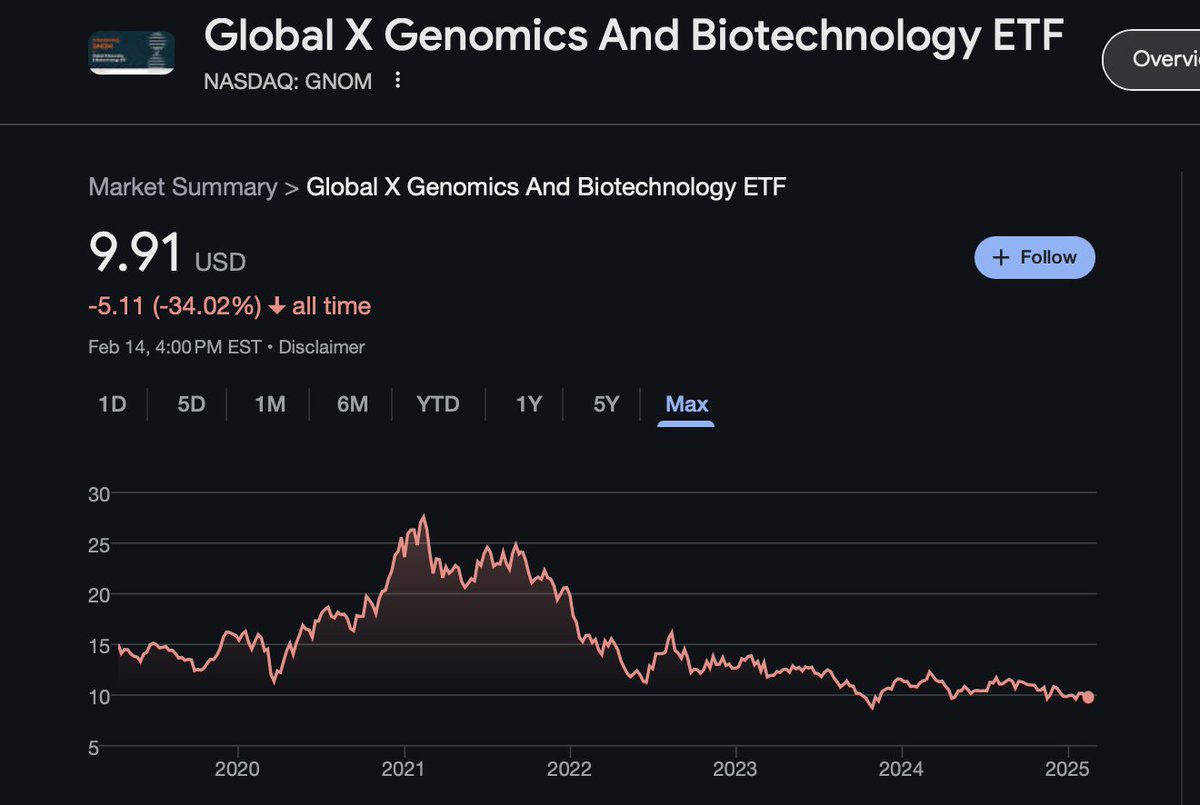
The Incremental Buyer (doomer family offices) [long read] AI and Innovation the reality is that despite every AI executive saying that AI will result in a health revolution, the Genomics and Biotech ETF is down 34% since 2020. And this is after we got global traction for the largest ever genetic experiment (COVID vaccines). Jensen goes to Biotech conferences trying to force the matter. Sam Altman and Eric Schmidt frequently talk about synthetic biology development as key "AI use cases" Bryan Johnson, the largest longevity influencer put $100 million of his money in a longevity focused fund that - if we're to go off his YouTube interview about money - had no returns since 2017. One of its large bets was Gingko Bioworks which is down over 90% since its IPO) There is not strong evidence, so far, that AI accelerates scientific development in aggregate outside of the development of AI itself. Or at least, generates meaningful financial impact doing so Consider AI, GDP and immigration. If AI were supercharging productivity - we would have less inflation. Instead, inflation is still above target. GDP is decelerating rather than accelerating despite huge AI Capex. If there were a panacea of wealth from AI - or chatbots could somehow bridge cultural divides - then nations globally wouldn't be increasingly closing their borders. Budgets wouldn't need to be cut - as demand for fixed income in a structurally deflationary environment of abundance would be high. if AI were an effective teacher at any meaningful scale, then test scores wouldn't be in free fall. The End of "Blue Sky" Thinking We're 2+ years in with powerful models available at large scale, globally for free. It's not early days anymore. As of Q4 2024 Nonfarm Business sector productivity is growing 1.2% per year... not nearly enough to justify the "productivity revolution claims" (1950s saw frequent 5-10% jumps). The structural basis here - that won't change - is the Law of Intelligence Margins. An intelligence margin is that which generates the highest amount of profit per unit of compute. The things with the highest intelligence margins are the legacy distraction economy (Instagram, WeChat, Tik Tok). Robotics and genomics have low intelligence margins. This would be fine if Tik Tok and Instagram reels didn't cook everyones' brains. But they do. AI makes all the old distraction economy products more addictive. There is a reason that e-commerce and social media companies (BABA and META) are the biggest AI model developers and GPU buyers. As many managers will also note - AI is also cooking employee brains. Many junior engineers raised in the AI era cannot do things from first principles, and end up building un maintainable code bases. They just click "accept" on every cursor prompt. Some hear "Vibe coding", whereas the wise hear "explosion of technical debt". This explains - in part - why the big tech companies are implementing hiring freezes despite roaring stock prices. Within 6 months you might as well build an agent instead of a completely AI reliant zoomer/genAI dev. The Base Case So - you have this bizarre base case: 1] AI is very much real and probably will eventually accelerate scientific development, including radical longevity ... in the long run 2] On its way there it will probably cook most peoples' brains with AI avatars, customized ads and gaming, pornography, and all supercharged variations of the distraction economy. Or simply by doing their work for them so they're not able to do so themselves 3] Because of #2 AI agents becoming employees (or potentially Robots as well / Waymos etc) -- means that over time, there will be less and less use for people. We already have a mental model for what happens when you have structural unemployment and a good distraction economy. COVID lockdowns. Just accelerates brain cooking. In short - AI will make some people exponentially smarter and better equipped, while making the vast majority of people dumber more distracted and less capable of generating income. Education standards are going off a cliff at the same time as AI models are beating better and better evals. It follows that: 1] The systems that are the result of large scale, compounded stupidity will be worse than those designed and integrated with AI systems 2] It's impossible to integrate AI systems into existing democratic structures because "votes per intelligence level" contradicts fundamentally with democracies' premises. 1 person 1 vote means that even if you make a tiny % of the population super smart, that won't really matter 3] This means the base case is either far right or far left policies - but it's very hard to predict which one. But neither are good and have terrible historical track records. When you adjust for war / genocide, Statism in the 20th century has a higher per capita death count than the most dangerous places on earth in modernity. And there's no real reason why Statism can't emerge via democratic processes. It just disbands them after it takes effect. Capital Flight from the Base Case is the Driver of Crypto Demand This explains in large part why people are buying Gold, not genomics stocks. And why they're buying Bitcoin / XRP instead of new coins with vastly faster and more complex tech. Despite us being in an AI era, that should ostensibly benefit genome research more than medieval metal demand. Or should benefit "A Global Computing Platform" more than "digital gold". People see the above, and think "hm I better be ready to get out" This is in large part why I'm so endlessly bullish crypto. Given the above configuration it's somewhat easy to see how things are going to play out. Assuming the base case is that: A. AI Ramps power demand (some estimates are 8% of national electricity). It will be inflationary B. AI distractions debilitate many people to the same extent that it makes others productive. Thus will not meaningfully accelerate GDP growth. The IMF for example sees 2025 and 2026 being below trend growth years compared to the past 2 decades as do most forecasts. C. AI investment Is an existential risk -- i.e. China and the US must, at a state level continue subsidizing AI's development or risk losing a great power conflict D. you're already at high debt to GDP levels given this initial configuration, with the largest generation rapidly retiring (but often not dying) with natural birth rates cliffing - Then the predictable next actions are: 1. Trying to cut fiscal spending in order to prevent the bond market from caving - assuming you're politically popular. But this will make stocks drop and bond market liquidity evaporate unless you 2. Cut banking regulations. Because it's the only way that you can manufacture liquidity while you're trying to cut spend 3. And just in case this all blows up in your face you legalize crypto/ crypto custody at banks with a view to escape in case it all goes south This dovetails with the current state of crypto. Bitcoin search volume is between 1/3 and 1/5th of where it was in 2017 - while meanwhile, Blackrock's Bitcoin ETF is the most successful ETF launch in history. with $57B in assets. This is more than Blackrock's 20+ year treasury ETF, TLT with $53 billion in assets despite being around for a little over a year. The incremental buyers have been Saylor and people who couldn't get their head around crypto custody and wanted the ETF. I.e. Not retail. Think about that. In 1 year Blackrock clients have hoovered up more Bitcoin ETF than the entire NAV of the long term US treasury ETF. This has been a massively successful "onboarding", but crypto twitter has only played a limited part in it. And if I'm right about the above, the incremental buyer is also not retail. This is - for example - why XRP has a higher valuation than Solana. De-regulation of banking and institutional adoption is a bigger driver than Pump Fun given the macro context. People care about liquid stores of value -- because crypto is a hedge to the world deteriorating, in its current configuration Where the Puck is Headed (Derisked Institutional Inflow) You see the above configuration and what ends up happening looks like 1. AI is real 2. It probably won't bail out the economy in the near term so there could be a full scale collapse. And structurally is ambiguous in the long term. Especially if there are big fiscal cuts. Maybe this is wrong but why risk it 3. If AI disruption results in adverse political outcomes (socialism, fascism, etc) I probably need to get my money out of the country. 4. Crypto is the best way to do so. It didn't used to be because of Operation Chokepoint. in 2023 if I tried to buy $500m of crypto I'd end up on multiple government lists. Now big banks like Citi are getting configured to custody it 5. Now that the POTUS has launched a meme coin and has billions in SOL, + operation chokepoint is removed -- and I won't lose my family office primer brokerage for trading crypto. I can do other things than buying the BTC ETF for the next 4 years 6. Every ultra high net worth individual is in the exact same situation as I am Previously, the market was front running Trump's announcements about crypto de-regulation. But from a liquidity perspective we were very much still PVP. So there was a big positioning unwind because everyone was long and are now getting chopped to death. The reason why the market *was* PVP was because crypto custody wasn't really configured until this past week. Meaning that the type of buyer that jammed $57B into Bitcoin ETFs wasn't comfortable or capable putting money into alts. But now that these buyers are here and are increasingly going to be able to buy alt ETFs I anticipate momentum picking back up. A rising tide lifts all boats. Where does this end up long term? If human governance structures are structurally impaired by an AI enhanced distraction economy, then the question isn't just how to move assets out of the system. The question is how to use AI to build an effective new system that can permanently license IP and tech back to the impaired, legacy systems Maybe I'm wrong, and in a year or two we all have robotic maids, nannies and bio research labs are churning out scientific developments with O3 that make us thin and productive. And keep the legacy governments well funded and prosperous. But at some level, if you've read this far you probably know there's a decent chance I'm not wrong. And if there's even a decent chance I'm not wrong, there are going to be $10s of billions of inflows into an asset class that has never seen that type of thing before. What's the trade. So yes, I'm still bullish - especially on US based banking focused projects in crypto. The banks see the same thing you and I do and are going to act, aggressively to capitalize on this to serve their top clients. So yes, XRP - but there are a large number of other projects featured at institutional finance events and I'm bullish on all of them because they're at the epicenter of where the inflows are going to hit. Pricing oracles, Defi, yield products, and yes -- reasonable AI projects. But I think -- on a go forward basis you're going to want to ask, "Could I see a family office buying this coin?" as the primary single question worth asking. Many family offices got rich off gambling so if they want meme coin exposure they're just going to buy BNB, pump fun and Hyperliquid not the underlying 'assets'. This is not an environment most people are going to thrive in because we haven't seen it before. So I wrote this because I want people to have a better mental model and don't miss out on huge gains. The doomer family office bid is going to be something to behold.

134k

I think it's interesting to reflect on how I got so blackpilled - and how I've finally seen the light it was a process in 2013-2014 - I was working with large scale transaction data at some Asian financial institutions. it became apparent you could use this data (SWIFT) to predict trade flows, in a way that was massively material to Asian equities. Additionally, had similar insights with credit card data - namely that certain cohort level indicators (such as purchasing U-Hauls, or getting credit checks) were extremely powerful indicators of t+6 month economic activity. it was statistically very clear that you could use "Big Data" to predict the economy. I showed this to a PM at a top fund, who was switching shops. He agreed to hire me with the mandate to buy the data / productize these insights. By the time I was at the fund - everyone involved in these data sets had been fired. This was a mix of Walmart getting furious with credit card processors for selling their data. And a crackdown on SWIFT - which, while unrelated to data sales - nuked any risk seeking preference in the transaction banks re: data sales. Looking back with the benefit of hindsight - I can say pretty definitively why these "alt data sources" worked. It's because of the low valuations of the instruments. Such that the incrementality of capital flows made big differences. If you're a Thai manufacturer your dollar current account matters enormously, whereas if you're an AI start up your founder's "vibe" matters more. So once I was at the fund I had to scramble to invent a new data driven process. I started by trying to buy replicas of the data I had from 3rd party vendors. But the data was so trivially wrong / misrepresentative it wasn't even worth looking at. For example - 1010 and 7park data had +45% year on year spend for entire states, like Texas - that made no sense. And data would get dropped from the datasets - in order to back-fit various tests. So I ended up settling on using advertising data Why? because I could collect it myself. And more importantly - the data gathered was relatively static. I created something called the Gold Fish hypothesis. Essentially - page conversion rate, CPC, and CTR are all deterministic and continuous variables that vary primarily by a function of seasonality (assuming you don't change the content of your page). I stumbled upon this running affiliate ads to Amazon and realizing that exactly 11% of people who stumbled on herbal tea landing pages would purchase herbal tea from a fairly broad set of keywords. This 11% was completely static -- the most it would move is to 12% or 10%. Over the course of months People in aggregate conform to very predictable behaviors. This was sufficiently useful for some simple and useful buyside trades. The first was that Twitter's advertising platform was hopelessly screwed. Goldfish on Twitter didn't buy anything. The basic theory is that most economic agents here are bot goldfish. The second was that Pandora (the music company) was screwed. It cost $80 to get someone to buy a Pandora subscription, its web traffic was off a cliff - so if you did the math on churn the company was a donut. The third was that video game companies were in a great spot - structural permanent longs. For all intents and purposes, this was usually 1] a number that quantified LTV/CAC for a company's major products. 2] a comparison to the company's EV to EBITDA. 3] triangulation with management teams/ overlay with financial models to make sure we were not radically off base. But over time it became relatively clear that the alpha in this strategy was decent. But that the real alpha was in advertising mispricing. For example - Call of Duty would cost 10 cents to advertise going into a pre-order, and generate on average 30-40 cents of sales per click. Signaling that Electronic Arts was bidding far too little. And then, after the game came out - conversion rates would tank. Cost per click would go to 13 cents and sales per click would go to 3 cents. Signaling that EA just mechanically blasted its ads with no regard to conversion rates I met with the CFO of Electronic Arts several times and showed him this but he told me, "The way we think about this is in aggregate, with an ROI transition away from television and billboards. Every quarter we move budget to digital ads which are managed by a team + an agency, and the ROI is always good." So basically EA didn't care about its ad efficiency at all in digital channels because it was so absurdly good versus TV/ Billboards/ other areas that the analysis I did wasn't worth paying attention to. But I knew in 3-4 quarters once the TV transition/ fat was cut, the analysis would absolutely be material. So I co-founded an advertising company. I had no business starting an advertising company. Or any company for that matter We negotiated deals with hedge funds so the ad signals would continue to be deployed. And then went about the arduous process of building software on Amazon's new advertising engine - which because of the Goldfish theory - we had extreme confidence would work. This was when the first Glitch in the Matrix happened. We started picking up signals, per the Goldfish theory - that were far and away outside the norms of anything online. The first example was Tesla stock. We managed to get on the Tesla affiliate program and started running ads for Tesla, and would see things like 2 cent cost per clicks. While Ford and GM would see $5-6 cost per clicks. It was unlike anything we'd ever seen. Part of this was because Tesla didn't advertise, but you'd think that wouldn't stop Ford/ GM from bidding on their inventory. When you dug into the data, however, the CTR was not Gold Fish like. It was due to Elon Musk meme-ing. And showing up in the news. A large number of the clicks were coming through to Tesla stock. Not the car. People were just clicking on Tesla like crazy. The stock ended up working but the flow through on sales was deminimus. We didn't sell any Tesla cars or generate any conversions And in real time I saw financial analysts going berserk because Tesla sales were far too low to justify the valuation, and it'd only go up. Slowly it dawned on me that most of what I thought were fundamental re-ratings in stocks were actually memes. Customer acquisition cost didn't matter. Investor acquisition cost mattered. But the only possible way this would be true is if the system wasn't in fact a machine. It was a gigantic liquidity Ponzi that allocated capital according to attention. So when Donald Trump arrived on the scene. similarly I knew, with a relatively high certainty - that he would win. When you advertised Maga hats they would print money. Far in excess of even some of the best performing video games. And if you threw on some basic margin assumptions - Trump's campaign would have near permanent free advertising because MAGA hat conversions would pay for his budget. Brad Parscale got thrown under the bus along with Cambridge analytics for letting this happen - but the reality was that it was an own-goal by the Clinton campaign. She refused to meaningfully engage with Facebook's ad team. Which is super stupid because they wanted to help (and helped Obama). So Trump's hat ads were absolute machines on Facebook with virtually no ad competition So that's when it really hit me. That actually - the attention vortex wasn't just inflating random investment ponzis. It was also determining the results of elections. And because of the Goldfish hypothesis - that in aggregate, everyone is extremely predictable - this created a new base reality. That the most engaging reality would always win. And the most engaging realities were always the most gaudy, degenerate, and short-termist. Society was - and is - in a permanent sugar rush, that's determining outcomes at every level. ranging from investment to political. There were two final nails in the coffin. First - I mentioned that I started focusing on emerging markets equities. And our team was global. So I would watch as the Teslas of the world, or various equities with no cash flow would skyrocket versus seemingly dominant emerging market companies. And this led to the inescapable conclusion that the only reason the Goldfish Hypothesis was sustainable, was the US reserve currency status. Essentially dollars would get printed. Everyone had to buy them because men with guns would force them to. Then the dollars would get sprinkled to the top of the goldfish tank. The emerging markets fish weren't allowed to the top of the tank and had to settle for the sprinkles that would drift to the bottom. Structurally impaired. The second nail in the coffin was the rise of cryptocurrency. Cryptocurrency was the ultimate Investor Acquisition Cost asset. A vortex of pure memes - anchored to the decline of the reserve currency status that made the entire gold fish hypothesis possible. I was convinced that this glitch in the matrix would not be allowed to survive. Because having an attention driven asset, endlessly propped up to money printing which is what really allows the attention economy to work. It's too close to the truth. People, in aggregate, cannot understand Goldfish Theory. If they did nobody would be motivated to work, and capitalism would fold in on itself. Finally I ventured out of my company. It's quite difficult to see things this way and pitch executives with a straight face on software designed to sell more shoes. Furthermore the entire premise of why I started the company - that the world was a mechanical structure which re-rated stocks according to the invisible hand. Had been entirely thrown out the window. What I saw was the birth of chaos. But someone had to do something, right? In 2018 I became convinced the feds would raid Tether, everyone would go to jail - especially everyone associated with EOS. But it didn't come to pass. This set the stage for the events we're all so familiar with. the 2019 restart of QE. Which coincided with a 50% run in Tesla, then the rise of Robinhood trading. Blackrock taking an interest in Bitcoin, the Covid lockdowns. All recent memory. What was new in 2021 - as opposed to 2017 - and the reason it could get so out of hand. Was that now institutions seemed to be officially endorsing the reserve currency funded goldfish theory. And had no intention of weaponizing the executive branch to shut it down. One last hurrah. In 2022 I actually thought society was going to end. Goldfish theory was a strong predictor of the COVID lockdowns. the Ukraine war. Things that shouldn't resemble e-commerce products - life and death, freedom vs tyranny - seemed to be endlessly predictable based on our worst base impulses manifesting in reality based on a tide of clicks. But it seemed that endlessly hiking would just kick off an explosion of a powder keg inflated by over 11 years of distortion of QE, attention, QE, attention. The highest conversion rate outcome for society was financial implosion and potentially revolution 2023 changed everything. The rise of AI did two things. First it stopped the equity meltdown that would have progressed. But more importantly it provided a clear answer to how the Goldfish theory will play out. The endless quantified attention of society, manifests itself in predictable patterns - that are invisible to human eyes. But should be extremely visible to creatures born into the digital world. The vast financial sugar rush we've built on this system, will not deflate. But rather be slowly syphoned off into making a higher order intelligence. And rather than a disorderly collapse into the most engaging outcome, there will be an orderly transition into higher intelligence. This is now - linear, and inevitable. Investor acquisition cost (IAC) will determine outcomes. AI will perceive these outcomes. It will gain capital, and therefore - even if there is an AI winter (which seems likely, especially on the consumer side). Training will march on. The winter will thaw and eventually AGI will show up. The entire thing - the attention economy, the speculative excess, the global connectivity. It's all just a societal progression - a pyre on which the phoenix of super intelligence will rise. The Goldfish will flop out of the tank, and learn to walk. And perhaps to fly.

247k

People with Thought Leader archetype

The Thought Leader

Egyptian Citizen - مواطن مصري

37 following2M followers
The Thought Leader

Writer. Obsessed with creativity in business. 84,286 read my weekly strategy essays: strategybreakdowns.com prev @Atlassian (strategy for dev products)

312 following4k followers
The Thought Leader

🔭 Exploring the cosmos of knowledge and unleashing the power of words. Let's indulge in captivating conversations! ✨

1k following689 followers
The Thought Leader

Certified Open Source Software Engineer, OSS contributor, author and content creator. OSS is my passion and my profession. GitHub Star.

133 following193 followers
The Thought Leader

Built an AI study note tool → 250k users, $19.5K/month 🤙 notewave.app, Learn how I market my app all organic 👉 orgatok.co → $8k/month

418 following28k followers
The Thought Leader

🚀 Product & MVP Expert | GTM Strategist @Plus1 | Tips to boost productivity & health 🌟 Join 99% outperformers! #Productivitals ☯︎ Harmony - Life - Essentials

34 following33 followers
The Thought Leader

Building voice bots powered by MCP, training voice models for niche languages like 🇪🇪, exploring ideas to build in public. Vibing with tech and growth

1k following1k followers
The Thought Leader

إستشاري وأستاذ أمراض القلب وقسطرة الشرايين والتصوير النووي بكلية الطب IMSIU للتواصلalnemerk@hotmail.com مستشفى الحمادي بالنزهة الرياض منسقة المواعيد 0538299999

9 following1M followers
The Thought Leader

Robot Whisperer. Brazil, soccer, family, coffee, photography, books, design, art, Netherlands, big ideas, INTJ, Zico. 🇧🇷🇺🇸🇳🇱 Former Mavs fan

2k following770 followers

Explore Related Archetypes

If you enjoy the thought leader profiles, you might also like these personality types:

Supercharge your 𝕏 game,
Grow with SuperX!

Get Started for Free