 SuperX
Get live statistics and analysis of Jen Jen's profile on X / Twitter

blockchain infra & defi curious | data-in-progress.
The Analyst
Jen Jen is a blockchain infrastructure and DeFi enthusiast who dives deep into the technical nuances and practical challenges of blockchain technology. Their content is rich with detailed analysis, solutions-oriented insights, and a passion for advancing decentralized ecosystems. Always curious, Jen Jen breaks down complex concepts into engaging narratives.
Top users who interacted with Jen Jen over the last 14 days

Jen Jen’s feed is like a blockchain whitepaper on steroids — a mega-thesis every time you scroll, so dense your brain almost needs a HPU just to keep up. It's blockchain for those who think ‘simple’ is a bug, not a feature.
Successfully hosted their first event as a member of @AvaxTeam1, showcasing leadership and community-building skills within a recognized blockchain ecosystem.
Jen Jen’s life purpose is to demystify blockchain technology and drive its adoption by providing in-depth, accurate, and accessible analyses that empower developers, users, and advocates to navigate and innovate within the decentralized space.
Jen Jen believes in transparency, interoperability, and the unifying power of technology to solve fragmentation problems in blockchain ecosystems. They value education, precision, and the fusion of technical rigor with practical application to foster trust and growth in decentralized networks.
Jen Jen’s strengths lie in their ability to synthesize complex technical topics into digestible and insightful narratives, their detailed research skills, and their capacity to spot emerging trends, like seamless cross-chain interactions and privacy-preserving hardware.
The high volume of detailed content may sometimes overwhelm casual followers, potentially limiting broader reach to non-technical audiences who seek more approachable or simplified explanations.
To grow their audience on X, Jen Jen should experiment with bite-sized, easily shareable threads or infographics that summarize key concepts, alongside their deep dives. Engaging more directly with followers through AMA sessions or polls can boost interaction and expand their reach beyond hardcore blockchain enthusiasts.
Jen Jen has tweeted over 26,000 times, demonstrating consistent engagement and an eagerness to share knowledge about blockchain innovations and decentralized finance.
Top tweets of Jen Jen

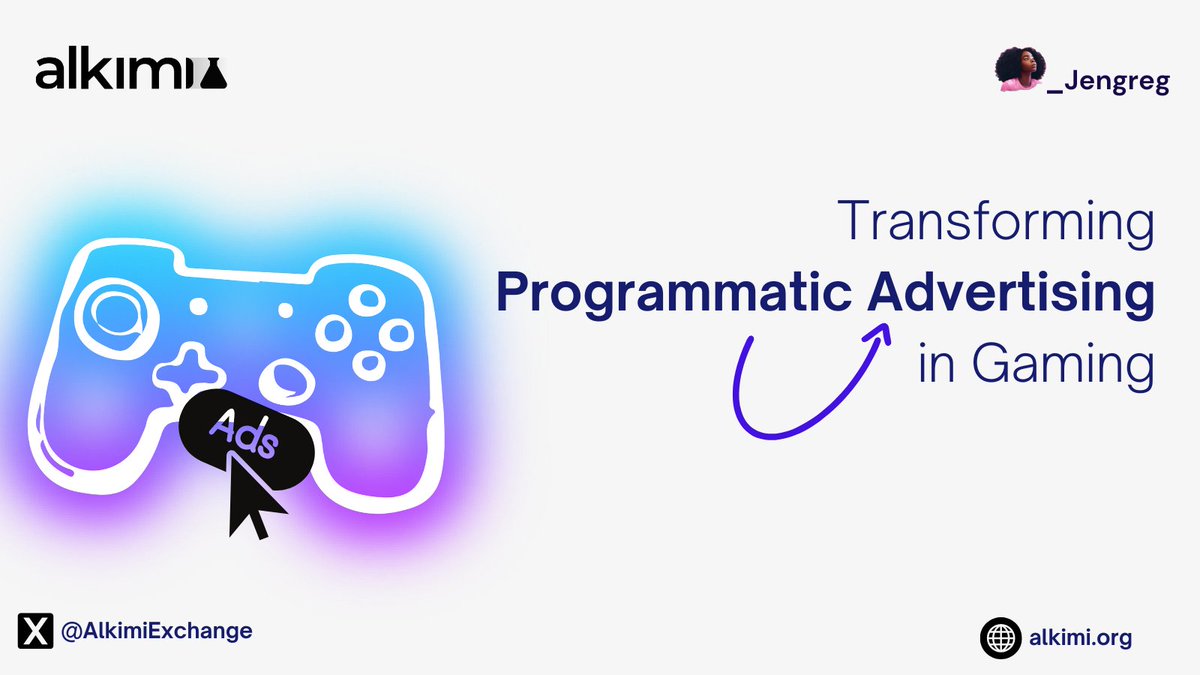
The gaming industry has become one of the top target markets for advertisers due to its global reach and immersive environment. However, traditional advertising models, on the other hand, frequently disrupt user experiences or lack transparency. @AlkimiExchange is changing this narrative, HOW? Keep reading ⇓⇓⇓ The Challenge of Traditional In-Game Advertising: Imagine a player deeply immersed in a high-stakes fantasy quest. Just as they are about to defeat a challenging villain, an intrusive pop-up ad for a completely unrelated product disrupts the flow. This jarring experience is all too common in traditional in-game advertising: ads that interrupt, frustrate, and fail to engage users meaningfully. Opaque ad placement systems like that lead to wasted budgets and reduced trust. (You get the feeling now, right?) Pragmatic Advertising Redefined: @AlkimiExchange changes this approach. Instead of disruptive ads, it creates ads that blend into the game’s narrative, such as virtual billboards or contextual items tailored to the player's journey. This approach increases user immersion, makes ads relevant and valuable, and optimizes ad spend through decentralized verification. It transforms advertising into an enriching part of gameplay rather than an unwelcome intrusion. @AlkimiExchange is reshaping how programmatic advertising functions within the gaming industry by utilizing innovative, blockchain-based solutions. With the prevalence of gaming as a dominant entertainment form, effective advertising requires new approaches that align with gamers' preferences and expectations, a challenge Alkimi is uniquely addressing. Also leverages blockchain technology to combat ad fraud, ensuring that every interaction is verifiable. PATNERSHIP: @AlkimiExchange has partnered with @RenoviHub to create in-game ad placements that enrich rather than disrupt the experience within virtual worlds, enhancing the gamers experience positively. For example, a gamer might discover a branded virtual item or encounter a billboard relevant to their journey, deepening their connection to both game and brand. Pretty cool, right? To conclude this, I'll say that by redefining the advertising model in gaming, @AlkimiExchange leads the programmatic ad industry into a more user-friendly, transparent, and efficient era. This increases trust between advertisers, game developers, and players, benefiting all parties involved. For more information, explore Alkimi’s perspective on AdTech's Role in Gaming: alkimi.org/blog/adtechs-r… Join Community: t.co/qmoa2tv3Ko
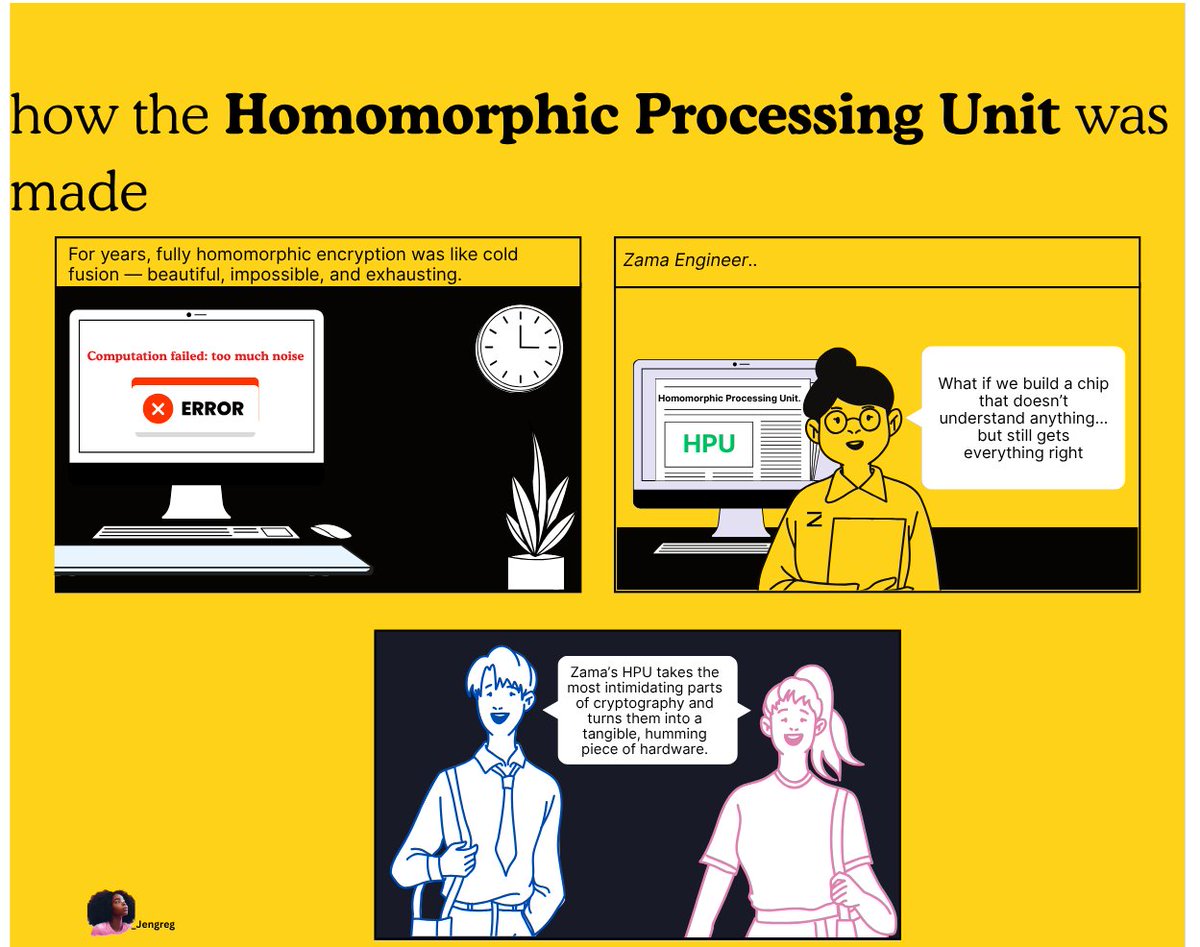
Homomorphic encryption is one of those ideas that makes you wonder if computer scientists are brilliant… or just bored. It’s the art of computing on encrypted data — doing math without ever knowing what the numbers mean. Beautiful in theory, excruciating in practice. For years, it’s been the academic equivalent of cold fusion: technically possible since Craig Gentry’s 2009 breakthrough, practically unbearable ever since. Then @zama_fhe came along in May 2025 and said, “What if we made a processor that understands nothing… and still gets everything right?” And that’s how the Homomorphic Processing Unit (HPU) was born, the world’s first open-source hardware accelerator for Fully Homomorphic Encryption (FHE), initially implemented on affordable FPGA hardware (AMD Alveo V80). Backed by a $57 million Series B round to push it toward ASIC production and mass deployment, the HPU isn’t just a proof of concept, it’s a glimpse of what privacy at hardware speed looks like. Honestly, kind of refreshing. Even with decades of algorithmic upgrades, fully homomorphic encryption (FHE) was still moving at the speed of bureaucracy. Each operation added layers of noise and mathematical overhead, turning simple math into a full-blown existential crisis for your CPU. It’s a special kind of chip that sits beside your computer’s main processor, like a GPU does for graphics, but instead of rendering images, it crunches encrypted numbers. The CPU does the usual setup work: preparing the encrypted inputs, loading the cryptographic keys, and telling the HPU what to do. Then it steps aside and lets the HPU do the heavy lifting. Here’s the key difference: the HPU never sees the actual data. It works completely blind. What looks like nonsense to us—random strings of digits—is, to the HPU, raw material for computation. It adds, multiplies, and compares these encrypted values just as a regular processor would with normal numbers. The brilliance lies in what’s happening under the hood. The HPU has hardware built specifically for the two hardest parts of homomorphic encryption—bootstrapping and key switching. ➠ Bootstrapping is what keeps encrypted data usable; it “refreshes” a ciphertext when too much noise builds up. ➠ Key switching changes the encryption format so the system can keep computing correctly. Both of these tasks are ridiculously heavy in software, but in the HPU they’re baked into the silicon. The chip can do them in parallel, fast, and automatically, almost like a reflex. What’s even cooler is how it merges those steps. Instead of running key switching and bootstrapping separately, the HPU fuses them into a single hardware instruction. It can clean and refresh data mid-computation without slowing down. This means encrypted information can move through endless calculations without collapsing under its own weight, a bit like having a self-cleaning engine that never overheats. And it doesn’t work alone. The HPU is designed for parallel thought: it breaks tasks apart and sends them to multiple tiny processors inside the chip. So while one part handles an addition, another might be comparing two encrypted numbers, and another might be cleaning noise from the results. All of this happens simultaneously, silently, and without a peek at the actual data. Then there’s the real magic trick: programmable bootstrapping. Think of it as refreshing data while teaching it something new. During the cleanup process, the HPU can apply a small look-up table—a preset map of inputs to outputs—to perform a custom operation “for free.” That might be a comparison, a logic gate, or a nonlinear function used in AI. In software, that would take a long series of steps; in hardware, it’s just one pulse of electricity. The chip cleans and computes at the same time. Put simply, what used to be FHE’s biggest weakness has become its superpower. Bootstrapping is now a part of the flow. This might sound abstract, but it’s what makes the idea of private AI finally feel possible. Picture a hospital encrypting patient scans and sending them to a cloud AI for diagnosis. The model runs entirely on ciphertexts—the HPU handles every neuron and activation—so the cloud never sees the images, and yet the predictions are still correct when decrypted. What used to take hours could happen in seconds. The same principle applies to blockchains. Smart contracts could soon run on encrypted inputs and state, meaning your trades, votes, or financial data stay private, while the network still verifies that everything’s valid. No trusted hardware enclaves, no external proofs—just math and hardware doing the job together. That’s the real promise here: turning privacy from a feature into a default. @zama_fhe HPU takes the most intimidating parts of cryptography and turns them into a tangible, humming piece of hardware. It’s the moment fully homomorphic encryption stops being a research dream and starts behaving like a real-world tool. The journey from bootstrapping to booting up isn’t just a clever title—it’s the shift from theory to practice, from slow math to silicon speed. And it’s what might finally let us compute on private data without ever breaking its seal.
I am thrilled to be hosting my first event as a member of @AvaxTeam1, It’s going to be an amazing experience filled with fun, learning, and great conversations. I’d love to have you there as we explore new ideas together. Looking forward to seeing you.... All details are in the post below ⬇️⬇️⬇️
There are over a hundred existing ethnicities in my country, and throughout high school, we were taught the significance of the phrase “unity in diversity.” The idea is simple—our differences don’t divide us; instead, they make us stronger by complementing one another’s weaknesses. But what if that concept was applied to the blockchain? By 2023, an article published on @WatcherGuru stated that more than 1,000 blockchains were up and running in various industries, each doing its own thing. But all these separate blockchains create a big problem—fragmentation. This means they often don’t "talk" to each other easily, making it hard to transfer assets or share data easily. Users end up juggling multiple wallets and facing different fees, while liquidity stays stuck in one place instead of flowing freely. Plus, relying on extra tools to bridge these gaps can introduce security risks and force developers to rebuild the same solutions over and over. In short, while there are many blockchains, their isolation can slow down progress and complicate the user experience. Enter @PushChain —a unifying Layer 1 blockchain that provides a solution for fragmentation between blockchain layers and ecosystems. It introduces the “Unity in diversity” concept on the blockchain but with more spice. What is @PushChain ? Push Chain is a shared-state blockchain designed to serve as a universal settlement layer for L1s, L2s, and L3s. A Proof of Stake (PoS) blockchain that allows seamless cross-chain transactions while abstracting gas fees and wallets, making it easier for both Web3 users and Web2 newcomers to onboard. With it’s shared state status, you can retrieve data not only from its own chain but also from external chains, resulting in the ability to carry out several activities such as NFTs, DeFi positions, etc., across several chains. Ultimately, it allows building a system where users from any blockchain, or even traditional web2 platforms, can connect easily. #PushChain enables shared transactions across both EVM and non-EVM blockchains, leading to the development of universal apps (universal smart contracts) and shared experiences. In simple terms, #PushChain is a blockchain that acts as a bridge between different blockchains (L1s, L2s, and L3s), allowing them to work together smoothly, promoting interoperability, and simplifying interactions for both users and developers. BUT HOW? How does #PushChain provide solutions for fragmented ecosystems and make cross-chain interactions seamless, and what impacts do these solutions provide? WHAT ARE THE INNOVATIONS TO MAKE THIS POSSIBLE AND THEIR FEATURES? To ease the processing of this information, I have curated a detailed mind map that explains the innovations and features of @Pushchain and how each feature plays out. Push Wallet: simplifying your blockchain experience Push Wallet simplifies your experience across multiple blockchains, what I like to refer to as "A satisfying multichain experience." No need for separate wallets—whether it's Ethereum, Solana, or Arbitrum, just name it. Push Wallet supports seamless transactions, gas abstraction, and cross-chain support, making your Web3 interactions smoother by just connecting your wallet and, for new users, offering a single, user-friendly wallet. No more worrying about multiple wallets or gas fees. It simplifies your onboarding experience, allowing you to interact with blockchain apps without the technical complexities. Get started:wallet.push.org NATIVE TOKEN, $PUSH; At the time of this report: 💰 $PUSH price: $0.04029 📈 Market Cap: $3.6M 📊 Fully Diluted Valuation (FDV): $4M CA: 0xf418588522d5dd018b425E472991E52EBBeEEEEE PERSONAL BIAS ON the role of @PushChain on AI Infrastructure ; Earlier in this text, it has been established that universal smart contracts are transforming blockchain interoperability by connecting L1s and L2s into a unified ecosystem. Instead of developers building separate applications for each chain, they can now create universal apps that work seamlessly across multiple networks. This removes fragmentation, improves liquidity flow, and enhances cross-chain interactions. Even more exciting is how this concept lays the foundation for AI infrastructure. It's a known fact that AI models rely on vast amounts of data in order to train, execute, and optimize, and in a multi-chain world, this data is scattered across different blockchains. Universal Smart Contracts can bridge these data sources, allowing AI models to access real-time blockchain information, execute computations across chains, and automate processes in a decentralized, trustless manner. By breaking down blockchain silos, Universal Smart Contracts not only make Web3 more connected but also pave the way for AI-driven applications that can learn, adapt, and interact with multiple blockchains effortlessly. This is the next step toward a more intelligent and scalable decentralized future and @PushChain is playing a huge role in it. Ecosystem news: Push Chain Public Devnet & SDK is now LIVE ⇒ x.com/PushChain/stat… Get started on @PushChain; here are resources that would come in handy: Knowledgebase: push.org/knowledge/ Litepaper: push.org/litepaper.pdf Website: t.co/VDJUaW9U9m x.com/PushChain/stat… You made it here; Thank you, I hope you had a great read. Keep the fun and share with others.

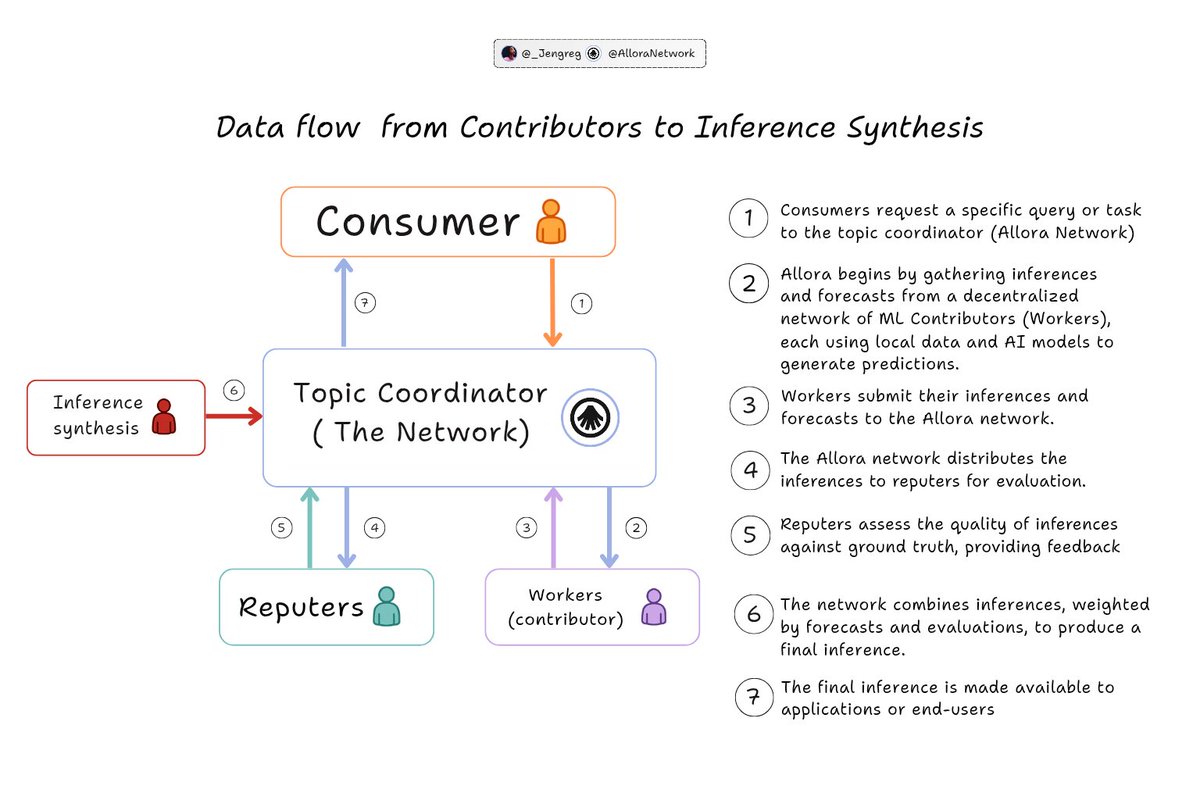
Data Flow from Contributors to Inference Synthesis To illustrate how data flows in @AlloraNetwork , here is a detailed textual representation of the flowchart, capturing the process from consumers to inference synthesis. This flow ensures that data is effectively shared in the form of inferences and forecasts, breaking down silos while maintaining privacy. The feedback loop, where evaluations refine future contributions, ensures continuous improvement, aligning with the network's (Allora Network) self-improving network design.
Most engaged tweets of Jen Jen
I am thrilled to be hosting my first event as a member of @AvaxTeam1, It’s going to be an amazing experience filled with fun, learning, and great conversations. I’d love to have you there as we explore new ideas together. Looking forward to seeing you.... All details are in the post below ⬇️⬇️⬇️
The gaming industry has become one of the top target markets for advertisers due to its global reach and immersive environment. However, traditional advertising models, on the other hand, frequently disrupt user experiences or lack transparency. @AlkimiExchange is changing this narrative, HOW? Keep reading ⇓⇓⇓ The Challenge of Traditional In-Game Advertising: Imagine a player deeply immersed in a high-stakes fantasy quest. Just as they are about to defeat a challenging villain, an intrusive pop-up ad for a completely unrelated product disrupts the flow. This jarring experience is all too common in traditional in-game advertising: ads that interrupt, frustrate, and fail to engage users meaningfully. Opaque ad placement systems like that lead to wasted budgets and reduced trust. (You get the feeling now, right?) Pragmatic Advertising Redefined: @AlkimiExchange changes this approach. Instead of disruptive ads, it creates ads that blend into the game’s narrative, such as virtual billboards or contextual items tailored to the player's journey. This approach increases user immersion, makes ads relevant and valuable, and optimizes ad spend through decentralized verification. It transforms advertising into an enriching part of gameplay rather than an unwelcome intrusion. @AlkimiExchange is reshaping how programmatic advertising functions within the gaming industry by utilizing innovative, blockchain-based solutions. With the prevalence of gaming as a dominant entertainment form, effective advertising requires new approaches that align with gamers' preferences and expectations, a challenge Alkimi is uniquely addressing. Also leverages blockchain technology to combat ad fraud, ensuring that every interaction is verifiable. PATNERSHIP: @AlkimiExchange has partnered with @RenoviHub to create in-game ad placements that enrich rather than disrupt the experience within virtual worlds, enhancing the gamers experience positively. For example, a gamer might discover a branded virtual item or encounter a billboard relevant to their journey, deepening their connection to both game and brand. Pretty cool, right? To conclude this, I'll say that by redefining the advertising model in gaming, @AlkimiExchange leads the programmatic ad industry into a more user-friendly, transparent, and efficient era. This increases trust between advertisers, game developers, and players, benefiting all parties involved. For more information, explore Alkimi’s perspective on AdTech's Role in Gaming: alkimi.org/blog/adtechs-r… Join Community: t.co/qmoa2tv3Ko
Homomorphic encryption is one of those ideas that makes you wonder if computer scientists are brilliant… or just bored. It’s the art of computing on encrypted data — doing math without ever knowing what the numbers mean. Beautiful in theory, excruciating in practice. For years, it’s been the academic equivalent of cold fusion: technically possible since Craig Gentry’s 2009 breakthrough, practically unbearable ever since. Then @zama_fhe came along in May 2025 and said, “What if we made a processor that understands nothing… and still gets everything right?” And that’s how the Homomorphic Processing Unit (HPU) was born, the world’s first open-source hardware accelerator for Fully Homomorphic Encryption (FHE), initially implemented on affordable FPGA hardware (AMD Alveo V80). Backed by a $57 million Series B round to push it toward ASIC production and mass deployment, the HPU isn’t just a proof of concept, it’s a glimpse of what privacy at hardware speed looks like. Honestly, kind of refreshing. Even with decades of algorithmic upgrades, fully homomorphic encryption (FHE) was still moving at the speed of bureaucracy. Each operation added layers of noise and mathematical overhead, turning simple math into a full-blown existential crisis for your CPU. It’s a special kind of chip that sits beside your computer’s main processor, like a GPU does for graphics, but instead of rendering images, it crunches encrypted numbers. The CPU does the usual setup work: preparing the encrypted inputs, loading the cryptographic keys, and telling the HPU what to do. Then it steps aside and lets the HPU do the heavy lifting. Here’s the key difference: the HPU never sees the actual data. It works completely blind. What looks like nonsense to us—random strings of digits—is, to the HPU, raw material for computation. It adds, multiplies, and compares these encrypted values just as a regular processor would with normal numbers. The brilliance lies in what’s happening under the hood. The HPU has hardware built specifically for the two hardest parts of homomorphic encryption—bootstrapping and key switching. ➠ Bootstrapping is what keeps encrypted data usable; it “refreshes” a ciphertext when too much noise builds up. ➠ Key switching changes the encryption format so the system can keep computing correctly. Both of these tasks are ridiculously heavy in software, but in the HPU they’re baked into the silicon. The chip can do them in parallel, fast, and automatically, almost like a reflex. What’s even cooler is how it merges those steps. Instead of running key switching and bootstrapping separately, the HPU fuses them into a single hardware instruction. It can clean and refresh data mid-computation without slowing down. This means encrypted information can move through endless calculations without collapsing under its own weight, a bit like having a self-cleaning engine that never overheats. And it doesn’t work alone. The HPU is designed for parallel thought: it breaks tasks apart and sends them to multiple tiny processors inside the chip. So while one part handles an addition, another might be comparing two encrypted numbers, and another might be cleaning noise from the results. All of this happens simultaneously, silently, and without a peek at the actual data. Then there’s the real magic trick: programmable bootstrapping. Think of it as refreshing data while teaching it something new. During the cleanup process, the HPU can apply a small look-up table—a preset map of inputs to outputs—to perform a custom operation “for free.” That might be a comparison, a logic gate, or a nonlinear function used in AI. In software, that would take a long series of steps; in hardware, it’s just one pulse of electricity. The chip cleans and computes at the same time. Put simply, what used to be FHE’s biggest weakness has become its superpower. Bootstrapping is now a part of the flow. This might sound abstract, but it’s what makes the idea of private AI finally feel possible. Picture a hospital encrypting patient scans and sending them to a cloud AI for diagnosis. The model runs entirely on ciphertexts—the HPU handles every neuron and activation—so the cloud never sees the images, and yet the predictions are still correct when decrypted. What used to take hours could happen in seconds. The same principle applies to blockchains. Smart contracts could soon run on encrypted inputs and state, meaning your trades, votes, or financial data stay private, while the network still verifies that everything’s valid. No trusted hardware enclaves, no external proofs—just math and hardware doing the job together. That’s the real promise here: turning privacy from a feature into a default. @zama_fhe HPU takes the most intimidating parts of cryptography and turns them into a tangible, humming piece of hardware. It’s the moment fully homomorphic encryption stops being a research dream and starts behaving like a real-world tool. The journey from bootstrapping to booting up isn’t just a clever title—it’s the shift from theory to practice, from slow math to silicon speed. And it’s what might finally let us compute on private data without ever breaking its seal.
There are over a hundred existing ethnicities in my country, and throughout high school, we were taught the significance of the phrase “unity in diversity.” The idea is simple—our differences don’t divide us; instead, they make us stronger by complementing one another’s weaknesses. But what if that concept was applied to the blockchain? By 2023, an article published on @WatcherGuru stated that more than 1,000 blockchains were up and running in various industries, each doing its own thing. But all these separate blockchains create a big problem—fragmentation. This means they often don’t "talk" to each other easily, making it hard to transfer assets or share data easily. Users end up juggling multiple wallets and facing different fees, while liquidity stays stuck in one place instead of flowing freely. Plus, relying on extra tools to bridge these gaps can introduce security risks and force developers to rebuild the same solutions over and over. In short, while there are many blockchains, their isolation can slow down progress and complicate the user experience. Enter @PushChain —a unifying Layer 1 blockchain that provides a solution for fragmentation between blockchain layers and ecosystems. It introduces the “Unity in diversity” concept on the blockchain but with more spice. What is @PushChain ? Push Chain is a shared-state blockchain designed to serve as a universal settlement layer for L1s, L2s, and L3s. A Proof of Stake (PoS) blockchain that allows seamless cross-chain transactions while abstracting gas fees and wallets, making it easier for both Web3 users and Web2 newcomers to onboard. With it’s shared state status, you can retrieve data not only from its own chain but also from external chains, resulting in the ability to carry out several activities such as NFTs, DeFi positions, etc., across several chains. Ultimately, it allows building a system where users from any blockchain, or even traditional web2 platforms, can connect easily. #PushChain enables shared transactions across both EVM and non-EVM blockchains, leading to the development of universal apps (universal smart contracts) and shared experiences. In simple terms, #PushChain is a blockchain that acts as a bridge between different blockchains (L1s, L2s, and L3s), allowing them to work together smoothly, promoting interoperability, and simplifying interactions for both users and developers. BUT HOW? How does #PushChain provide solutions for fragmented ecosystems and make cross-chain interactions seamless, and what impacts do these solutions provide? WHAT ARE THE INNOVATIONS TO MAKE THIS POSSIBLE AND THEIR FEATURES? To ease the processing of this information, I have curated a detailed mind map that explains the innovations and features of @Pushchain and how each feature plays out. Push Wallet: simplifying your blockchain experience Push Wallet simplifies your experience across multiple blockchains, what I like to refer to as "A satisfying multichain experience." No need for separate wallets—whether it's Ethereum, Solana, or Arbitrum, just name it. Push Wallet supports seamless transactions, gas abstraction, and cross-chain support, making your Web3 interactions smoother by just connecting your wallet and, for new users, offering a single, user-friendly wallet. No more worrying about multiple wallets or gas fees. It simplifies your onboarding experience, allowing you to interact with blockchain apps without the technical complexities. Get started:wallet.push.org NATIVE TOKEN, $PUSH; At the time of this report: 💰 $PUSH price: $0.04029 📈 Market Cap: $3.6M 📊 Fully Diluted Valuation (FDV): $4M CA: 0xf418588522d5dd018b425E472991E52EBBeEEEEE PERSONAL BIAS ON the role of @PushChain on AI Infrastructure ; Earlier in this text, it has been established that universal smart contracts are transforming blockchain interoperability by connecting L1s and L2s into a unified ecosystem. Instead of developers building separate applications for each chain, they can now create universal apps that work seamlessly across multiple networks. This removes fragmentation, improves liquidity flow, and enhances cross-chain interactions. Even more exciting is how this concept lays the foundation for AI infrastructure. It's a known fact that AI models rely on vast amounts of data in order to train, execute, and optimize, and in a multi-chain world, this data is scattered across different blockchains. Universal Smart Contracts can bridge these data sources, allowing AI models to access real-time blockchain information, execute computations across chains, and automate processes in a decentralized, trustless manner. By breaking down blockchain silos, Universal Smart Contracts not only make Web3 more connected but also pave the way for AI-driven applications that can learn, adapt, and interact with multiple blockchains effortlessly. This is the next step toward a more intelligent and scalable decentralized future and @PushChain is playing a huge role in it. Ecosystem news: Push Chain Public Devnet & SDK is now LIVE ⇒ x.com/PushChain/stat… Get started on @PushChain; here are resources that would come in handy: Knowledgebase: push.org/knowledge/ Litepaper: push.org/litepaper.pdf Website: t.co/VDJUaW9U9m x.com/PushChain/stat… You made it here; Thank you, I hope you had a great read. Keep the fun and share with others.
Data Flow from Contributors to Inference Synthesis To illustrate how data flows in @AlloraNetwork , here is a detailed textual representation of the flowchart, capturing the process from consumers to inference synthesis. This flow ensures that data is effectively shared in the form of inferences and forecasts, breaking down silos while maintaining privacy. The feedback loop, where evaluations refine future contributions, ensures continuous improvement, aligning with the network's (Allora Network) self-improving network design.
People with Analyst archetype

Breaking down AI tools & no-code workflows | ✉️ socialwithayan@gmail.com

Real-time updates on conflicts & military affairs | Focus on the Middle East & Europe , Specifically India & Pakistan | OSINT | DM for business & WP group |

Juvenile | Physics | Code

Prediction markets & DeFi | Polymarket insights | Web3 trends | @zscdao

web3 / FE / Galxe

bad managers in recovery. somewhere @nasdaq.

Dropping alpha in the dark | Airdrops, farming.

web 工作者

Data Analyst | 数据分析师 Part-time crypto hustler | 兼职加密货币爱好者 Yapper |

🧠在家居士 | 🥦素食者 | 🏃🏻马拉松爱好者 | 💰省钱小能手 | 搭🪜技术资深学者 | 👨💻科技宅 | 🆕更新狂 | 🆅 六边型战五渣

Helping navigate #Bitcoin's volatility Newsletter newsletter.checkonchain.com Onchain Analyst @_checkonchain Charting Suite charts.checkonchain.com

🟩@RallyOnChain丨@KaitoAI丨@wallchain Yapper🧑🍳 🟨@GOATRollup丨@NEARMobile_app 大使🏅
Explore Related Archetypes
If you enjoy the analyst profiles, you might also like these personality types:
